
The short answer is under 10 percent of your calories from added sugars, which on a 2,000-calorie day is 50 grams, about 12 teaspoons, and the figure the US Nutrition Facts label uses as its Daily Value. The World Health Organization adds that going below 5 percent, roughly 25 grams a day, brings extra benefit, and the American Heart Association sets its own limits at about 25 grams a day for women and 36 for men. The honest headline is that most people are nowhere near any of these: the average American adult takes in 15 to 19 teaspoons of added sugar a day. This guide sets out the limits by authority and calorie level, explains exactly what counts as sugar and what does not, shows how much sits in common foods and drinks, and ends with the cuts that make the biggest difference for the least effort.
The quick answer
Every major health body lands in the same neighborhood, and the differences come down to how strict they choose to be:
| Authority | Daily limit | On a 2,000-calorie day |
|---|---|---|
| WHO (2015), strong recommendation | Free sugars under 10% of energy | Under 50 g (about 12 teaspoons) |
| WHO (2015), conditional recommendation | Under 5% of energy | Under 25 g (about 6 teaspoons) |
| US Dietary Guidelines (2025–2030) | No amount of added sugar recommended | No more than 10 g in any one meal |
| US FDA Nutrition Facts label | Added sugars Daily Value | 50 g |
| American Heart Association | Under 100 kcal (women), 150 kcal (men) | About 25 g (women), 36 g (men) |
| UK (NHS) | Free sugars, adults | No more than 30 g |
| EFSA (EU, 2022) | As low as possible | No ceiling set |
The WHO guideline recommends that adults and children keep free sugars below 10 percent of total energy intake, with a further reduction to below 5 percent, roughly 25 grams or 6 teaspoons a day, for additional health benefits (WHO, 2015). In the United States, the 50-gram Daily Value printed on every Nutrition Facts label rests on the Dietary Guidelines’ long-standing limit of under 10 percent of calories (FDA). The 2025–2030 edition of the guidelines goes further: it says no amount of added sugar is recommended as part of a healthy diet, and that no single meal should contain more than 10 grams (Dietary Guidelines for Americans, 2025–2030). The American Heart Association’s scientific statement is stricter: a prudent upper limit of 100 calories a day for most women and 150 for most men from added sugars (Johnson et al., 2009), which the association itself puts at about 25 and 36 grams. The UK sets 30 grams of free sugars a day for adults, with lower limits for children (NHS). And in 2022 the European Food Safety Authority, asked to set a safe upper level, concluded that the evidence would not allow one and that intake of added and free sugars should simply be as low as possible within an adequate diet (EFSA, 2022).
So the practical answer has two tiers. Stay under 50 grams a day and you meet the standard the label is built on. Aim for 25 to 30 grams and you are at the level the WHO, the AHA, and the UK consider better still.
Your limit by calorie level
Because the WHO limits are percentages, your personal number depends on how much you eat. The table converts both tiers into grams across common daily calorie targets, rounded to the nearest gram (each gram of sugar is 4 calories).
| Daily calories | 10% ceiling | 5% target |
|---|---|---|
| 1,500 kcal | 38 g | 19 g |
| 1,800 kcal | 45 g | 23 g |
| 2,000 kcal | 50 g | 25 g |
| 2,200 kcal | 55 g | 28 g |
| 2,500 kcal | 63 g | 31 g |
| 3,000 kcal | 75 g | 38 g |
Notice what this means in a calorie deficit. If you are eating 1,500 calories to lose weight, your 10 percent ceiling is 38 grams, which one can of regular cola very nearly uses up on its own. That is why sugar deserves attention on a diet even though it is not, by itself, what makes you gain or lose fat. If you have not set a calorie target yet, the free calorie calculator will give you one, and 10 percent of it, divided by 4, is your ceiling in grams.
What counts as sugar, and what does not
This is where most confusion lives, so it is worth being precise. The guidelines above target added sugars (the US term) or free sugars (the WHO and UK term). The FDA defines added sugars as sugars added during processing, such as sucrose or dextrose, plus sugars from syrups, honey, and concentrated fruit or vegetable juices; they do not include the naturally occurring sugars in milk, fruits, and vegetables (FDA). The WHO’s free sugars are the sugars added to foods and drinks by the manufacturer, cook, or consumer, plus the sugars naturally present in honey, syrups, fruit juices, and fruit juice concentrates (WHO, 2015).
Three consequences follow:
- Whole fruit does not count. A medium apple carries about 19 grams of sugar and a banana about 14, but that sugar arrives inside a structure of fiber and water that slows it down and fills you up. No guideline asks you to limit fruit, and our guide to how much fiber you need explains why fruit with the skin on is one of the best things you can eat.
- Plain milk and plain yogurt do not count. Their sugar is lactose, naturally present, and it comes with protein and calcium. A cup of whole milk has about 12 grams of it, and it is not added sugar.
- Juice, honey, and syrups do count. Pressing an orange strips out the fiber and leaves the sugar, so a glass of even 100 percent orange juice is free sugar under the WHO definition. Honey is 82 percent sugar by weight and is counted the same way as table sugar. The distinction is not about where the sugar came from originally; it is about whether it still comes packaged with the whole food.
The one place the two definitions differ is juice: the US label does not list the sugar in 100 percent juice as added, while the WHO and UK count it as free sugar. For your own purposes, treat juice as a sugary drink. It is closer to cola than to fruit.
Why the limit matters
EFSA’s 2022 assessment, which screened more than 30,000 publications, linked sugars intake to dental caries and, through sugar-sweetened drinks, juices, and nectars in particular, to obesity, non-alcoholic fatty liver disease, and type 2 diabetes (EFSA, 2022). The body-weight evidence is unusually clean for nutrition research. A systematic review and meta-analysis of randomized trials and cohort studies, the work the WHO guideline drew on, found that reducing dietary sugars lowered body weight by about 0.8 kg and increasing them raised it by about 0.75 kg, while swapping sugars for other carbohydrates at equal calories changed weight not at all (Te Morenga et al., 2012). In other words, sugar affects your weight through the calories it adds, and it adds them easily because sugary foods and drinks are so poor at making you feel full. Our guide to what a calorie deficit is covers the mechanism.
Set against that, the gap is wide. On average, American adult men take in 19 teaspoons of added sugars a day and women 15, and 3 in 5 Americans aged 2 and over exceed the recommended amount (CDC). At 4.2 grams per teaspoon, that is roughly 80 and 63 grams a day, against a 50-gram ceiling.
How much sugar is in common foods and drinks
The table uses USDA FoodData Central values and realistic servings, and it separates sugar that counts (added or free) from sugar that does not (naturally present in whole fruit and plain dairy). A level teaspoon of granulated sugar weighs about 4.2 grams, which is the conversion used throughout.
| Food or drink | Serving | Total sugars | Calories | Counts toward the limit? |
|---|---|---|---|---|
| Regular cola | 12 fl oz can (355 ml, about 368 g) | 37 g | 155 kcal | Yes, all added |
| Vanilla low-fat yogurt | 170 g pot | 23.5 g | 145 kcal | Partly: about 12 g is milk sugar, the rest added |
| Milk chocolate | 1 bar (43 g) | 22 g | 230 kcal | Yes, nearly all added |
| Orange juice | 1 cup (248 g) | 21 g | 112 kcal | Yes under WHO and UK rules (free sugar); not listed as added on the US label |
| Honey | 1 tablespoon (21 g) | 17 g | 64 kcal | Yes, free sugar |
| Vanilla ice cream | 1/2 cup (66 g) | 14 g | 137 kcal | Yes, mostly added |
| Table sugar | 1 teaspoon (4.2 g) | 4.2 g | 16 kcal | Yes |
| Ketchup | 1 tablespoon (17 g) | 3.6 g | 17 kcal | Yes, added |
| White bread | 1 slice (28 g) | 1.6 g | 75 kcal | Mostly added, but small |
| Apple, with skin | 1 medium (182 g) | 19 g | 95 kcal | No, whole fruit |
| Banana | 1 medium (118 g) | 14 g | 105 kcal | No, whole fruit |
| Whole milk | 1 cup (244 g) | 12 g | 149 kcal | No, lactose |
| Plain low-fat yogurt | 170 g pot | 12 g | 107 kcal | No, lactose |
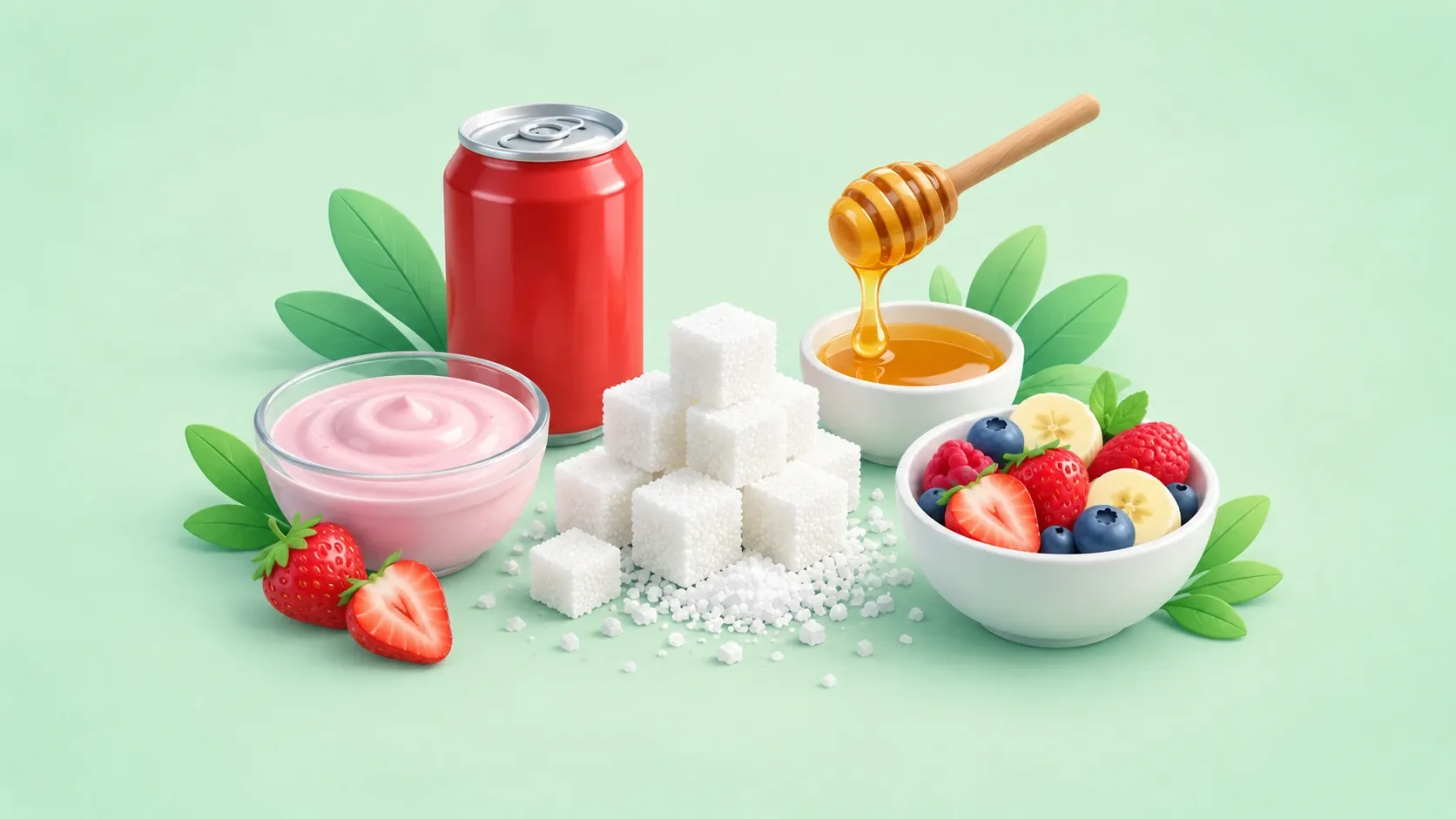
A few things jump out. One can of cola carries about 37 grams, roughly 9 teaspoons: on its own it exceeds the AHA limit for women and uses three quarters of the 50-gram Daily Value. That 37 grams is the USDA figure for a generic cola; the CDC puts a 12-ounce regular soda at more than 10 teaspoons, about 42 grams, and branded colas sit in that range, so treat any full-sugar can as 37 to 42 grams (CDC). The flavored yogurt has nearly twice the sugar of the plain one for the same pot, and the difference, about 11 or 12 grams, is entirely added. Honey and syrups are concentrated sugar no matter how natural the jar looks. And the bottom four rows show why the rules exclude whole foods: an apple has more total sugar than a tablespoon of honey, but nobody sensible would tell you to skip apples.
For individual foods, see our guides to chocolate, milk, bananas, apples, and coffee, where the sugar and syrup in a sweetened drink often outweigh the coffee itself.
How a normal day blows through 50 grams
None of the numbers above look alarming alone, which is exactly the problem. Take an unremarkable day: two teaspoons of sugar in your morning coffee (8.4 grams), a vanilla yogurt at breakfast (about 11.5 grams added), two tablespoons of ketchup with lunch (7.2 grams), and one can of cola in the afternoon (37 grams). That is about 64 grams of added sugar, past the 50-gram ceiling and two and a half times the WHO’s 25-gram target, before any cookie, dessert, cereal, sauce, or granola bar has entered the picture. The lesson is not that ketchup is dangerous; it is that added sugar is spread thinly across dozens of ordinary products, and the drinks do most of the damage.
How to cut sugar without feeling deprived
- Start with what you drink. Sugary drinks are the leading source of added sugars in the American diet, the CDC says, and they are also the easiest to remove because they do nothing for fullness. Water, sparkling water, plain coffee and tea, or a zero-sugar version of your usual drink each save that whole 37 to 42 grams. Dropping the one can of cola from the sample day above takes it from 64 grams to about 27.
- Read the added-sugars line. US labels list Added Sugars separately from Total Sugars, with a percent Daily Value against 50 grams. The FDA’s rule of thumb is that 5 percent of the Daily Value or less per serving is low and 20 percent or more is high (FDA), so anything at 10 grams or more of added sugars per serving is a high-sugar food. Our guide to reading a nutrition label walks through the rest.
- Buy plain, sweeten yourself. Plain yogurt, plain oatmeal, and unsweetened cereal with fruit added at home cost a fraction of the sugar of the pre-flavored versions, because you will never add 12 grams of sugar to a yogurt by hand.
- Keep the fruit, drop the juice. Whole fruit is not on any list of things to limit. Juice, smoothies from concentrate, and fruit “drinks” are.
- Watch the sauces and dressings. Ketchup, barbecue sauce, teriyaki, sweet chili, and many salad dressings carry several grams per tablespoon. Two or three servings across a day add up to a can of cola’s worth.
- Do not chase “natural” sweeteners. Honey, maple syrup, agave, and coconut sugar count the same as sugar under every guideline. If you prefer the flavor, fine, but do not use more of it because it sounds healthier.
- Check where you actually stand. Most people underestimate their sugar the way they underestimate everything else they eat. Logging your meals for a few days shows which products carry the grams. The free CalcEat app lets you snap a photo of your plate, scan barcodes for packaged foods, or log manually, so you can see the sweetened items for what they are. Our list of healthy food swaps has fifty more trades that cut sugar and calories together.
Do you need to quit sugar entirely?
No, and no guideline asks you to. The limits are ceilings, not bans, and the research shows the harm rises with the amount, not from the first teaspoon. What the evidence does say is that lower is better and that sugary drinks are the specific habit worth breaking. If you are managing diabetes or prediabetes, your clinician or dietitian may set a tighter target for you, and it is worth following theirs over a general guideline.
The bottom line
Keep added sugars under 10 percent of your calories, which is 50 grams a day at 2,000 calories and the Daily Value on the label; the WHO, the American Heart Association, and the UK all point to roughly half that, 25 to 30 grams, as the better target. Sugar in whole fruit and plain milk does not count; sugar in drinks, juice, honey, syrups, sweets, and packaged foods does. A single can of cola carries about 37 grams, so what you drink is the first and biggest lever, and cutting sugar works on your weight through the calories it removes rather than through anything mystical. Set your calorie target with the calorie calculator, take 10 percent of it as your ceiling, and treat 25 grams as the goal. It sits naturally alongside our guides on how many carbs to eat and how much fiber you need, and if you want a full plan built around your goal, you can get a free plan.