If you have ever wondered exactly how many glasses of water you are supposed to drink, the honest answer is that there is no single right number. Hydration advice gets passed around as if it were a fixed law, but the science is more flexible and, frankly, more forgiving than the rules suggest.
Your water needs depend on your body size, the weather, how much you move, what you eat, and your health. This guide walks through what the major health authorities actually recommend, where the famous “8 glasses a day” idea came from, why coffee and food count, and the simple body signals that beat any number you could memorize.
Why there is no single magic number
Water is essential. Your body uses it to regulate temperature, cushion joints, carry nutrients, and flush waste, and you lose it constantly through breathing, sweating, and urinating. Replacing those losses is the whole point of drinking. But the amount that replaces them varies a lot from person to person and day to day.
The CDC is direct about this: daily water intake recommendations vary by age, sex, pregnancy status, activity level, and breastfeeding status (CDC). A small, sedentary person in a cool office and a large, active one working outdoors in summer simply do not need the same amount.
That is why a fixed target can mislead. It might leave one person chasing a number they do not need while another quietly under-drinks. The better approach is to know the ballpark ranges, then let your body fine-tune from there.
What the official guidelines actually say
Two of the most respected bodies in nutrition have published reference values for water, and it helps to see them side by side. The key thing to notice is what each number includes.
The U.S. National Academies of Sciences, Engineering, and Medicine (formerly the Institute of Medicine) report on total water, which means everything: plain water, other drinks, and the water inside food. The European Food Safety Authority (EFSA) reports an adequate intake for total water as well, with the expectation that most of it comes from drinks.
| Authority | Women | Men | What it covers |
|---|---|---|---|
| U.S. National Academies | About 2.7 L (91 oz) | About 3.7 L (125 oz) | Total water from all drinks and food |
| EFSA | About 2.0 L | About 2.5 L | Total water, mostly from drinks |
The National Academies found that women who appear adequately hydrated take in about 2.7 litres and men about 3.7 litres of total water per day (National Academies). EFSA, looking at European data, set its adequate intake at 2.0 litres for women and 2.5 litres for men (EFSA).
Why are the two sets of numbers different? Partly because they were derived from different populations and methods, and partly a matter of framing. Harvard’s Nutrition Source puts the National Academies advice at roughly 13 cups of fluid a day for men and 9 cups for women, which is about 3.1 and 2.2 litres. That is lower than the 3.7 and 2.7 litres above because those totals include the water you get from food, while these count what you drink. Harvard stresses that the numbers “are not a daily target, but a general guide” (Harvard). That phrase is the most useful part: a guide, not a quota.
Roughly a fifth of your water comes from food
One reason the “drink X litres” framing trips people up is that it ignores food. You are already hydrating every time you eat.
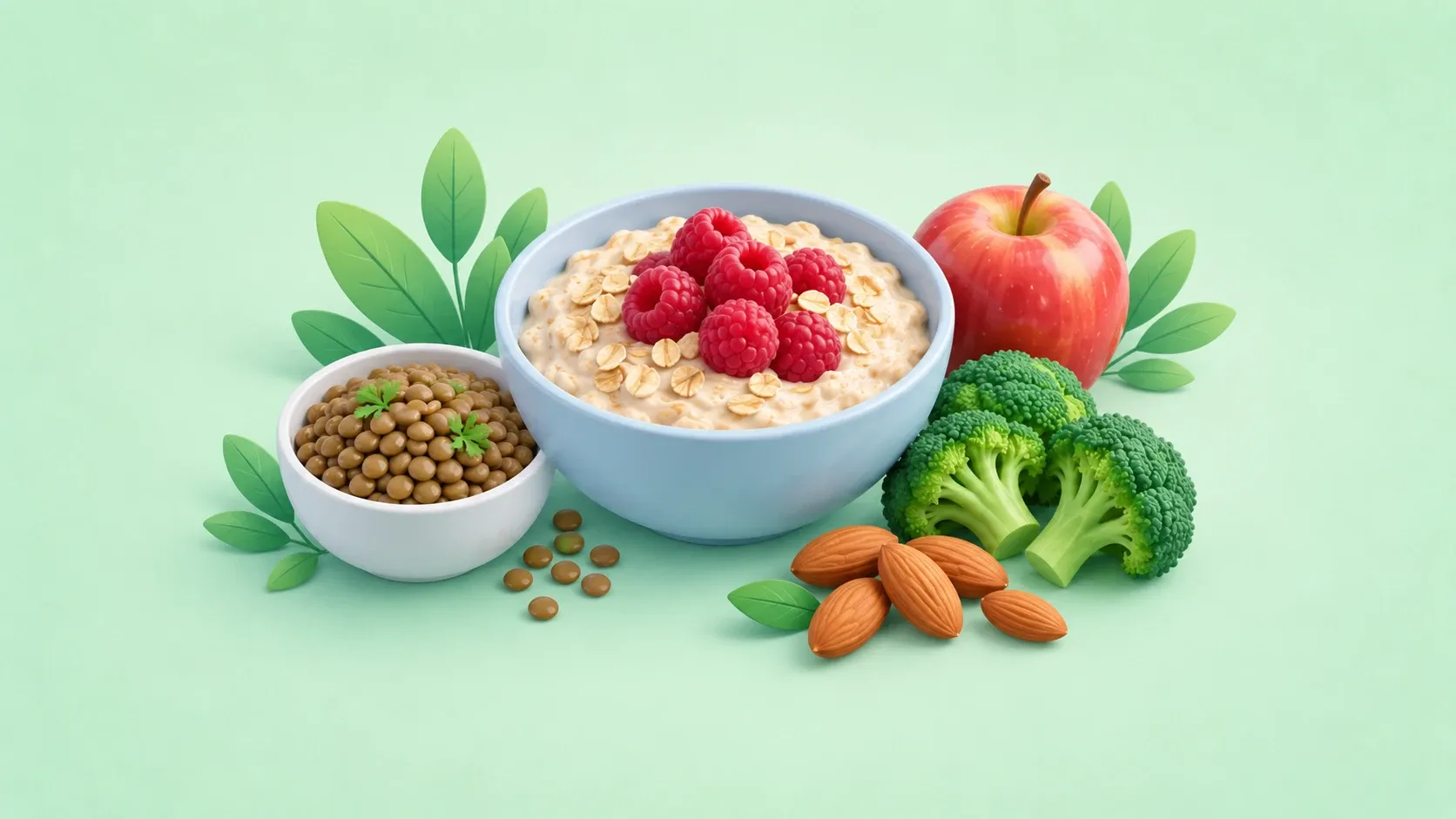
About 20% of your total water intake comes not from beverages but from water-rich foods (Harvard). Fruit, vegetables, soup, yogurt, and similar foods are mostly water by weight, and they count toward the totals above. Many of these are also low in calories for their volume, which is one reason high-volume, water-heavy foods are so good at keeping you full. Our guide to low-calorie, filling foods leans on exactly this idea.
So if you eat plenty of produce, a meaningful share of your daily water is already handled before you pour a single glass. That also means the amount you need to drink is lower than the total-water numbers imply.
Where the “8 glasses a day” rule came from
The most famous hydration rule is to drink eight 8-ounce glasses a day, often shortened to “8 by 8.” It is easy to remember and not a terrible starting point, but it is not the precise law it is often treated as.
When Dr. Heinz Valtin, a kidney physiologist, spent months searching the literature for evidence behind the rule, he could not find scientific studies supporting it for healthy adults in temperate climates (Valtin, 2002). His best guess for its origin was a 1940s recommendation of about 1 millilitre of water per calorie eaten, roughly 2 to 2.5 litres a day. The very next sentence noted that most of that water is already present in food, but that part seems to have been dropped, leaving people with a “drink this much” rule that was never quite intended.
Here is the practical takeaway. Eight glasses (about 1.9 litres) is a fine rough floor for many adults, not a magic target. Some people need more, some less, and the number on its own tells you nothing about your particular day.
A weight-based rule of thumb
If you want something a little more tailored than a flat number, a common rule of thumb scales water to body size: roughly 30 to 35 millilitres of fluid per kilogram of body weight per day. For a 70 kg (about 154 lb) adult, that works out to roughly 2.1 to 2.5 litres.
This is still just an estimate, and it should be adjusted for heat, activity, age, and health. But it has a logic the flat rules lack, because a larger body genuinely needs more water than a smaller one. If you would rather not do the math, our water intake calculator applies this kind of weight-based approach and adjusts for your activity, so you get a personalized starting estimate in a few seconds.
Whatever number you land on, hold it loosely. It is a starting point to sanity-check against how you actually feel, not a finish line.
Better signals than a number
The good news is that your body is built to manage hydration, and it gives you feedback that is more reliable than any formula. The National Academies put it plainly: most healthy people meet their hydration needs by letting thirst be their guide (National Academies).
Two everyday signals do most of the work:
- Thirst. For most healthy adults, drinking when you feel thirsty keeps you in a good range. Thirst becomes less reliable with age and in illness, so older adults and unwell people should be more deliberate, but for the general population it is a solid guide.
- Urine colour. Pale yellow, like lemonade, generally signals good hydration. Darker, more concentrated urine suggests you could use more fluid, since urine darkens the more concentrated it is (Harvard). Frequently clear urine usually means you are well hydrated, possibly more than you need.
Lean on these and you can stop counting glasses. They reflect what your body is actually doing, in real time, far better than a target set for an average person who is not you.
Coffee, tea, and other drinks count too
A stubborn myth says coffee and tea dehydrate you, so they should not count toward your fluids. For everyday amounts, that is not accurate. Caffeinated beverages including coffee and tea contribute to your total daily water intake, and concerns that the caffeine causes net dehydration are not well supported by research (Harvard).
That said, not all fluids are equal once you look past hydration:
- Plain water is the gold standard: it hydrates with zero calories, which is why the CDC notes that replacing sugary drinks with water can help reduce calorie intake (CDC).
- Coffee and unsweetened tea hydrate and count, just be mindful of added sugar and cream.
- Sugary drinks like soda and juice hydrate but bring a lot of liquid calories, which are easy to overlook. If you are tracking intake, these are worth logging.
So you can absolutely count that morning coffee toward your fluids. Just keep an eye on what else comes with it.
When you need more
Baseline guidelines assume a healthy, fairly sedentary person in a temperate climate. Several common situations push your needs higher, and on those days you should drink more freely and watch your urine colour:
- Heat and humidity. Hotter weather means more sweat and more fluid lost.
- Exercise. Any activity that makes you sweat increases your needs during and after; longer or more intense sessions need more replacement.
- Altitude. Higher elevations can increase fluid loss through faster breathing and more urination.
- Illness. Fever, vomiting, and diarrhea all drain fluids quickly, so steady sipping matters.
- Pregnancy and breastfeeding. Both raise fluid needs, and EFSA recommends a modest increase during pregnancy and a larger one while breastfeeding (EFSA).
None of these require a precise formula. They are cues to drink a bit more than usual and to pay closer attention to thirst and urine.
Can you drink too much?
Yes, although it is uncommon. Drinking far more water than your kidneys can excrete dilutes the sodium in your blood, a condition called hyponatremia that can be serious. The reassuring part is who it tends to affect: it is mostly seen in endurance athletes during prolonged events like marathons and triathlons, and in certain illnesses, rather than in normal daily drinking (Harvard).
For nearly everyone going about an ordinary day, this is not a practical worry, and under-drinking is the far more likely problem. The takeaway is simply that more is not automatically better. There is a healthy middle range, and forcing down water well past thirst has no benefit and, in rare extremes, a real downside. Mayo Clinic’s guidance reflects this balanced view, treating the National Academies figures as general targets rather than minimums to exceed (Mayo Clinic).
The bottom line
There is no universal number of glasses you must hit. The reference ranges, roughly 2.0 to 2.7 litres for women and 2.5 to 3.7 litres for men depending on whether food is counted, are useful guideposts, not commandments. The “8 glasses” rule is a rough floor with shaky origins, coffee and food both count toward your total, and your needs climb in heat, during exercise, and when you are ill.
The simplest plan is the most reliable one: drink when you are thirsty, aim for pale yellow urine, lean on water as your default drink, and adjust up on hot or active days. If you would like a personalized starting estimate, try the water intake calculator, and for the bigger picture of building genuinely nourishing habits, our Healthy Eating hub pulls it all together. When you want to keep an eye on the liquid calories that sneak in alongside your fluids, CalcEat makes logging a drink as quick as snapping a photo. Stay curious about what your body is telling you, and the right amount tends to take care of itself.