
You do not need a strict diet to eat fewer calories. You need a handful of small swaps, repeated often enough that the math quietly works in your favor. Trade one sugary drink for sparkling water, one creamy sauce for a lighter one, and you have cut real calories without feeling like you gave anything up.
This guide walks through roughly 50 easy upgrades, grouped by when you eat them, each with an approximate number of calories saved. The numbers come from USDA data, and they are estimates, since portions and brands vary. Think of these as additions to your toolkit, not punishments.
Why small swaps beat strict diets
All-or-nothing diets fail for a simple reason: they rely on willpower, and willpower runs out. The day you slip, the whole plan feels broken, so you quit. Swaps work differently. You are not banning foods or going hungry; you are upgrading the foods you already eat to lower-calorie versions, so the change barely registers but the savings stack up.
Two principles do most of the work.
The first is energy density, the number of calories packed into a given weight of food. Foods high in water and fiber, like vegetables, fruit, and brothy soups, carry few calories per bite, so you can eat a big, satisfying plate for less. People tend to eat a fairly consistent weight of food day to day, so choosing less calorie-dense options naturally lowers intake without extra hunger. The Mayo Clinic calls this the practical key to feeling full on fewer calories (Mayo Clinic), and behavioral research backs it up (NIH/PMC).
The second is protein and fiber, the two nutrients that keep you full the longest. Swap a refined carb for something with more of either and you tend to eat less later without trying. If you want to go deeper on this, our guide to low-calorie foods that keep you full breaks down the science.
The other reason swaps win: they compound. One 140-calorie soda swapped each day is about 1,000 calories a week. That single habit, left alone, is most of the way to a meaningful calorie deficit on its own.
Breakfast swaps
Breakfast is full of refined carbs and added sugar that are easy to upgrade. Lean on protein and whole grains to stay full until lunch.
| Instead of | Try | Approx. calories saved |
|---|---|---|
| Granola (1/2 cup) | Oatmeal (1/2 cup dry, cooked) | About 150 |
| A large bagel with cream cheese | Whole-grain toast or an English muffin with a thin spread | About 150–200 |
| Sugary flavored yogurt (cup) | Plain Greek yogurt with fresh fruit | About 80–120 |
| Buttered toast (2 tbsp butter) | Toast with mashed avocado (2 tbsp) | About 150 |
| A pastry or muffin | Greek yogurt with berries and a few nuts | About 200–300 |
| Sweetened cereal (large bowl) | Oatmeal topped with fruit | About 100–150 |
| Two strips of pork bacon | Two strips of turkey bacon | About 40–60 |
| Whole milk in your bowl (1 cup) | Skim or 1% milk | About 35–65 |
| Fruit juice on the side (8 oz) | A whole piece of fruit | About 50 |
| Flavored coffee creamer (2 tbsp) | A splash of milk | About 50–70 |
A few notes on the numbers. Granola runs around 470 calories per 100 grams versus roughly 70 for cooked oatmeal, so cup for cup the savings are large. Whole milk is about 149 calories a cup against roughly 83 for skim. And plain Greek yogurt brings protein that a sugary flavored cup does not, so you are not just cutting calories, you are getting fuller.
Snack swaps
Snacks are where mindless calories hide. The fix is not to skip snacks but to choose ones with crunch, volume, or protein so they actually satisfy you.
| Instead of | Try | Approx. calories saved |
|---|---|---|
| Potato chips (1 oz) | Air-popped popcorn (1 oz) | About 45 |
| A candy bar | A piece of fruit with a few nuts | About 100–150 |
| Crackers and cheese | Cut vegetables with hummus | About 100 |
| A granola bar | Plain Greek yogurt with berries | About 50–100 |
| Trail mix with chocolate (1/2 cup) | Plain mixed nuts (small handful, 1 oz) | About 100–150 |
| Ice cream (1/2 cup) | Frozen yogurt (1/2 cup) | About 90 |
| Full-fat sour cream dip | Plain Greek yogurt dip | About 130 per 100 g |
| A handful of pretzels | Air-popped popcorn | About 40–60 |
| Sweetened dried fruit (1/4 cup) | Fresh fruit | About 60–100 |
| A second helping at dinner | A glass of water, then wait 10 minutes | Varies |
Air-popped popcorn is a standout: at about 110 calories an ounce versus roughly 155 for chips, it gives you far more volume and whole-grain fiber for fewer calories. Swapping full-fat sour cream (about 193 calories per 100 grams) for plain Greek yogurt (about 59) is one of the biggest calorie cuts on this list, and you keep the creamy texture.
Drink swaps
This is the highest-impact group, so it is worth its own section. Liquid calories are sneaky: your body does not register them the way it does solid food, so they add up without filling you up. Sugary drinks are the number-one source of added sugar in the American diet, and a single 12-ounce regular soda packs more than 10 teaspoons of sugar, around 150 calories (CDC). The 2025–2030 Dietary Guidelines tell Americans to avoid sugar-sweetened drinks outright and recommend no added sugar at all, and drinks are the easiest place to claw it back (Dietary Guidelines for Americans, 2025–2030). Our guide to how much sugar you should eat a day puts every limit in grams and shows where sugar hides.
| Instead of | Try | Approx. calories saved |
|---|---|---|
| Regular soda (12 oz) | Sparkling water or diet soda | About 140 |
| A flavored latte (medium) | Black coffee or a plain latte with skim milk | About 150–250 |
| Sweetened iced tea (12 oz) | Unsweetened iced tea | About 90 |
| Orange juice (8 oz) | A whole orange | About 50 |
| Sports drink (20 oz) | Water | About 120–140 |
| Energy drink (16 oz) | Black coffee or green tea | About 200 |
| A sugary smoothie (16 oz, store-bought) | A homemade smoothie with whole fruit and Greek yogurt | About 150–250 |
| Sweetened coffee with cream and sugar | Coffee with a splash of milk | About 100–150 |
| A regular beer (12 oz) | A light beer (12 oz) | About 50 |
| A cocktail with soda or juice mixer | The same spirit with soda water and lime | About 100–150 |
| Lemonade (12 oz) | Water with fresh lemon | About 150 |
| Hot chocolate with whipped cream | Plain coffee or tea | About 150–250 |
The single move that pays off most here is swapping any sugary drink for a zero-calorie one. A black coffee is about 2 to 5 calories against 150 or more for a flavored latte, and unsweetened tea is essentially free. Plain water is still the best everyday default, but sparkling water, diet drinks, and unsweetened tea are all big upgrades over sugar-sweetened versions.
Cooking and kitchen swaps
How you cook a food often matters as much as the food itself. Frying, heavy oils, and creamy sauces can double or triple the calories of an otherwise lean ingredient. These swaps keep the meal and cut the extras.
| Instead of | Try | Approx. calories saved |
|---|---|---|
| Frying in oil (1 tbsp poured) | A light spray of cooking oil | About 100 |
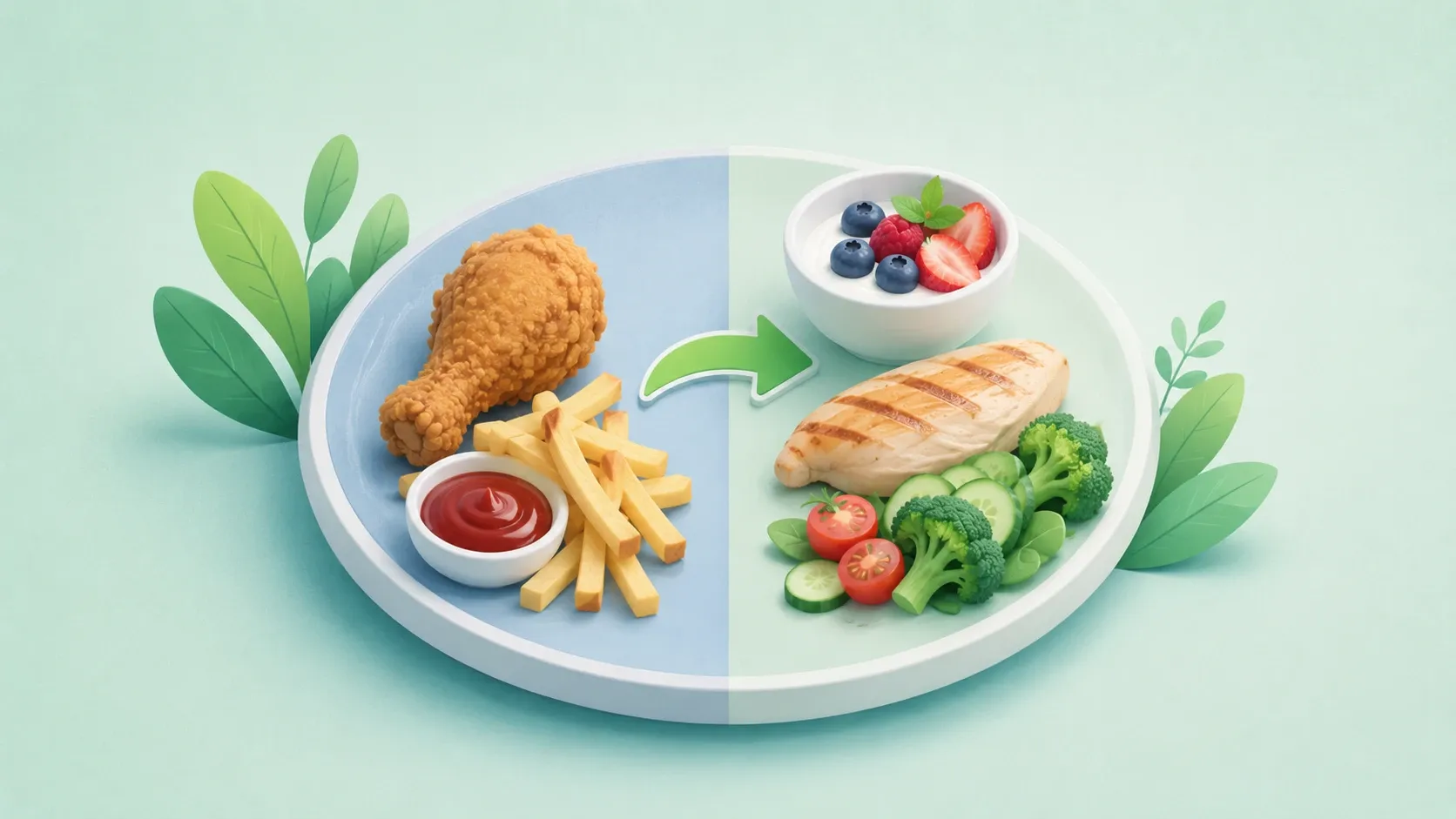
| Deep-fried chicken | Grilled or baked chicken breast | About 85–100 per 100 g |
| French fries | A baked potato or oven-roasted potatoes | About 150–200 per 100 g |
| Ground beef 80/20 | Lean ground beef 93/7 or ground turkey | About 100 per 100 g |
| A creamy pasta sauce | A tomato-based marinara | About 100–200 per serving |
| Mayonnaise on a sandwich (1 tbsp) | Mustard or mashed avocado | About 85 |
| Ranch dressing (2 tbsp) | A light vinaigrette, used sparingly | About 60–100 |
| Sour cream as a topping (2 tbsp) | Plain Greek yogurt | About 40 |
| Half the rice on your plate | Swap it for extra vegetables or cauliflower rice | About 100 |
| Pasta (1 cup) | Half pasta, half zucchini noodles | About 80–100 |
| Cream in a soup | A brothy, vegetable-based soup | About 100–200 per bowl |
| Cheese on everything (extra 1 oz) | A lighter sprinkle, or skip it | About 100 |
| Butter to cook eggs (1 tbsp) | A nonstick pan with cooking spray | About 100 |
| White rice (1 cup) | Cauliflower rice, or a mix | Up to about 180 |
The frying swaps are the heavy hitters. Pouring a tablespoon of oil adds about 119 calories, while a quick spray adds only a handful. Deep-fried chicken runs well over 250 calories per 100 grams versus about 165 for grilled, and French fries are roughly 312 per 100 grams against about 93 for a plain baked potato. None of these ask you to give up the dish, only to change how it is made.
Dining-out swaps
Restaurants are built around generous portions and rich extras, but you have more levers than you think. None of these mean ordering the saddest thing on the menu, just small trades that add up.
| Instead of | Try | Approx. calories saved |
|---|---|---|
| Fries as your side | A side salad or steamed vegetables | About 150–300 |
| A bun-and-cheese loaded burger | The same burger, lettuce-wrapped or single-patty | About 150–300 |
| Cream-based soup to start | A brothy soup or side salad | About 150 |
| A sugary soft drink with the meal | Water, unsweetened tea, or a diet soda | About 140 |
| A fried main (chicken, fish) | The grilled or baked version | About 100–200 |
| Dressing poured on the salad | Dressing on the side, dipped | About 100–150 |
| A whole dessert to yourself | Splitting one dessert with the table | About 200–400 |
| A second basket of bread | A sparkling water while you wait | About 150–300 |
| A large or upsized combo | The regular or small size | About 150–300 |
| Loaded nachos as an appetizer | Shrimp cocktail or a simple salad | About 200–400 |
| Alfredo or cream pasta | A tomato or olive-oil-based pasta | About 200–400 |
| A milkshake | An iced coffee or sparkling water | About 300–500 |
The biggest dining-out wins are usually portion and format choices: splitting a dessert, choosing a vegetable side over fries, asking for dressing on the side, and skipping the upsize. Ordering grilled instead of fried and starting with a broth-based soup or salad both lean on the same energy-density principle from earlier, more food, fewer calories.
How to make swaps actually stick
A list of swaps is only useful if you keep doing them. The trick is to change gently, in a way that fits your life rather than fighting it.
Swap one thing at a time. Trying to change every meal at once is just a strict diet in disguise, and it fails the same way. Pick a single swap this week, the soda, the breakfast, the cooking oil, and let it become automatic before adding the next. A few locked-in habits beat a dozen you abandon.
Keep the foods you love. Swapping is about upgrading your defaults, the meals you eat on autopilot, not policing every bite. Protect the foods that genuinely matter to you and trade the ones you will not miss. You will stick with the plan far longer if it still has room for what you enjoy.
Make the better choice the easy choice. Keep sparkling water cold in the fridge, fruit washed on the counter, and Greek yogurt at eye level. Most eating is habit and convenience, so set up your kitchen so the swap is the path of least resistance.
Aim for better, not perfect. A swap you make most days beats a perfect plan you quit by Friday. Miss one, shrug, and make the next one. Consistency over weeks is what moves the needle, not any single meal.
Watch the add-ons. A lean grilled chicken breast can quietly become calorie-dense once it is drowning in oil, cheese, or creamy dressing. Often the highest-impact swap is not the main food at all but what goes on top of it.
No food is off-limits
One thing worth saying plainly: nothing on the “instead of” side of these tables is bad, and you are not banned from any of it. No single food makes or breaks your diet, and labeling foods as forbidden usually backfires, driving cravings and the all-or-nothing thinking that derails progress in the first place.
Swaps are about your everyday pattern, the choices you make without thinking, on a normal Tuesday. Upgrade those and you create room for pizza on Friday or dessert on a birthday without guilt or math gymnastics. This is general information, not medical or dietary advice; if you have a health condition or specific nutrition needs, talk to a doctor or registered dietitian. Aim for a pattern that is mostly nourishing and genuinely enjoyable, because that is the only kind you will keep.
A little awareness makes all of this easier. You do not have to weigh every gram, but seeing the rough calorie cost of a meal helps you spot which swaps are worth it. An app like CalcEat lets you snap a photo of your plate for a quick estimate, scan a barcode, or log by hand, so you can watch your swaps add up in real numbers instead of guessing.
The bottom line
Cutting calories does not have to mean feeling deprived. The most reliable approach is the least dramatic one: a steady stream of small swaps that lower energy density or add protein and fiber, repeated often enough to matter. Start with drinks, since liquid calories are the easiest to cut, then upgrade a breakfast, a snack, or how you cook.
Pick one swap from this list and start today. Let it become a habit, then add another. Small changes, kept up over time, are what add up to real results, and they leave plenty of room for the foods you love. For more practical, no-shame strategies, explore our Healthy Eating hub, or see the calories in common fruits if you are building a fruit-forward snack swap. You have got this.