
Most adults should aim for about 25 grams of fiber a day if you are a woman and 38 grams if you are a man, which is what the Dietary Reference Intakes set for ages 19 to 50. Those numbers come from a simple rule of 14 grams of fiber for every 1,000 calories you eat, so a 2,000-calorie day lands at 28 grams, the same figure printed as the Daily Value on the US Nutrition Facts label. The honest headline is that almost nobody gets there: the average American eats about 16 grams a day. This guide gives you the targets by age and calorie level, explains what the numbers are based on, and ends with a food table and a sample day that reaches 30-plus grams without leaving you bloated.
The quick answer
The Adequate Intake (AI) for total fiber, set by the Institute of Medicine (now the National Academies), depends on age and sex because it scales with how much you eat (DRI summary table). The full set of targets:
| Group | Fiber per day |
|---|---|
| Children 1 to 3 | 19 g |
| Children 4 to 8 | 25 g |
| Boys 9 to 13 | 31 g |
| Girls 9 to 13 | 26 g |
| Boys 14 to 18 | 38 g |
| Girls 14 to 18 | 26 g |
| Men 19 to 50 | 38 g |
| Women 19 to 50 | 25 g |
| Men 51 and over | 30 g |
| Women 51 and over | 21 g |
| Pregnancy | 28 g |
| Breastfeeding | 29 g |
Two things stand out. The targets fall after 50 because calorie needs fall, not because older adults need less fiber per calorie. And the pregnancy and breastfeeding figures sit above the standard women’s number for the same reason: more calories, more fiber.
These are Adequate Intakes rather than Recommended Dietary Allowances, which means the evidence was not precise enough to set a formal requirement. In practice they are the figures every US guideline, label, and calculator builds on.
Where the number comes from: 14 grams per 1,000 calories
The National Academies set the fiber AI at 14 grams for every 1,000 calories of intake, the level that, in the studies available at the time, went with the lowest risk of coronary heart disease (National Academies, 2005). Multiply that by the typical calorie intake of each group and you get the table above: a woman eating roughly 1,800 calories needs about 25 grams, a man eating roughly 2,700 needs about 38.
That makes the rule easy to personalize. Find your own calorie target, then scale:
| Daily calories | Fiber target (14 g per 1,000 kcal) |
|---|---|
| 1,500 kcal | 21 g |
| 1,800 kcal | 25 g |
| 2,000 kcal | 28 g |
| 2,200 kcal | 31 g |
| 2,500 kcal | 35 g |
| 3,000 kcal | 42 g |
If you are in a calorie deficit to lose weight, your fiber target shrinks a little with it, which is one reason a smaller intake still needs to be built around fiber-rich foods to feel filling. If you do not know your calorie number yet, the free calorie calculator gives you one in a minute, and the rule above turns it into a fiber target.
The targets around the world
Different authorities arrive at similar numbers by different routes, and it helps to know which one applies to you:
- United States. The Daily Value used on the Nutrition Facts label is 28 grams (FDA), which is simply the 14-gram rule applied to a 2,000-calorie day. Percent Daily Value figures on packaging are calculated against it.
- European Union. EFSA concluded that 25 grams a day is adequate for normal bowel function in adults, while noting that higher intakes are linked to additional health benefits (EFSA, 2010).
- United Kingdom. Government guidance is 30 grams a day for adults, and most adults get only about 20 (NHS).
- World Health Organization. The 2023 carbohydrate guideline recommends at least 25 grams of naturally occurring fiber a day for adults, with at least 15 grams for children aged 2 to 5, 21 grams for 6 to 9, and 25 grams from age 10, alongside at least 400 grams of vegetables and fruit a day (WHO, 2023).
The spread between 25 and 38 grams is not a disagreement about direction. Every one of these bodies says the same thing: most people need noticeably more than they eat now.
Why the target matters
Fiber is the part of plant food your small intestine cannot digest. Some of it dissolves in water and forms a gel that slows digestion (the kind that dominates in oats, beans, and fruit), and some passes through largely intact and adds bulk (the kind in wheat bran and vegetable skins). Both matter, and whole foods deliver a mix.
The evidence for eating enough is unusually strong for a single nutrient. A 2019 series of systematic reviews and meta-analyses in The Lancet, commissioned to inform the WHO guideline, pooled 185 prospective studies and 58 clinical trials. People with the highest fiber intakes had a 15 to 30 percent lower risk of dying from any cause or from cardiovascular disease than those with the lowest, along with lower rates of coronary heart disease, stroke, type 2 diabetes, and colorectal cancer. The risk reduction was greatest at intakes of 25 to 29 grams a day, with signs that more would help further, and the clinical trials showed lower body weight, systolic blood pressure, and total cholesterol at higher intakes (Reynolds et al., 2019). The FDA sums up the day-to-day effects more plainly: a high-fiber diet increases the frequency of bowel movements, lowers blood glucose and cholesterol, and can reduce calorie intake (FDA).
Set against that, the gap is striking. Analysis of US national survey data puts mean fiber intake at 16.2 grams a day, and an estimated 95 percent of American adults and children do not consume the recommended amount (Quagliani and Felt-Gunderson, 2017). The FDA lists fiber alongside vitamin D, calcium, iron, and potassium as the nutrients Americans generally under-consume, which is why it is on the label at all.
Fiber in common foods
The fastest way to close the gap is to know where the grams actually are. The table below uses USDA FoodData Central values and realistic servings, sorted by fiber per serving. Per-100-gram values are included so you can scale any portion.
| Food | Serving | Fiber per serving | Fiber per 100 g | Calories per serving |
|---|---|---|---|---|
| Chia seeds | 2 tablespoons (28 g) | 9.6 g | 34.4 g | 136 kcal |
| Raspberries | 1 cup (123 g) | 8.0 g | 6.5 g | 64 kcal |
| Lentils, cooked | 1/2 cup (99 g) | 7.8 g | 7.9 g | 115 kcal |
| Black beans, cooked | 1/2 cup (86 g) | 7.5 g | 8.7 g | 114 kcal |
| Chickpeas, cooked | 1/2 cup (82 g) | 6.2 g | 7.6 g | 134 kcal |
| Whole-wheat pasta, cooked | 1 cup (140 g) | 5.5 g | 3.9 g | 209 kcal |
| Pear, with skin | 1 medium (178 g) | 5.5 g | 3.1 g | 101 kcal |
| Broccoli, cooked | 1 cup chopped (156 g) | 5.1 g | 3.3 g | 55 kcal |
| Avocado | half a medium (75 g flesh) | 5.0 g | 6.7 g | 120 kcal |
| Apple, with skin | 1 medium (182 g) | 4.4 g | 2.4 g | 95 kcal |
| Oats, dry | 1/2 cup (40 g) | 4.2 g | 10.6 g | 156 kcal |
| Sweet potato, baked in skin | 1 medium (114 g) | 3.8 g | 3.3 g | 103 kcal |
| Almonds | small handful (30 g) | 3.8 g | 12.5 g | 174 kcal |
| Brown rice, cooked | 1 cup (195 g) | 3.1 g | 1.6 g | 240 kcal |
| Banana | 1 medium (118 g) | 3.1 g | 2.6 g | 105 kcal |
| Whole-wheat bread | 1 slice (32 g) | 1.9 g | 6.0 g | 80 kcal |
| White rice, cooked | 1 cup (158 g) | 0.6 g | 0.4 g | 205 kcal |
A few patterns worth noticing. Legumes are the workhorses: half a cup of lentils or black beans gives you four times the fiber of a slice of whole-wheat bread for 115 calories against the slice’s 80. Berries and pears beat most other fruit by a wide margin, and eating fruit with the skin on matters, since a lot of the fiber lives there. Seeds and nuts are dense in fiber per gram but also dense in calories, so they are a top-up rather than a base. And the refined-versus-whole swap is dramatic at the bottom of the table: a cup of white rice (158 g) has about 0.6 grams, a cup of brown rice (195 g) about 3 grams, and a cup of whole-wheat pasta (140 g) about 5.5 grams, which per 100 grams is 0.4 against 1.6 and 3.9.
For deeper dives on individual foods, see our guides to oatmeal, broccoli, apples, and avocado.
What 30 grams looks like in a day
Hitting the target does not take a special diet. Here is an ordinary day built from the table, with the fiber running total:
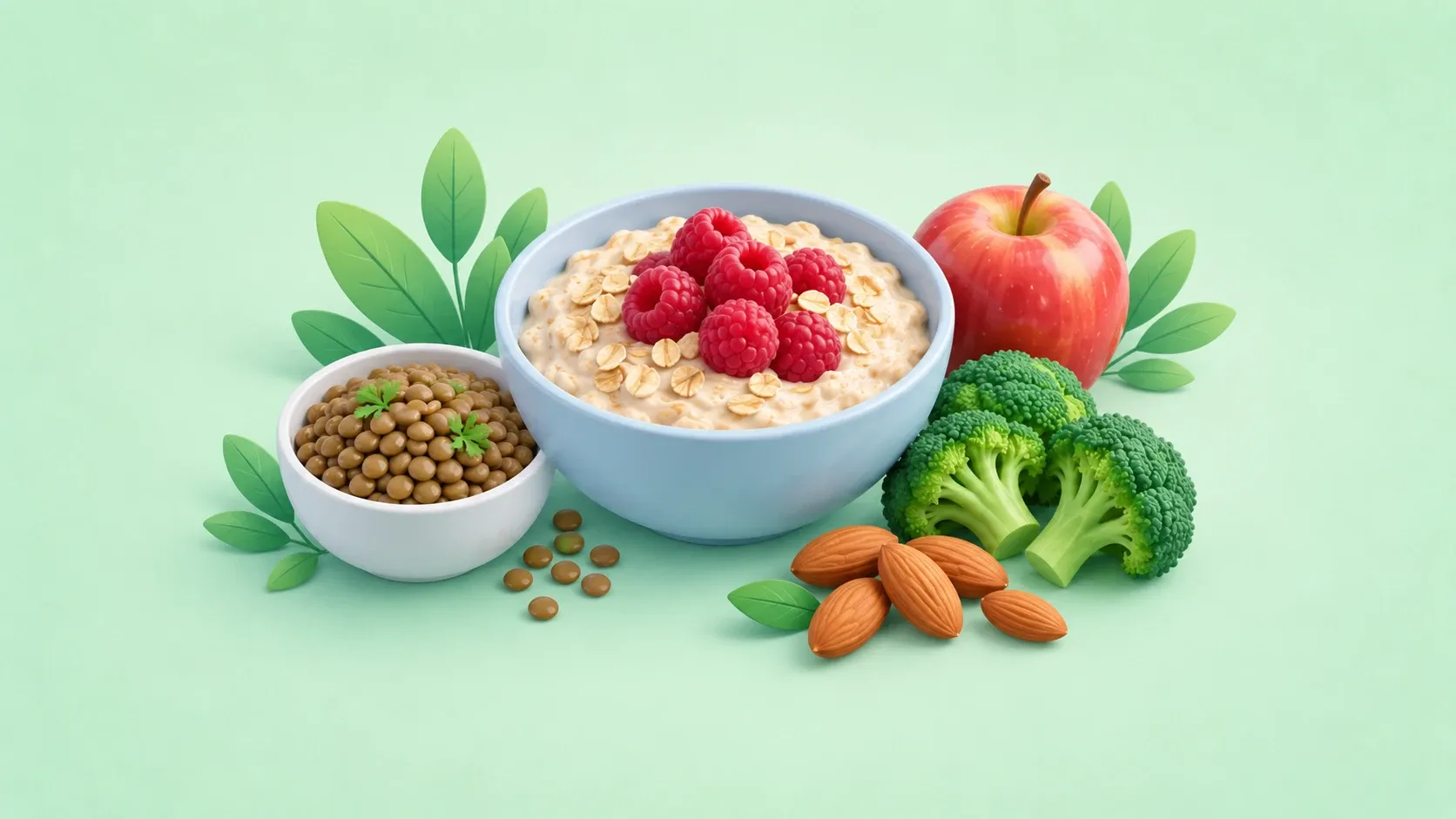
- Breakfast: oats made with 40 g dry oats (4.2 g) topped with a cup of raspberries (8.0 g). Running total: 12.2 g.
- Lunch: a bowl with half a cup of cooked lentils (7.8 g) and a cup of cooked broccoli (5.1 g), plus whatever protein you like. Running total: 25.1 g.
- Snack: a medium apple (4.4 g). Running total: 29.5 g.
- Dinner: a cup of whole-wheat pasta (5.5 g) with a tomato and vegetable sauce. Running total: 35.0 g.
That is 35 grams before counting the vegetables in the sauce or anything else you ate, and a small handful of almonds (3.8 g) takes it past the 38-gram men’s target. Notice that nothing on the list is exotic and none of it is a supplement. The day also comes in at a modest calorie cost, because the fiber-rich foods here are among the most filling foods per calorie you can eat.
How to get more fiber without the bloat
If you currently eat 15 grams a day, doubling it overnight is a recipe for gas, bloating, and cramps. Fiber feeds gut bacteria, and they need time to adjust. A gentler approach works better and sticks:
- Add a few grams at a time. Increase by roughly 3 to 5 grams a day each week, giving your digestion a few days to settle before the next step.
- Drink more water as you go. Fiber works by absorbing water; without enough fluid, more fiber can leave you constipated rather than regular. Our guide on how much water to drink covers what “enough” means.
- Swap, do not add. Trade white rice for brown, white pasta for whole-wheat, and refined bread for whole-grain, and you gain fiber without extra calories. Our list of healthy food swaps has more of these.
- Put legumes on the plate most days. Beans, lentils, and chickpeas are the single biggest lever in the table, and canned versions work just as well; rinsing them also removes some of the sodium.
- Eat the skins. Apples, pears, potatoes, and sweet potatoes lose a meaningful share of their fiber when peeled.
- Read the label. The Daily Value for fiber is 28 grams, and the FDA’s rule of thumb is that 5 percent of the Daily Value or less per serving is low while 20 percent or more is high. That makes about 5.6 grams per serving the threshold for a genuinely high-fiber food. Our guide to reading a nutrition label walks through the rest of the panel.
- Check where you actually stand. Most people overestimate their fiber. Logging your meals for a week, even loosely, shows whether the beans and whole grains are really showing up every day or only on good days. The free CalcEat app lets you snap a photo of your plate, scan barcodes for packaged foods, or log manually, so the check takes seconds rather than a spreadsheet.
Can you eat too much fiber?
For most healthy adults, no practical ceiling exists. The National Academies did not set a tolerable upper intake level for fiber, because there was no evidence of harm from high intakes of fiber from food. What does exist is a comfort limit that is different for everyone: too much, too fast, brings the gas and bloating described above, and very large intakes can crowd out calories or make you feel too full to eat enough of everything else. The fix is the same gradual approach.
Two groups should be more careful. If you have a digestive condition such as irritable bowel syndrome, inflammatory bowel disease, or a history of bowel obstruction, the type and amount of fiber you tolerate can differ a lot from the general advice, and it is worth working it out with a clinician or dietitian. And if you take medication with meals, large fiber doses close to the dose can affect absorption for some drugs; your pharmacist can tell you whether yours is one of them.
The bottom line
Aim for 25 grams of fiber a day if you are a woman and 38 grams if you are a man, or about 14 grams per 1,000 calories if you want a number tailored to your intake; the US label rounds that to 28 grams, Europe says 25, the UK says 30, and the WHO says at least 25. Most people eat little more than half of any of those figures, and the research says closing that gap is one of the highest-value changes you can make: 25 to 29 grams a day is where mortality and heart-disease risk fall the most. Legumes, oats, berries, vegetables, fruit with the skin on, and whole-grain swaps get you there, and the sample day above reaches 35 grams from ordinary food. Add a few grams a week, drink more water alongside it, and use the calorie calculator to size the target to your own calories. It fits naturally alongside the rest of our healthy eating guides, and if you want the full plan built around your goal, you can get a free plan.