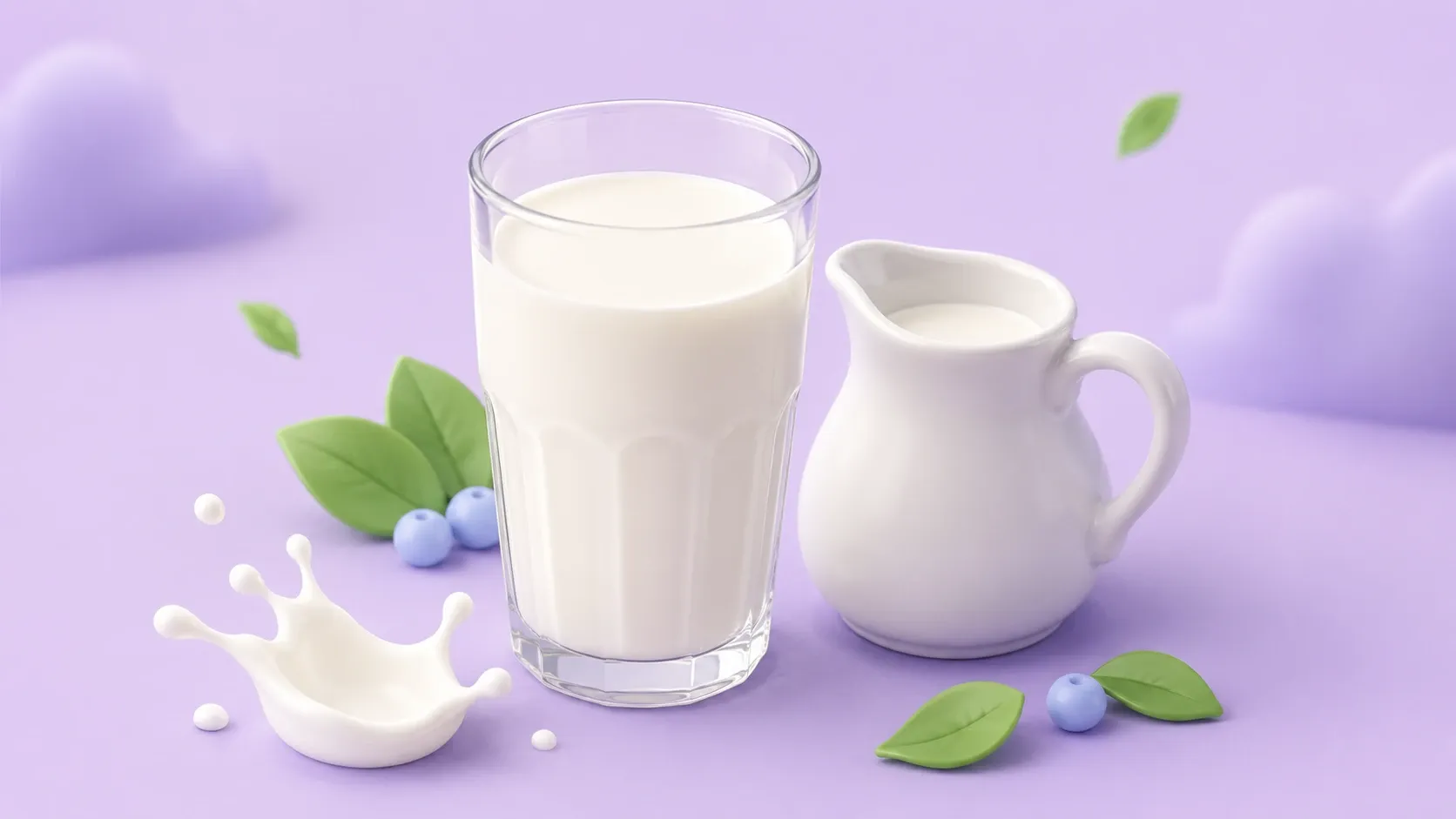
One cup of whole milk has about 149 calories, along with roughly 8 grams of protein, 12 grams of carbohydrate, and 8 grams of fat, according to USDA FoodData Central. Drop the fat and the calories fall in step: 2% milk is about 122 calories per cup, 1% is about 102, and skim is about 83. Milk is one of the most logged drinks in any tracking app, and almost the entire calorie spread between these four comes down to one thing: how much milkfat is left in.
The quick answer: calories in milk
The calories in a glass of cow’s milk are set by its fat percentage. Whole milk runs about 61 calories per 100 grams, and a standard cup (244 g, roughly 8 fluid ounces) lands near 149 calories. As the fat is skimmed off, the number drops cleanly through the four common varieties.
Here is the per-cup breakdown for each fat level, based on USDA data:
- Whole (3.25% milkfat): about 149 kcal, 8 g protein, 8 g fat, 12 g carbohydrate
- 2% reduced fat: about 122 kcal, 8 g protein, 5 g fat, 12 g carbohydrate
- 1% lowfat: about 102 kcal, 8 g protein, 2.4 g fat, 12 g carbohydrate
- Skim / nonfat: about 83 kcal, 8 g protein, 0.2 g fat, 12 g carbohydrate
Notice what does not change. Protein holds at about 8 grams and carbohydrate at about 12 grams per cup no matter which carton you pick, because those live in the non-fat part of the milk. Only the fat moves, and fat carries more than twice the calories per gram of protein or carbohydrate, which is why milk shows up so often in our Food and Calorie Guides hub as a quick win for trimming calories without losing nutrition.
Calories by serving size and fat level
“A glass of milk” is not a fixed amount, and neither is the fat percentage, so the calories swing on two axes at once. The table below applies the USDA per-cup figures to common pours, from a splash in coffee to a tall glass.
| Serving | Whole | 2% | 1% | Skim |
|---|---|---|---|---|
| 2 tbsp (about 30 g), in coffee | about 18 | about 15 | about 13 | about 10 |
| 1/2 cup (122 g) | about 74 | about 61 | about 51 | about 42 |
| 1 cup (244 g) | about 149 | about 122 | about 102 | about 83 |
| Tall glass / 1.5 cups (366 g) | about 223 | about 183 | about 154 | about 124 |
The takeaway: a tall glass of whole milk carries nearly as many calories as a small meal, while the same glass of skim is closer to a light snack. If you drink milk by the glass several times a day, the fat level you choose can swing your daily total by a few hundred calories.
How the fat level changes the number
The whole story of milk calories is the fat. Start with whole milk at about 61 calories per 100 grams, then watch the number fall as fat is removed:
| Type | Calories (per 100 g) | Fat | Protein | Carbohydrate |
|---|---|---|---|---|
| Whole 3.25% | about 61 | 3.25 g | 3.2 g | 4.8 g |
| 2% reduced fat | about 50 | 1.98 g | 3.3 g | 4.8 g |
| 1% lowfat | about 42 | 0.97 g | 3.4 g | 5.0 g |
| Skim / nonfat | about 34 | 0.08 g | 3.4 g | 5.0 g |
Going from whole to skim removes roughly 3 grams of fat per 100 grams and with it about 27 calories, which works out to about 66 calories per cup. That is a meaningful saving if you drink milk daily, and you give up almost nothing in protein or calcium to get it. The trade-off is the fat itself: it carries the fat-soluble vitamins A and D and adds a richer mouthfeel and more staying power, which is why some people find whole milk more satisfying despite the extra calories.
What milk gives you besides calories
Milk earns its place in a diet because of what comes with those calories. A single cup, at any fat level, delivers:
- Protein: about 8 grams of high-quality, complete protein, which is why milk lands on most lists of high-protein foods and is a popular post-workout drink.
- Calcium: roughly 300 mg per cup, close to a quarter of the daily target for most adults, plus phosphorus for bone health.
- Vitamin D: most fluid milk in the United States is fortified, supplying a good share of the daily amount, which helps the body actually use the calcium.
- Potassium and B vitamins: including riboflavin and B12, nutrients many people fall short on.
Because protein and calcium hold steady from whole down to skim, you do not sacrifice the headline nutrition by choosing a lower-fat carton. The Harvard Nutrition Source notes that milk is a convenient package of protein, calcium, and vitamin D, while also pointing out that you do not need milk to get these nutrients if you would rather get them elsewhere. If you are curious how the protein, carbs, and fat in a glass fit together, our guide on what macros are breaks it down.
Whole versus skim: which should you pick
There is no single right answer; it depends on your goals and the rest of your day.
Choose lower-fat to save calories. If you drink milk often and want to trim calories without losing protein, stepping down toward 1% or skim is one of the easiest swaps you can make. Skim keeps the 8 grams of protein and the calcium while shaving off about 66 calories per cup versus whole. It pairs naturally with other lean, filling choices like the ones in our low-calorie filling foods guide.
Choose whole for fullness and flavor. The fat in whole milk adds richness and helps a glass keep you satisfied longer, and current research has softened the old worry about dairy fat and heart health. If whole milk fits your calorie budget and you find it more filling, it is a reasonable choice. The fat-soluble vitamins A and D also travel with the fat, so they are naturally higher in whole milk before any fortification.
Mind what you add. A plain glass of milk is straightforward, but a flavored latte, a milkshake, or chocolate milk is a different story. Added sugar and syrups can double or triple the calories of the milk itself, so the carton is rarely the part worth worrying about.
How milk fits a calorie budget
Milk is a nutrient-dense drink that slots into almost any eating pattern as long as you account for it. Because it is a liquid, it is easy to drink more than you realize, so logging it honestly is where the control happens.
It is an easy protein source. A cup delivers 8 grams of protein for 83 to 149 calories depending on fat level, which is efficient, especially with skim. It works well alongside other staples like Greek yogurt and eggs when you are building protein into your day. If you are working out your own targets, our guide on how many calories you should eat to lose weight lays out the math.
Liquid calories add up quietly. Milk does not fill you up the way solid food does, so a few glasses a day can use a real slice of your budget without registering as “eating.” Measuring your pour, or logging it by the cup in a tracking app like CalcEat, keeps the math honest. You can also estimate your needs first with our calorie calculator and then fit milk around the rest of your meals.
Match the fat level to the goal. If calories are tight, skim or 1% gives you the protein and calcium for less. If you have room and prefer the taste, whole milk is fine. The key is consistency: pick your usual carton, log the real amount, and the difference between whole and skim becomes one simple lever you can pull.
The bottom line
A cup of whole milk is about 149 calories, 2% is about 122, 1% is about 102, and skim is about 83, and the entire spread comes down to milkfat. Protein stays near 8 grams and calcium near 300 mg per cup across all four, so a lower-fat carton keeps the nutrition that matters while cutting calories. Per 100 grams the values run 61, 50, 42, and 34 from whole to skim.
Keep it simple: choose the fat level that fits your goals, measure your pour, and remember that flavored and sweetened versions are where the real calories hide. Logged honestly, milk is a convenient, protein-rich drink that fits a calorie budget at any fat level.
This article is general information, not medical or dietary advice for your specific situation.