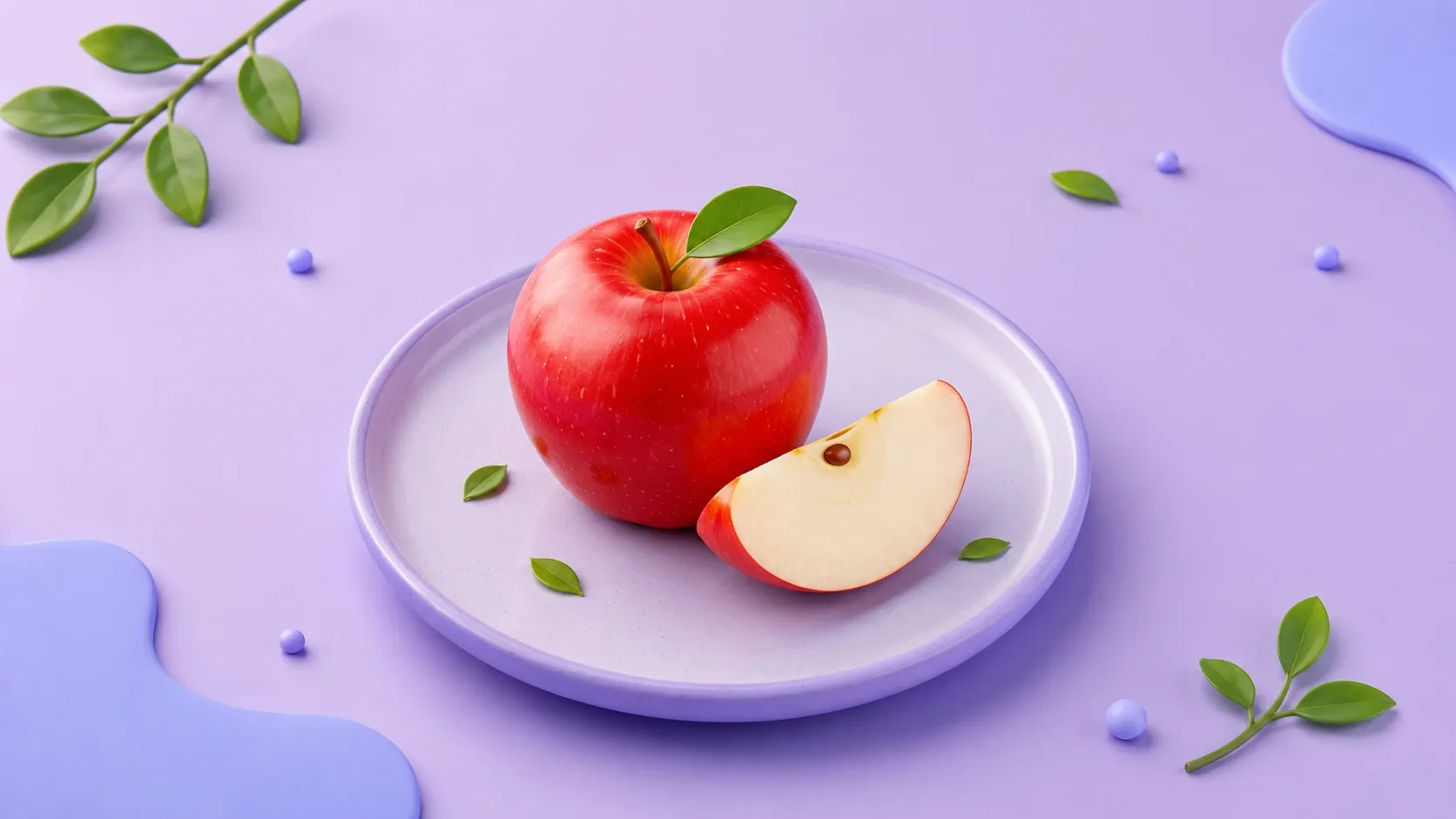

A medium apple with the skin on has about 95 calories, along with roughly 4 grams of fiber and around 19 grams of natural sugar, according to USDA FoodData Central. That makes it one of the most satisfying low-calorie snacks you can grab: mostly water and fiber, no added sugar, and almost no fat. The total comes down mainly to one thing, the size of the fruit.
The quick answer: calories in an apple
Raw apple with skin lands at about 52 calories per 100 grams. Apples are roughly 85 percent water, so the calories track closely with how big the apple is. A typical medium apple weighs around 182 grams, which puts it at about 95 calories.
Here is how the numbers break down for 100 grams of raw apple with skin:
- Calories: about 52 kcal
- Carbohydrate: about 13.8 g
- Fiber: about 2.4 g
- Sugar: about 10.4 g (all naturally occurring)
- Protein: about 0.3 g
- Fat: about 0.2 g
With almost no fat or protein, an apple is essentially water, carbohydrate, and fiber. That is exactly why it sits on most lists of low-calorie filling foods: a lot of volume and fiber for very few calories.
Calories by apple size
“One apple” is not a fixed amount. Apples range from small lunchbox fruit to large ones nearly double the weight, so the calories swing accordingly. The table below applies the USDA per-100-gram value for raw apple with skin to the standard size weights.
| Apple size | Weight | Calories | Carbs | Fiber |
|---|---|---|---|---|
| Small (about 2.75 in) | 149 g | about 78 | 21 g | 3.6 g |
| Medium (about 3 in) | 182 g | about 95 | 25 g | 4.3 g |
| Large (about 3.25 in) | 223 g | about 116 | 31 g | 5.4 g |
| Per 100 g | 100 g | about 52 | 13.8 g | 2.4 g |
| One cup, sliced | 109 g | about 57 | 15 g | 2.6 g |
The takeaway: even a large apple stays around 116 calories, and a small one is under 80. For most people, a whole apple is a snack you can fit into almost any day without much thought. For more reference numbers like these, our Food and Calorie Guides hub keeps them in one place.
Natural sugar versus fiber
Apples taste sweet, and that can make calorie-counters nervous about the sugar. It helps to keep two things in perspective. First, the sugar in a whole apple is naturally occurring, not added, and a medium apple has about 19 grams of it, far less than most candy or a glass of soda. Second, that sugar comes packaged with fiber.
Fiber is what changes the picture. A medium apple delivers about 4 grams of it, a meaningful share of the 25 to 30 grams most adults are encouraged to eat per day. Fiber slows how quickly the natural sugar is absorbed, which softens the rise in blood sugar compared with the same sugar in liquid form. So while an apple is sweet, it behaves very differently in your body than a sugary drink with the same number of grams.
Eat the skin for the fiber
If you want the most out of an apple, leave the skin on. A large share of an apple’s fiber, along with many of its beneficial plant compounds, sits in and just beneath the skin. Peeling an apple strips away much of that fiber and the majority of its flavonoids, as the Harvard Nutrition Source notes about whole versus peeled fruit.
The trade-off is easy to make. The skin adds almost no calories, so keeping it on gives you more filling fiber for essentially the same calorie cost. A whole, unpeeled apple is the most nutrient-dense and the most satisfying way to eat one.
Satiety and low calorie density
Apples are a textbook example of low calorie density, meaning few calories for a large, filling volume. Two things drive that: water and fiber. An apple is mostly water, and it carries several grams of fiber, both of which add bulk and slow you down without adding calories.
That combination is why a single apple can take the edge off hunger for around 90 calories. It also takes time to eat, you have to chew a whole apple, which gives your body a chance to register fullness in a way that a quick, calorie-dense snack does not. For anyone watching calories, swapping a processed snack for a piece of fruit is one of the simplest wins available, and our guide to low-calorie filling foods covers more options that work the same way.
Apple versus apple juice
A whole apple and a glass of apple juice are not the same thing nutritionally, even though they start from the same fruit. A cup of unsweetened apple juice has roughly 110 to 120 calories, in the same range as a large whole apple, but the juicing process removes almost all of the fiber.
Without that fiber, the natural sugar hits faster, and juice is much easier to drink quickly than a whole apple is to eat. You could drink the juice from two or three apples in seconds and barely notice, whereas eating two or three whole apples takes real effort. For calorie control and fullness, the whole fruit almost always wins. If you are tracking, it is also worth logging juice carefully, since liquid calories are some of the easiest to overlook.
How an apple fits a calorie budget
An apple is one of the easiest foods to fit into a daily target, and it earns its place for a few reasons.
It is filling for very few calories. Water plus fiber plus a low calorie density means a whole apple satisfies a snack craving for under 100 calories. If you are figuring out your own intake, our guide on how many calories you should eat to lose weight lays out the math.
It is a clean swap for processed snacks. Trading a 200-calorie packaged snack for a 95-calorie apple saves calories and adds fiber at the same time. Done a few times a week, those swaps add up.
It travels and portions itself. An apple needs no prep, no measuring, and no packaging. One fruit is one portion, which removes a lot of the guesswork that trips up snacking.
A few simple ways to keep apples working for your goals:
- Eat them whole and with the skin. That is where the fiber lives, and it costs you almost nothing in calories.
- Reach for fruit over juice when calories count. The whole apple is more filling for the same or fewer calories.
- Log the size you actually eat. A large apple has roughly 50 percent more calories than a small one, so a tracking app like CalcEat helps you stay honest when “one apple” varies this much. For other fruit numbers, see our calories in fruits guide.
The bottom line
A medium apple with skin is about 95 calories, with roughly 4 grams of fiber and around 19 grams of natural sugar, and the count scales with the size of the fruit, from about 78 calories for a small one to about 116 for a large one. Apples are mostly water and fiber, which makes them filling for very few calories and an easy fit for almost any calorie budget.
Keep it simple: eat the whole fruit, leave the skin on for the fiber, and choose apples over juice when you are watching calories. As a low-calorie, high-fiber snack, a fresh apple is hard to beat.
This article is general information, not medical or dietary advice for your specific situation.