
The short answer is under 2,300 milligrams of sodium a day, about one level teaspoon of table salt. That is the limit in the 2025–2030 Dietary Guidelines for Americans for everyone 14 and older, and the Daily Value printed on US food labels. The World Health Organization goes a little lower, under 2,000 mg, and the American Heart Association says 1,500 mg is ideal for most adults. The honest headline is that almost nobody is close: the average American eats about 3,400 mg a day, and most of it arrives already inside packaged and restaurant food. This guide sets out the limits by authority, shows how to convert between salt and sodium, lists how much is in the foods you actually eat, and ends with the changes that cut the most for the least effort.
The quick answer
The major health bodies agree closely, and the differences come down to how much margin each one builds in:
| Authority | Daily limit | As salt |
|---|---|---|
| US Dietary Guidelines (2025–2030), ages 14 and up | Under 2,300 mg of sodium | About 5.8 g |
| US FDA Nutrition Facts label | Daily Value of 2,300 mg | About 5.8 g |
| National Academies (2019) | Reduce intake if above 2,300 mg; 1,500 mg covers needs | About 5.8 g; 3.8 g |
| American Heart Association | Ideal limit of 1,500 mg for most adults | About 3.8 g |
| World Health Organization | Under 2,000 mg | Under 5 g |
| EFSA (EU, 2019) | 2,000 mg is safe and adequate | 5 g |
| UK (NHS) | About 2,400 mg | No more than 6 g |
The 2025–2030 Dietary Guidelines for Americans say the general population aged 14 and above should consume less than 2,300 mg of sodium a day, with lower limits for children (Dietary Guidelines for Americans, 2025–2030). The same figure is the Daily Value on US Nutrition Facts labels, which the FDA describes as about one teaspoon of table salt (FDA). It traces back to the National Academies, whose 2019 review told everyone 14 and older to reduce their intake if it is above 2,300 mg, and set 1,500 mg as the amount that covers the body’s needs (National Academies, 2019). The American Heart Association recommends bringing intake down to under 1,500 mg (Whelton et al., 2012). The World Health Organization’s limit is under 2,000 mg of sodium, equal to under 5 grams of salt (WHO), and the European Food Safety Authority considers 2.0 grams of sodium a day a safe and adequate intake for adults (EFSA, 2019). The UK tells adults to eat no more than 6 grams of salt a day, around a level teaspoon (NHS).
So the practical answer is one number: stay under 2,300 mg. If you have high blood pressure, or simply want the extra margin, aim for 1,500.
Salt vs sodium: how to convert
Labels and guidelines switch between the two words, and the difference is a factor of 2.5. Salt is sodium chloride, and sodium is about 40 percent of it by weight. EU law makes the conversion official: the “salt” figure on a food label is its sodium content multiplied by 2.5 (EU Regulation 1169/2011).
- Sodium to salt: multiply by 2.5. 2,300 mg of sodium is about 5.8 grams of salt.
- Salt to sodium: multiply by 0.4. 6 grams of salt is 2,400 mg of sodium.
- A teaspoon of salt: a level teaspoon of table salt weighs about 6 grams and holds about 2,325 mg of sodium, a full day’s allowance on its own (USDA).
This matters when you read a label. US labels list sodium in milligrams per serving, with a percent Daily Value next to it. EU labels list salt in grams per 100 grams, against a reference intake of 6 grams (EU Regulation 1169/2011). Our guide to reading a nutrition label walks through the rest of the panel.
Limits for children
Children need less because they eat less. The 2025–2030 Dietary Guidelines set these ceilings, which match the National Academies’ 2019 values exactly (Dietary Guidelines for Americans, 2025–2030; National Academies, 2019):
| Age | Sodium, under | As salt |
|---|---|---|
| 1 to 3 years | 1,200 mg | About 3.0 g |
| 4 to 8 years | 1,500 mg | About 3.8 g |
| 9 to 13 years | 1,800 mg | About 4.5 g |
| 14 years and older | 2,300 mg | About 5.8 g |
Why the limit matters
Eating too much sodium raises blood pressure, which increases the risk of heart disease and stroke (CDC). The WHO estimates that about 1.7 million deaths a year are associated with eating too much of it (WHO).
The trial evidence is consistent. A Cochrane systematic review and meta-analysis of 34 trials with 3,230 participants found that cutting salt by about 4.4 grams a day lowered blood pressure by about 4.2/2.1 mmHg on average: 5.4/2.8 mmHg in people with high blood pressure and 2.4/1.0 mmHg in people with normal blood pressure (He et al., 2013). In the DASH-Sodium feeding trial, the DASH diet combined with a low sodium intake lowered systolic pressure by 11.5 mmHg in people with hypertension, compared with a typical American diet high in sodium (Sacks et al., 2001). Our DASH diet guide covers the eating plan behind that result.
The strongest evidence on hard outcomes comes from the Salt Substitute and Stroke Study. It enrolled 20,995 people in 600 villages in rural China, all with a previous stroke or aged 60 or older with high blood pressure, and gave half the villages a salt substitute of 75 percent sodium chloride and 25 percent potassium chloride. Over about 4.7 years, the substitute group had 14 percent fewer strokes, 13 percent fewer major cardiovascular events, and 12 percent fewer deaths than the group using regular salt, with no significant rise in serious high-potassium events (Neal et al., 2021).
One honest caveat. When the National Academies reviewed the evidence in 2019, they concluded that intakes above 2,300 mg raise the risk of chronic disease across a population, but they found insufficient evidence that intakes below 2,300 mg lower the risk of death from any cause or from cardiovascular disease (National Academies, 2019). Going lower still reduces blood pressure, as the trials above show. The open question is how far the benefit on hard outcomes extends, not whether most people should eat less.
Where sodium actually comes from
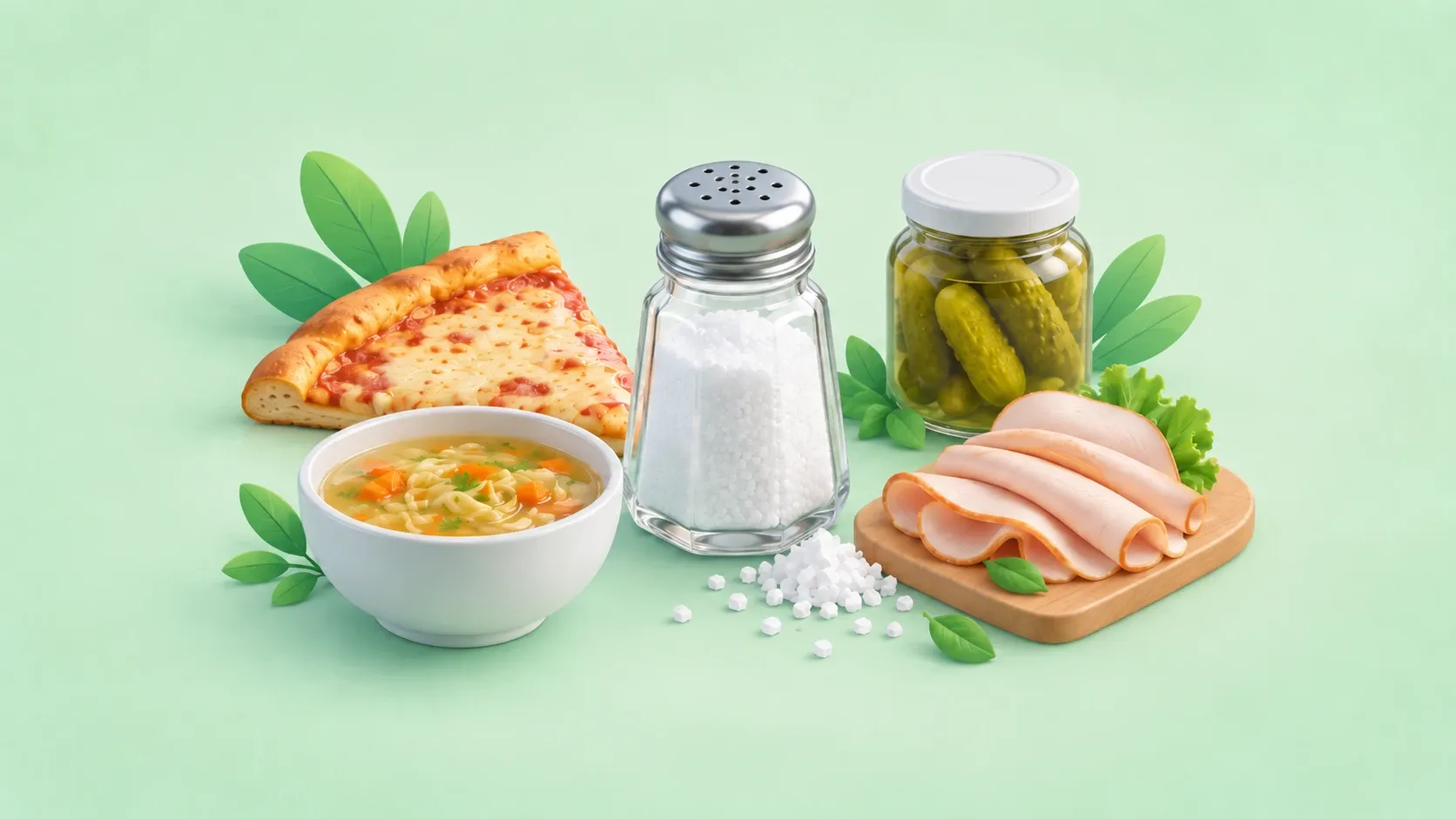
The salt shaker is a small part of the story. More than 70 percent of the sodium Americans eat comes from packaged and prepared foods (FDA), and in the UK around three quarters of the salt people eat is already in the food they buy, in things like bread, breakfast cereals, meat products, and ready meals (NHS). The FDA lists the top contributors in the US, which together make up about 40 percent of intake: deli meat sandwiches, pizza, burritos and tacos, soups, savory snacks, poultry, pasta dishes, burgers, and egg dishes (FDA). The CDC puts average intake at more than 3,300 mg a day and adds chicken nuggets and bread to the list (CDC).
Bread is the one that surprises people. A slice of white bread carries about 142 mg, which is not much on its own, but two slices of toast at breakfast and two more in a sandwich add up to more than 550 mg before anything goes on them.
How much sodium is in common foods
The table uses USDA FoodData Central values and realistic servings. The last column is each serving’s share of the 2,300 mg Daily Value.
| Food | Serving | Sodium | % Daily Value |
|---|---|---|---|
| Table salt | 1 teaspoon (6 g) | 2,325 mg | 101% |
| Soy sauce | 1 tablespoon (16 g) | 879 mg | 38% |
| Chunky chicken noodle soup, canned | 1 cup (243 g) | 744 mg | 32% |
| Frozen cheese pizza | A third of a pizza (151 g) | 675 mg | 29% |
| Deli turkey breast | 4 slices (64 g) | 575 mg | 25% |
| Cottage cheese, 2% | 1/2 cup (113 g) | 348 mg | 15% |
| Feta cheese | 1 oz (28 g) | 319 mg | 14% |
| Dill pickle | 1 small spear (35 g) | 283 mg | 12% |
| Tuna, canned in water, drained | 3 oz (85 g) | 210 mg | 9% |
| Cheddar cheese | 1 oz (28 g) | 183 mg | 8% |
| Ketchup | 1 tablespoon (17 g) | 154 mg | 7% |
| Potato chips, salted | 1 oz (28 g) | 148 mg | 6% |
| White bread | 1 slice (29 g) | 142 mg | 6% |
| Chicken breast, roasted, unseasoned | 3 oz (85 g) | 63 mg | 3% |
| Banana | 1 medium (118 g) | 1 mg | 0% |
A few things stand out. A tablespoon of soy sauce is more than a third of the day. Canned tuna drops from 210 mg to about 43 mg when it is packed without added salt, which shows how much of the sodium in processed food is a manufacturing choice rather than a property of the food. Cottage cheese and feta are saltier than most people guess, and a single large dill pickle, about 135 grams, carries roughly 1,090 mg, close to half the daily limit. Fresh, unprocessed foods sit near zero: a banana has 1 mg.
For more on individual foods, see our guides to pizza, cheese, bread, and tuna.
How a normal day passes 2,300 mg
None of those numbers look alarming alone, which is exactly the problem. Put an ordinary day together: half a cup of cottage cheese with a banana at breakfast (about 349 mg), a turkey sandwich on white bread with a pickle spear and a small bag of chips at lunch (about 1,290 mg), and a third of a frozen cheese pizza for dinner (about 675 mg). That is about 2,310 mg, over the limit without a single shake of salt. Add a cup of canned chicken noodle soup and the day reaches about 3,060 mg, closing in on the American average of 3,400.
The lesson is not that any one of these foods is dangerous. It is that sodium is spread across dozens of ordinary products, and the processed ones carry most of it.
How to cut sodium without losing flavor
- Read the label. US labels show sodium with a percent Daily Value, and the FDA’s rule of thumb is that 5 percent or less per serving is low and 20 percent or more is high (FDA). Label claims have legal definitions too: “low sodium” means 140 mg or less per serving, “very low sodium” 35 mg or less, and “reduced sodium” at least 25 percent less than the regular product (FDA).
- Go after the biggest contributors first. Deli meat, pizza, soup, and savory snacks top the list for a reason. Switching to a lower-sodium version of the one or two you eat most beats trying to cut everything at once.
- Cook more of your own food. Most sodium arrives in food someone else made, so every meal you cook from fresh ingredients puts you in charge of the salt. When you do eat out, our guide to eating out and staying on track helps.
- Drain and rinse canned beans. In a test of five kinds of canned beans, draining removed an average of 36 percent of the sodium, and draining plus rinsing removed 41 percent (Duyff et al., 2011).
- Season with something other than salt. Herbs, spices, garlic, citrus, and vinegar add flavor without adding sodium.
- Eat more potassium-rich foods. Vegetables, fruits, beans, and dairy are the backbone of the DASH plan, which lowered blood pressure most when it was combined with less sodium (Sacks et al., 2001).
- Ask before you switch to a salt substitute. Potassium-enriched substitutes cut strokes in the trial above, but that trial excluded people taking potassium-sparing diuretics or potassium supplements and people with severe kidney disease (Haghdoost et al., 2024). If any of those apply to you, check with your doctor first.
- See where you actually stand. Most people underestimate what they eat. Logging your meals for a few days shows which foods make up your day. The free CalcEat app lets you snap a photo of your plate, scan barcodes for packaged foods, or log manually. Our list of healthy food swaps has more easy trades.
What the new US guidelines say about salt
The 2025–2030 Dietary Guidelines kept the 2,300 mg limit and tell Americans to avoid highly processed foods that are high in sodium. They also say that, if you prefer, you can flavor meat and vegetables with salt, spices, and herbs (Dietary Guidelines for Americans, 2025–2030). The American Heart Association responded that the salt-seasoning advice could inadvertently lead people to exceed the sodium limit (AHA, 2026).
The two positions fit together once you remember where sodium comes from. A dash of salt, about 0.4 grams, adds roughly 155 mg to a dish of home-cooked vegetables (USDA). That is small next to the sodium already in the processed foods both bodies tell you to cut. It stops being small when the dash becomes a heavy hand.
Do some people need more?
The 2,300 mg limit is aimed at the general population. The 2025–2030 Dietary Guidelines note that highly active people may benefit from more sodium to offset what they lose in sweat (Dietary Guidelines for Americans, 2025–2030), which mostly matters for long, hard training in the heat. Our guide to how much water you should drink covers the fluid side. In the other direction, if you have kidney disease, heart failure, or high blood pressure, your doctor may set a lower target for you, and it is worth following theirs over a general guideline.
The bottom line
Keep sodium under 2,300 mg a day, about a teaspoon of salt, and aim for 1,500 mg if you have high blood pressure or want the margin. Most of it is already inside packaged and restaurant food, so the biggest wins come from reading labels, choosing lower-sodium versions of the foods you eat most, and cooking more of your own meals. Salt is 40 percent sodium, so when a label lists salt instead, multiply your sodium figure by 2.5 to compare (2,300 mg is about 5.8 grams of salt), or multiply the salt by 0.4 to get sodium. This guide sits alongside our guides on how much sugar and how much fiber you need a day, and if you want a full plan built around your goal, you can get a free plan.