
The DASH eating plan is one of the few diets with a clinical trial rather than a book behind it. DASH stands for Dietary Approaches to Stop Hypertension, and it came out of research funded by the US National Heart, Lung, and Blood Institute in the 1990s that asked a specific question: can changing what people eat lower blood pressure on its own, without weight loss, without cutting salt, and without medication? The answer was yes, and the eating pattern that did it is what we now call DASH.
This guide covers what the plan actually asks of you day to day, what a serving means in practice, what the trials found, and where sodium fits. It is a description of an eating pattern and the evidence behind it, not medical advice: if you are treating high blood pressure, the plan belongs in a conversation with your doctor, not instead of one.
What the DASH eating plan actually is
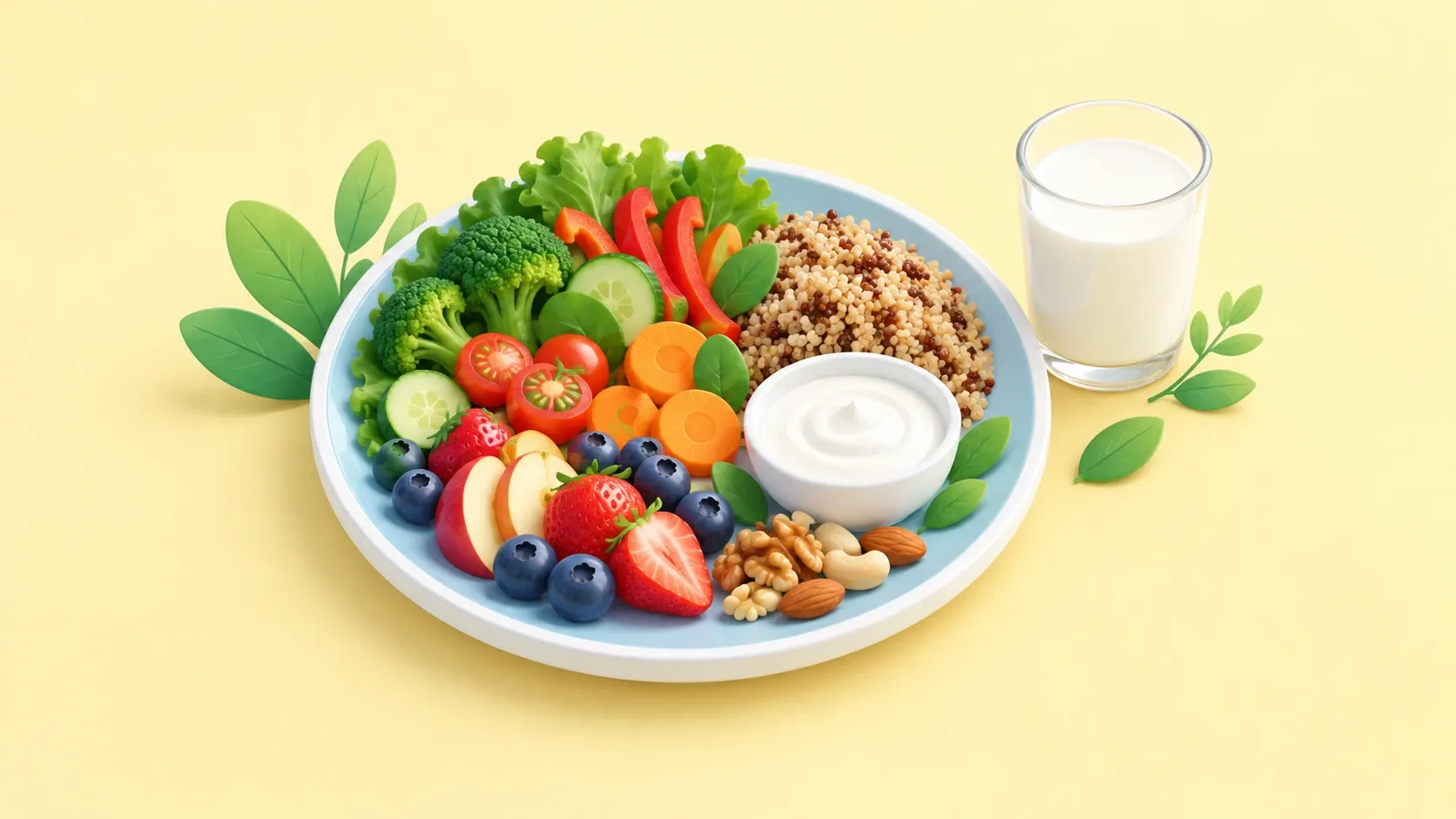
DASH is not a list of banned foods. It is a set of daily and weekly serving targets across food groups, built to be rich in potassium, calcium, magnesium, fiber and protein and lower in saturated fat and sodium (NHLBI). NHLBI describes it as a flexible, balanced plan meant to become a permanent eating style rather than a phase.
Here is the plan at 2,000 calories a day (NHLBI):
| Food group | Target |
|---|---|
| Grains, mostly whole | 6 to 8 servings a day |
| Vegetables | 4 to 5 servings a day |
| Fruit | 4 to 5 servings a day |
| Fat-free or low-fat dairy | 2 to 3 servings a day |
| Lean meat, poultry and fish | 6 servings a day or fewer |
| Nuts, seeds and legumes | 4 to 5 servings a week |
| Fats and oils | 2 to 3 servings a day |
| Sweets and added sugars | 5 servings a week or fewer |
| Sodium | 2,300 mg a day, or 1,500 mg for a larger effect |
Two things stand out immediately. The vegetable and fruit targets are high, 8 to 10 servings a day between them, and that is where most of the potassium comes from. And meat is capped rather than eliminated: 6 servings sounds generous until you see what one serving is.
What counts as one serving
This is where most people misjudge the plan, in both directions. NHLBI’s own definitions (serving sizes handout):
| Food group | One serving is |
|---|---|
| Grains | 1 slice of wholewheat bread, 1 oz of dry cereal, or 1/2 cup of cooked rice, pasta or cereal |
| Vegetables | 1 cup of raw leafy greens, or 1 cup of cut-up raw, frozen or cooked vegetables |
| Fruit | 1 medium fruit such as an apple, or 1/2 cup of fresh, frozen or canned fruit |
| Fat-free or low-fat dairy | 1 cup of milk or yogurt, or 1.5 oz of reduced-fat cheese |
| Protein foods | 1 oz of cooked lean meat, poultry or fish; 1 egg; 1/2 oz of nuts or seeds; 1 tablespoon of nut butter; or 1/4 cup of cooked beans or peas |
Now the numbers read differently. Six protein servings is about 170 g of cooked meat across a whole day, which is a modest chicken breast and not much else. And 4 to 5 vegetable servings is genuinely achievable once you know a cup of salad leaves counts as one.
The evidence
The original DASH trial fed 459 adults one of three diets for eight weeks: a typical American control diet, the same diet plus more fruit and vegetables, or the full DASH combination diet with fruit, vegetables and low-fat dairy and less saturated fat. Crucially, sodium was held constant across all three groups and participants’ weight was kept stable, so anything that happened to blood pressure came from the food pattern itself.
The combination diet lowered systolic and diastolic blood pressure by 5.5 and 3.0 mm Hg more than the control. Among the 133 participants who already had hypertension, the gap was much larger: 11.4 and 5.5 mm Hg (Appel et al., 1997). For context, that upper figure is in the range you might expect from a single blood-pressure medication, achieved with groceries.
That was one trial. A later systematic review pooled 17 randomized controlled trials covering 2,561 participants and found average reductions of 6.74 mm Hg systolic and 3.54 mm Hg diastolic, with bigger effects in trials that also restricted calories and in participants who already had high blood pressure (Saneei et al., 2014). The effect is real, replicated, and larger in the people who have the most to gain.
Sodium is the second lever
The original trial deliberately held salt constant, which left an obvious follow-up question. The DASH-Sodium trial answered it by testing the DASH diet and a control diet at three sodium levels each.
Lowering sodium helped on both diets, and the two levers stacked. Participants with hypertension eating the DASH diet at the lowest sodium level had systolic pressure 11.5 mm Hg lower than those on the control diet at high sodium (Sacks et al., 2001). NHLBI’s standard target is 2,300 mg a day, with 1,500 mg producing a further reduction.
The practical problem is that sodium is not mostly in your salt shaker. It is in bread, sauces, deli meat, cheese, soup and restaurant food, which is why reading the label matters more than cooking without salt. Our guide to reading a nutrition label covers where to find the sodium line and what the percentages mean, and our guide to how much sodium you should have a day sets out the limits by authority and how much sodium common foods carry.
DASH and the Mediterranean diet
These two get set against each other more often than they deserve. Look at what they ask for and the overlap is most of the plan: vegetables, fruit, whole grains, legumes, nuts, fish, and less red and processed meat.
The differences are real but narrow:
- DASH counts. It gives you servings per group and an explicit sodium number, which some people find clarifying and others find fussy.
- DASH includes low-fat dairy deliberately, because the trial found the version with dairy outperformed the fruit-and-vegetable version.
- The Mediterranean diet is a pattern rather than a prescription, leans harder on olive oil and fish, and its strongest evidence is for cardiovascular events rather than blood pressure specifically.
If you want a rule set, DASH. If you want a style, Mediterranean. The worst option is bouncing between them.
A simple day on DASH
Nothing exotic, and every item maps to the targets above:
- Breakfast: porridge made with a cup of low-fat milk (1 grain, 1 dairy), topped with a banana (1 fruit).
- Lunch: a large salad of leafy greens and cut vegetables (2 vegetables) with 1/4 cup of chickpeas (part of the weekly legume allowance), whole-grain bread on the side (2 grains), and an apple (1 fruit).
- Snack: plain yogurt (1 dairy) with berries (1 fruit), or a small handful of unsalted nuts.
- Dinner: roughly 100 g of chicken or fish (about 3 to 4 protein servings), a cup of cooked vegetables (1 vegetable), and half a cup of brown rice (1 grain), cooked with a tablespoon of olive oil (fats and oils).
That lands close to the daily targets without any specialist shopping. The fiber alone will be well above what most people manage, which is its own benefit: see how much fiber you need a day.
Where calorie awareness fits
DASH says nothing about calories. It was designed to hold weight steady so the blood-pressure effect could be isolated, and the serving targets are pegged to a 2,000-calorie day, which is not everyone’s number.
So if your goal is only blood pressure, follow the pattern and ignore calories. If you also want to lose weight, you still need a calorie deficit, and DASH is a good shape to put around one because it is filling per calorie. Set your target with the free calorie calculator, keep the DASH serving pattern inside it, and remember that the sweets allowance of 5 a week and the added-sugar limits point the same direction. Logging for a couple of weeks is the fastest way to see whether your version of the plan matches the targets; the free CalcEat app lets you photograph a plate or scan a barcode so the check is quick.
The bottom line
DASH is an NIH eating pattern with a trial behind it, not a brand. It asks for 4 to 5 servings each of vegetables and fruit a day, 6 to 8 of mostly whole grains, 2 to 3 of low-fat dairy, capped lean protein, weekly rather than daily nuts and legumes, and no more than 5 sweets a week, with sodium at 2,300 mg or 1,500 mg for a stronger effect. Across 17 trials it lowered systolic blood pressure by about 6.7 mm Hg on average, and in the original trial the effect among participants who already had hypertension was 11.4 mm Hg. It is not a weight-loss plan, and it is not a substitute for treatment, but as a description of how to eat for a healthier heart it is about as well evidenced as nutrition advice gets. If you want a plan built around your own numbers, you can get a free plan.