
Eating out is one of the best parts of normal life, and it does not have to wreck your progress. One restaurant meal will not make or break your results any more than one salad will transform them. What matters is the pattern you keep across the week, not any single plate.
So let us drop the idea that dining out is a “cheat” you have to earn or apologize for. With a few simple habits, you can enjoy the menu, the company, and the night out, and still wake up on track toward your goals.
Why one meal will not derail you
Your body responds to what you eat over days and weeks, not to a single dinner. A higher-calorie meal on Friday sits inside seven days of eating, and that bigger picture is what actually moves the scale. This is why obsessing over one night out tends to cause more harm than the meal itself, especially if the guilt spirals into giving up.
Think of your weekly calories as a budget rather than a daily pass-fail test. A relaxed restaurant meal can fit comfortably inside that budget when the days around it are steady. The goal is consistency over time, not perfection at every table.
That reframe matters because the all-or-nothing trap is real. People often treat one indulgent meal as proof the week is “ruined,” then overeat for days. Letting a normal meal just be a normal meal is one of the most underrated skills in healthy eating.
Why restaurant meals are easy to underestimate
Here is the honest part: restaurant food is genuinely hard to judge by eye, and that is not a personal failing. Even careful eaters tend to guess low. In a classic New England Journal of Medicine study, people underreported how much they actually ate by an average of about 47 percent without realizing it, and restaurant meals make that gap even wider.
There are three big reasons eating out adds up faster than you would expect.
Portions are large. Restaurant servings are frequently far bigger than a standard portion, so a single entree can quietly deliver one and a half or two “normal” meals’ worth of food. According to the USDA’s Economic Research Service, each meal eaten away from home adds an average of about 134 calories to an adult’s day compared with eating that same meal at home, with lunch out adding roughly 158 calories and dinner out about 144. Those numbers are averages, and a generous restaurant plate can run much higher.
Calories hide in the cooking. A lot of what makes restaurant food taste so good is added off the plate, where you never see it. Oil in the pan, butter finishing the sauce, sugar in the glaze, dressing tossed through the salad. These extras are calorie-dense and easy to overlook entirely, which is a big part of why estimates come in low.
The guessing is genuinely off. In a BMJ study of meals at six major fast-food chains, about two-thirds of people underestimated the calories in their meal, and roughly a quarter were off by at least 500 calories. Crucially, the underestimation grew as the meals got larger, meaning the biggest plates are exactly the ones people misjudge most.
The good news is that none of this requires perfection to manage. A handful of small, repeatable decisions closes most of the gap.
How regulations actually help you
You are not flying blind, either. In the United States, the FDA requires chain restaurants that are part of a group with 20 or more locations to post calorie counts right on their menus and menu boards. Those menus also carry a reminder that 2,000 calories a day is used for general advice, while individual needs vary.
That means at most large chains, the information you need is already printed next to the item. Using it is one of the simplest, most reliable moves you can make, and the strategies below build on it.
Strategies to eat out and stay on track
You do not need all of these at once. Pick two or three that fit how you eat, and let them become automatic.
1. Check the menu and calories before you go
Decisions are easier to make calmly at home than when you are hungry and a server is waiting. Pull up the restaurant’s menu online before you leave, and at chain spots, scan the posted calorie counts while you are at it. A few minutes of previewing takes the pressure off in the moment and helps you spot a solid option before the bread basket clouds your judgment.
2. Decide your order in advance
Once you have looked, actually choose. Picking your meal ahead of time means you are working from a clear plan instead of reacting to menu descriptions, table chatter, and whatever everyone else orders. When the moment comes, you simply order the thing you already decided on, which sidesteps a lot of impulse upsizing.
3. Anchor the plate on protein and vegetables
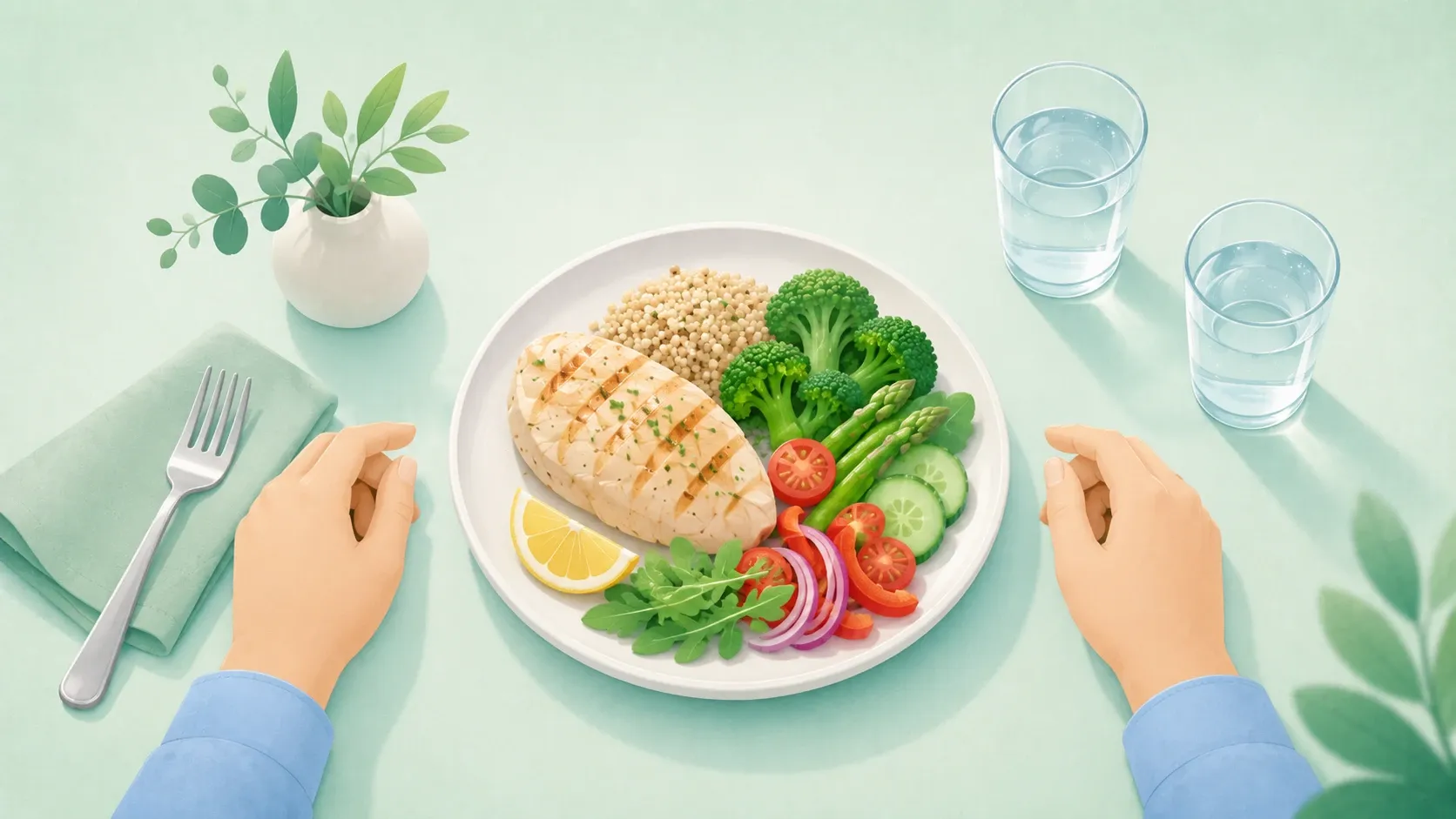
A simple, reliable template for any cuisine is to build the meal around a lean protein and some vegetables. Protein is the most filling macronutrient, so a protein-forward plate helps you feel satisfied on fewer calories and stay full longer afterward. Think grilled chicken, fish, lean steak, tofu, beans, or eggs, alongside a generous helping of vegetables, and let the heavier sides play a supporting role. If you want the deeper why behind this, our guide to low-calorie foods that keep you full breaks down what makes a plate satisfying.
4. Watch drinks and alcohol
Liquid calories are some of the easiest to overlook because they rarely feel like “eating.” A regular soda can carry around 150 calories and the equivalent of about 10 teaspoons of added sugar, and the CDC notes that sugary drinks are the single largest source of added sugars in the American diet. Alcohol stacks on top of that: it brings calories with little nutritional return, glasses get refilled without much thought, and a couple of rounds can rival the food itself. Setting a drink limit before you arrive and alternating each drink with water keeps this in check without making the night feel restrictive.
5. Get sauces and dressings on the side
This one small request quietly removes a surprising number of calories. Dressings, glazes, gravies, and creamy sauces are calorie-dense, and when they arrive pre-tossed you have no control over how much lands on your plate. Asking for them on the side lets you dip and add to taste, which usually means using far less, and it makes the whole meal much easier to estimate.
6. Manage the portion before you start
Because restaurant servings tend to run large, decide upfront what you will actually eat. You can ask for a takeout box when the food arrives and set aside half right away, split a dish with someone at the table, or order a starter and a side instead of a full entree. Pre-committing to the portion is far easier than trying to stop partway through a plate that is sitting right in front of you.
7. Slow down and eat mindfully
Fullness signals take time to register, so a fast pace often means you have eaten well past comfortable before your body catches up. Put your fork down between bites, join the conversation, and actually taste the food you came out to enjoy. Eating slowly gives your appetite a chance to speak up, and it tends to leave you satisfied with less, while making the meal more pleasurable, not less.
How to estimate calories when there is no label
Plenty of restaurants, especially independent and local spots, post no nutrition information at all. That is fine, because you can get close enough to keep your tracking useful, and close enough is what actually drives results over time.
Lean on hand portions and everyday visual cues: a palm-sized piece of protein, a fist of grains or starch, a thumb of oils or dressings. Then nudge your estimate upward to account for the cooking fats you cannot see, since restaurant kitchens are generous with oil and butter. Our full walkthrough on how to count calories accurately without weighing every meal shows exactly how to do this with confidence.
When eyeballing feels like too much, snap a photo instead. A free app like CalcEat lets you photograph the plate and get an estimate of its calories and macros, which is genuinely handy for a restaurant meal that has no label to read. Logging it in the moment, even roughly, beats trying to reconstruct the day from memory later, when underestimation creeps back in.
The aim is awareness, not a perfect number. An estimate you log consistently is worth far more than a precise figure you never record.
Quick cuisine-specific tips
Every menu has easy wins once you know where to look. A few to keep in your back pocket:
- Italian: Favor tomato-based (marinara) sauces over creamy ones like Alfredo, lean on grilled proteins, and treat the bread basket as optional rather than automatic.
- Mexican: Build around grilled chicken, steak, fish, or beans; choose soft corn tortillas or a bowl; and go easy on cheese, sour cream, and the bottomless chips.
- Chinese and other Asian takeout: Steamed beats fried, broth-based soups are light and filling, and ordering sauces on the side keeps sugary, oily glazes under control.
- Burgers and American: A single patty over a double, a side salad or fruit in place of fries part of the time, and skipping calorie-heavy sauces trims a lot without sacrificing the meal.
- Sushi: Sashimi and simple rolls run lighter than tempura or heavily mayo-dressed “special” rolls; go easy on soy sauce if you watch sodium.
- Cafes and breakfast spots: Black coffee or a plain latte instead of a blended, syrup-loaded drink can save several hundred calories before you have eaten a bite.
Putting it all together
Eating out is something to look forward to, not to fear. The people who keep enjoying restaurants while staying on track are not the ones with iron willpower; they are the ones leaning on a few simple habits like previewing the menu, anchoring on protein and vegetables, watching drinks, and keeping the rest of the week steady.
If a meal runs bigger than planned, shrug it off and carry on. One dinner is a single data point in a long, flexible pattern, and that pattern is built to absorb real life. For more everyday strategies, explore our Healthy Eating hub, and if losing weight is your aim, our guide on how to start losing weight ties these habits into a simple plan you can actually keep.
This article is general information and not medical advice.