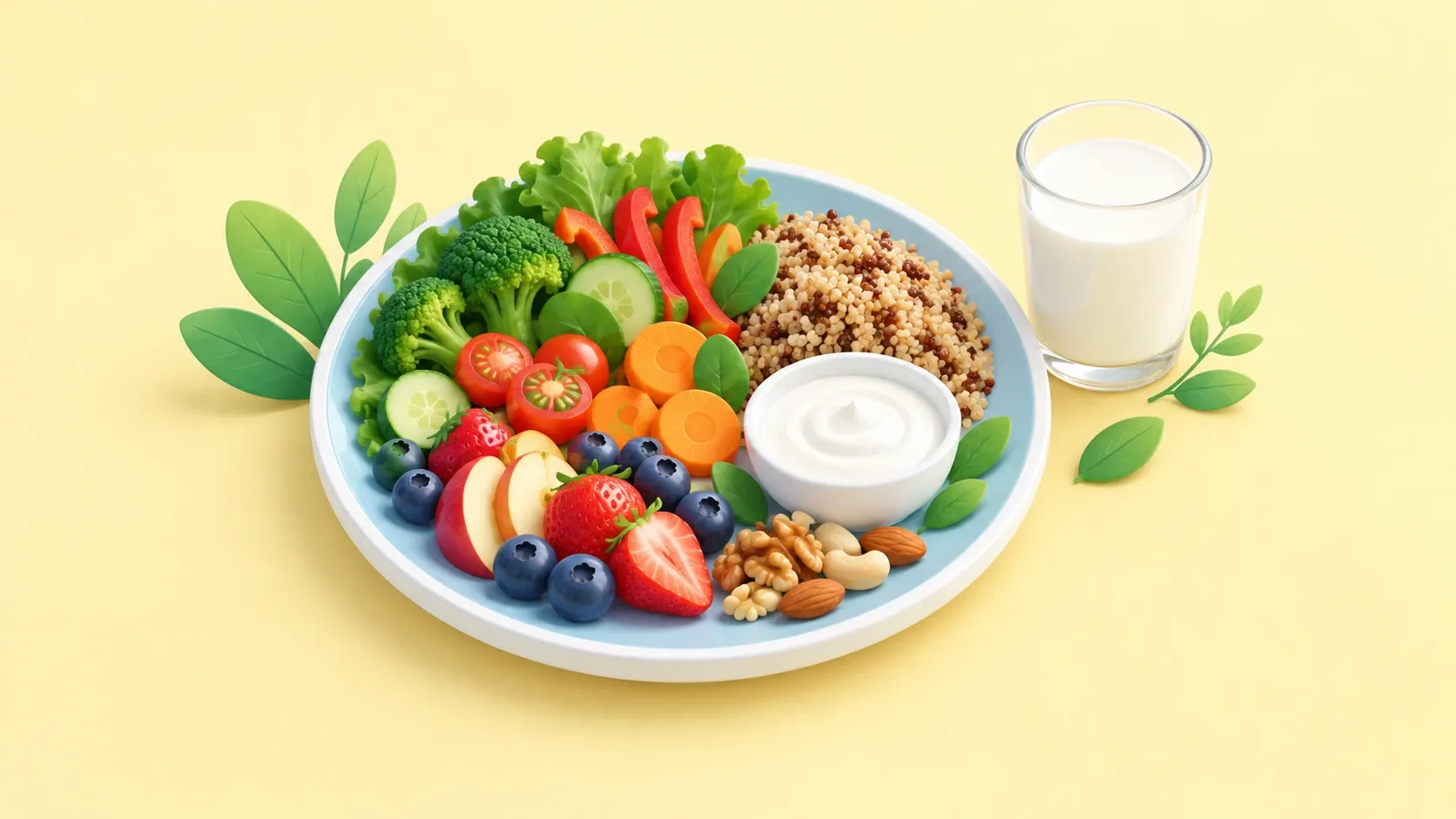
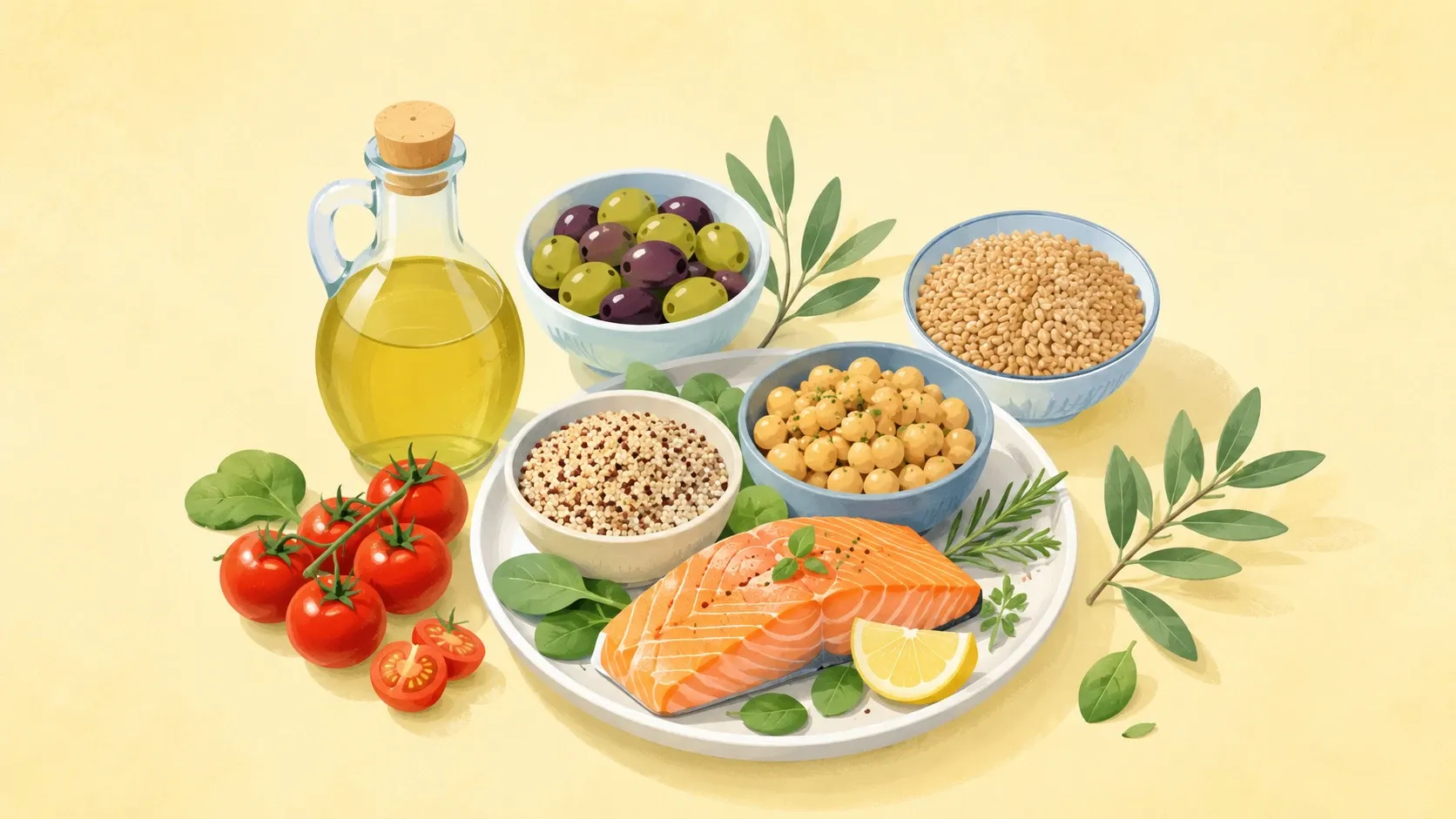

The Mediterranean diet is an eating pattern, not a calorie-counting plan: you build meals around vegetables, fruits, whole grains, legumes, nuts, and extra-virgin olive oil, eat fish a few times a week, and keep red meat, processed meat, and added sugar to a minimum. It is one of the few diets with a large randomized trial behind it, where it cut major cardiovascular events by about 30 percent, and the 2020–2025 US Dietary Guidelines named it one of three recommended ways to eat.
This guide explains what the pattern actually is, what the evidence does and does not show, a simple “eat more, eat less” breakdown, and a sample day to make it concrete. It is also worth being clear up front about what it is not: a quick-fix weight-loss scheme. It pairs well with a little calorie awareness, but the headline reason people adopt it is heart health and the fact that it is genuinely livable for years.
What the Mediterranean diet actually is
There is no single official “Mediterranean diet,” because it grew out of how people traditionally ate in countries around the Mediterranean Sea, places like Greece, southern Italy, and Spain, rather than from a rulebook. But the common thread is consistent and well described in the research literature (Tosti et al., J Gerontol A Biol Sci Med Sci; StatPearls, NIH).
It is a mostly plant-based pattern. Vegetables, fruits, whole grains, and legumes form the base of nearly every meal. Extra-virgin olive oil is the primary fat, used in place of butter and processed oils. Nuts and seeds show up regularly. Fish and seafood appear a few times a week, while poultry, eggs, and dairy (often as yogurt or cheese) are eaten in moderate amounts. Red meat and processed meat are occasional, not daily, and added sugar and ultra-processed foods are kept low.
Notice what is missing: calorie targets, banned food groups, “phases,” and shakes. That is the point. The Mediterranean diet is less a diet you go on and more a way of eating you settle into, which is a big part of why people stick with it.
The evidence: what the research shows
Most popular diets rest on testimonials and short studies. The Mediterranean diet is different, because it was tested in a large randomized controlled trial, the strongest kind of nutrition evidence.
That trial is PREDIMED. Researchers enrolled 7,447 adults in Spain who were at high cardiovascular risk but had no heart disease at the start, and randomly assigned them to one of three diets: a Mediterranean diet enriched with extra-virgin olive oil, a Mediterranean diet enriched with mixed nuts, or a control diet in which people were advised to reduce dietary fat. Over a median of about 4.8 years, the team tracked major cardiovascular events, defined as a composite of heart attack, stroke, and death from cardiovascular causes (Estruch et al., N Engl J Med 2018).
The result: both Mediterranean groups had meaningfully fewer of those events than the lower-fat control group. The hazard ratio was 0.69 (95% confidence interval, 0.53 to 0.91) for the olive-oil group and 0.72 (95% confidence interval, 0.54 to 0.95) for the nut group, which works out to roughly a 30 percent lower rate of major cardiovascular events (Estruch et al.).
One honest footnote, because credibility matters on health claims. The original 2013 PREDIMED paper was retracted in 2018 after the authors found problems in how some participants had been randomized. The trial was reanalyzed, accounting for those issues, and republished. The corrected results were essentially unchanged: the roughly 30 percent reduction in cardiovascular events held up (Harvard T.H. Chan, The Nutrition Source). That a finding survives reanalysis is reassuring, not a red flag.
Why might it work? Reviews point to several plausible mechanisms working together rather than one magic ingredient: the monounsaturated fats and polyphenols in olive oil and the omega-3 fats in fish improve cholesterol and blood vessel function, the high fiber from vegetables, legumes, and whole grains supports blood sugar and lowers LDL cholesterol, and the overall pattern lowers markers of inflammation and oxidative stress (Tosti et al.). In other words, the benefit comes from the whole pattern, not any single food.
This is also why it is mainstream, not fringe. The 2020–2025 Dietary Guidelines for Americans included a Healthy Mediterranean-Style Dietary Pattern as one of just three eating patterns they recommended, alongside a Healthy U.S.-Style and a Healthy Vegetarian pattern (Dietary Guidelines for Americans, 2020–2025). The shorter 2025–2030 edition no longer names eating patterns at all, though much of its advice overlaps with the Mediterranean diet: more vegetables, fruits, whole grains, seafood, and olive oil, and fewer highly processed foods (Dietary Guidelines for Americans, 2025–2030). A large randomized trial and an official government endorsement pointing the same direction is about as good as nutrition evidence gets.
What to eat more of, and what to eat less of
You do not need to memorize a system. The whole pattern fits on one mental chart: more plants, whole grains, fish, and olive oil, less red and processed meat, refined grains, and sugar.
| Eat more | Eat less |
|---|---|
| Vegetables (aim for some at most meals) | Red meat (a few times a month, not a week) |
| Fruit, as the default sweet or dessert | Processed meat (bacon, sausage, deli meats) |
| Whole grains (oats, brown rice, whole-grain bread, bulgur) | Refined grains (white bread, white rice, pastries) |
| Legumes (beans, lentils, chickpeas) several times a week | Added sugar and sugary drinks |
| Extra-virgin olive oil as the main fat | Butter and processed or fried fats |
| Fish and seafood, two to three times a week | Ultra-processed snacks and packaged sweets |
| Nuts and seeds, a small handful most days | Heavily salted foods |
| Poultry, eggs, and dairy (especially yogurt) in moderation | Anything you would call “junk,” kept occasional |
A few practical translations. “Olive oil as the main fat” means cooking and dressing with it instead of butter, not pouring it freely, since at about 119 calories a tablespoon it still adds up. “Fish two to three times a week” can be as simple and affordable as canned sardines, salmon, or tuna. And “fruit as dessert” is one of the easiest high-impact moves: it quietly replaces the pastries and sweets that drive most added sugar. If you want a longer list of upgrades in this spirit, our guide to healthy food swaps is built on the same idea.
A simple sample day
Here is what a relaxed Mediterranean day can look like. None of it is fancy, and you can shift it to your tastes, that flexibility is a feature, not a gap.
- Breakfast: Plain Greek yogurt with berries, a spoonful of chopped walnuts, and a drizzle of honey. Or whole-grain toast with mashed avocado and a sliced tomato.
- Lunch: A big lentil or chickpea salad with cucumbers, tomatoes, red onion, herbs, a little feta, and an olive-oil-and-lemon dressing. Whole-grain pita on the side.
- Snack: A piece of fruit and a small handful of almonds, or carrots and cucumber with hummus.
- Dinner: A fillet of baked or grilled fish with roasted vegetables and a side of bulgur or brown rice, finished with olive oil and lemon. A few nights a week, swap the fish for a bean stew or a vegetable-and-whole-grain bowl.
- Dessert: Fresh fruit. Save richer sweets for now and then.
- Drinks: Water as the default, plus coffee or unsweetened tea. Wine, if you drink, is optional and cultural, not required, and there is no reason to start for your health if you do not already.
That is a full, satisfying day built almost entirely from the “eat more” column, with very little from the “eat less” one. Do that most days and you are following the pattern.
How to start without overhauling everything
The fastest way to fail at any diet is to change everything at once. The Mediterranean pattern rewards a gentler approach, because it is meant to be permanent.
Switch your cooking fat to olive oil. This single change moves you toward the pattern at every meal and is the most-studied piece of it. Use it where you would have used butter or processed oils.
Add a plant, do not just subtract. Put a vegetable or some beans on the plate first, then build around it. Adding fiber-rich food is easier to stick with than policing what you remove, and it naturally crowds out the heavier stuff.
Make fish a weekly habit. Pick two nights, or lean on canned fish for lunches. You do not need anything expensive to hit two to three servings a week.
Let fruit be dessert. Defaulting to fruit instead of packaged sweets is a small change that quietly removes a lot of added sugar over a week.
Build from pantry staples. Beans, lentils, whole grains, canned fish, frozen vegetables, and olive oil are cheap and keep well, so the pattern does not have to cost more. If budget is the worry, our guide to eating healthy on a budget maps almost perfectly onto Mediterranean staples.
Where calorie awareness fits in
The Mediterranean diet is built for health and longevity, not for the scale, and it is worth being honest that the food is not magically slimming. Olive oil, nuts, and cheese are nutritious but calorie-dense, so it is entirely possible to eat a “perfect” Mediterranean day and still gain weight if the portions are large.
That is not a knock on the pattern, it is just how energy balance works. Any diet, Mediterranean included, only takes weight off if it puts you in a calorie deficit, meaning you eat a little less than your body burns. What the Mediterranean diet does well is make that deficit easier to reach and hold: the vegetables, legumes, fiber, and protein are filling, and the pattern naturally limits the sugary drinks and ultra-processed snacks that are easiest to overeat.
So if weight is one of your goals, treat calorie awareness as a complement, not a contradiction. You do not have to weigh every gram. A rough sense of where your calories are going is usually enough to catch the difference between a sensible drizzle of olive oil and half a cup of it. To get a realistic daily target to aim at, our free calorie calculator estimates your maintenance calories and a sensible deficit in about a minute, and the CalcEat plan turns that number into a simple day-to-day target.
This is where logging earns its keep. An app like CalcEat lets you snap a photo of a Mediterranean plate for a quick estimate, scan a barcode, or log by hand, so you can enjoy the food and still keep a loose eye on the calories. You get the heart-health pattern and the awareness that keeps it working toward your goals, without turning dinner into a math problem.
The bottom line
The Mediterranean diet is one of the few eating patterns that earns its reputation. It is simple to describe, more plants, whole grains, fish, nuts, and olive oil, and far less red meat, processed food, and added sugar, and it is backed by a large randomized trial showing roughly 30 percent fewer major cardiovascular events, plus a named place in the 2020–2025 US Dietary Guidelines. Just as importantly, it is livable, which is why people stay on it for years rather than weeks. If you want the same broad shape with counted servings and an explicit sodium target, the DASH eating plan is the more prescriptive cousin.
Treat it as a long-term way of eating, not a 30-day challenge. Start with one change, switch your cooking fat to olive oil, add a vegetable, make fruit your dessert, and let the rest follow. If weight loss is part of the goal, pair it with a little calorie awareness so the pattern works in your favor. This is general information, not medical advice; if you have a health condition or take medication, check with your doctor or a registered dietitian before making big changes. For more practical, evidence-based guidance, explore our Diets & Eating Patterns hub. You have got this.