
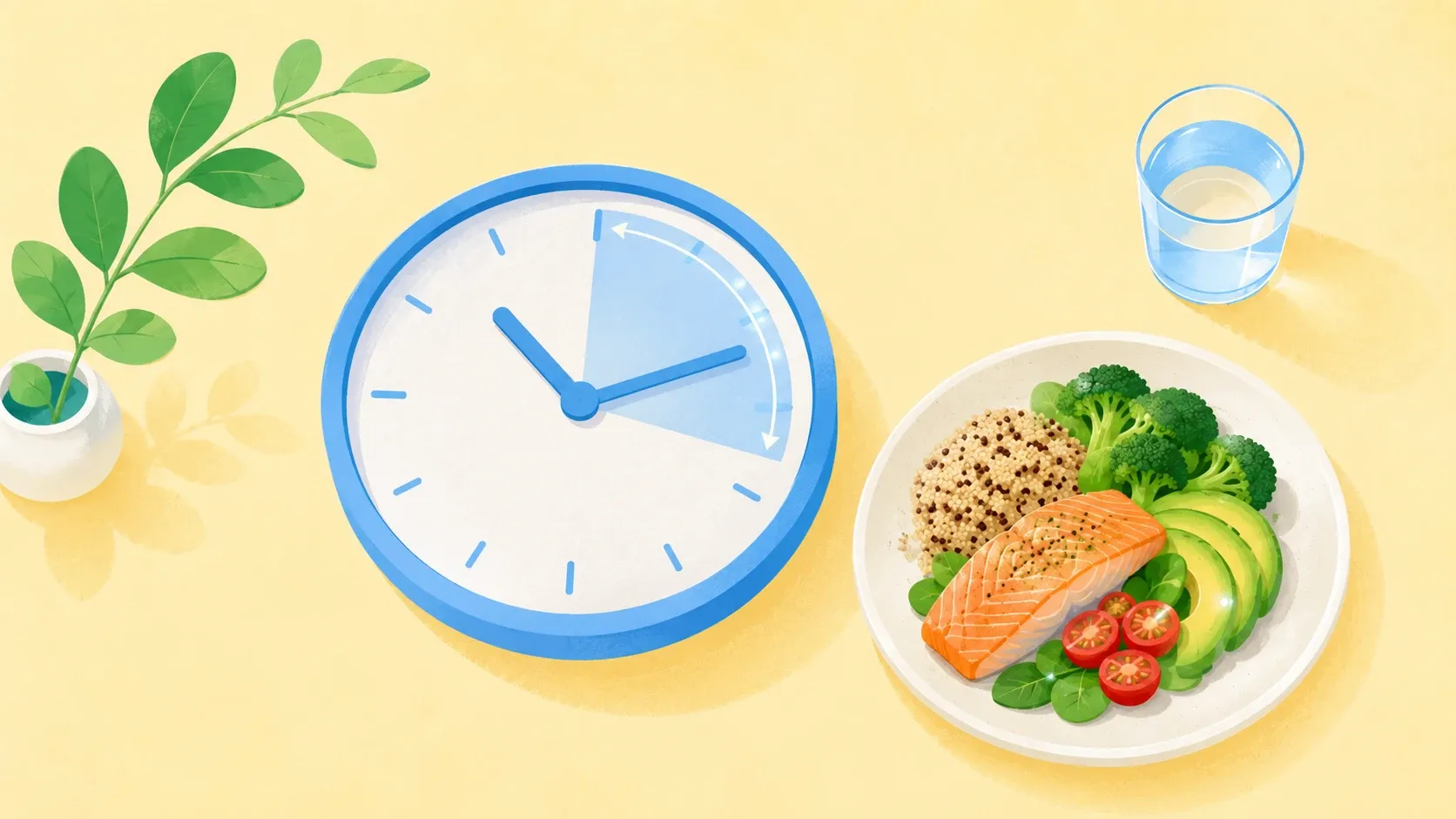

Intermittent fasting is one of the most popular ways to eat right now, and the basic idea is simpler than the hype suggests: instead of changing what you eat, you change when you eat. You pick a daily or weekly window for eating and fast the rest of the time. That is the whole concept.
The honest version most headlines leave out is this: intermittent fasting is not a magic fat-burning switch. It helps mostly by making a calorie deficit easier to keep up, because fewer eating hours and a simpler structure tend to mean you eat less overall. This guide explains what intermittent fasting is, how the popular methods work, what the research actually shows, how to start, and who should skip it.
What intermittent fasting actually is
Intermittent fasting (often shortened to IF) is an eating pattern that cycles between periods of eating and periods of voluntary fasting. It does not tell you which foods to eat or forbid; it tells you when to eat them. In that sense it is closer to a schedule than to a traditional diet.
During the fasting window you take in no calories. Water, black coffee, and plain unsweetened tea are fine, because they have essentially none. The eating window is when all your meals and snacks happen.
There is real biology behind the appeal. After a meal, your body runs mostly on glucose, and it stores spare carbohydrate in the liver. When you go several hours without food, those liver stores run down and your body shifts toward burning fat for fuel, releasing ketones in the process. In their New England Journal of Medicine review, researchers Rafael de Cabo and Mark Mattson describe how ketone levels in humans rise within 8 to 12 hours after the onset of fasting, with liver glycogen depletion and the switch toward fat-derived fuel setting in after roughly 10 to 14 hours without food (de Cabo and Mattson, 2019).
That “metabolic switch” is genuinely interesting, and it is the basis for claims that fasting does something special. But as the same review is careful to note, the health benefits of intermittent fasting are not simply the result of weight loss, and for the practical goal of losing weight, the schedule mostly matters because of how it changes your total intake. We will come back to that honesty below.
The popular methods: 16:8, 5:2, and eat-stop-eat
Most people who try intermittent fasting use one of three patterns. They differ in how long and how often you fast, not in any deeper way. The same NEJM review identifies daily time-restricted eating, 5:2, and alternate-day fasting as the three most-studied regimens (de Cabo and Mattson, 2019).
| Method | How it works | Fasting load | Best for |
|---|---|---|---|
| 16:8 (time-restricted eating) | Eat within an 8-hour window each day, fast the other 16 hours (often noon to 8 PM) | Daily, moderate | Beginners; people who want a simple everyday rhythm |
| 5:2 | Eat normally 5 days a week; on 2 non-consecutive days, cut to about 500 to 700 calories | 2 low-calorie days per week | People who would rather not restrict every day |
| Eat-stop-eat | One or two full 24-hour fasts per week (for example dinner to dinner), eating normally otherwise | 1 to 2 full-day fasts per week | More experienced fasters comfortable with longer fasts |
A few notes on the table. With 16:8, the eating window is the headline, but in practice it usually just means skipping breakfast and not snacking after dinner. The 8-hour window is flexible: noon to 8 PM and 10 AM to 6 PM work equally well, so pick whichever fits your life. This is the version most beginners start with, and it is the one tested in much of the recent research.
With 5:2, you eat normally five days a week and drop to a very low intake on two separate days. The roughly 500-to-700-calorie figure for those days comes straight from the fasting literature (de Cabo and Mattson, 2019). The appeal is that most days feel unrestricted.
Eat-stop-eat uses occasional full 24-hour fasts, which is the same idea as alternate-day approaches but less frequent. It demands the most comfort with hunger and is not where a beginner should start.
Does intermittent fasting actually work?
Here is the part to be honest about, because it is where most marketing oversells.
Intermittent fasting can absolutely help you lose weight, but not because the fasting itself melts fat in some unique way. It works for the same reason any successful approach works: it helps you take in fewer calories than you burn, which is the actual mechanism behind weight loss (our guide on what a calorie deficit is walks through this). A shorter eating window and a simpler set of rules just make that deficit easier to reach and maintain. Many people naturally eat less when two of their daily eating hours are off the table.
The clearest way to see this is to compare fasting head-to-head with plain daily calorie cutting, with calories matched. When researchers do that, the two come out about even:
- A 2018 systematic review and meta-analysis in the Journal of Translational Medicine pooled 11 randomized controlled trials covering 528 people who completed the studies. It found comparable weight loss between intermittent and continuous calorie restriction, with a pooled difference of about 0.6 kg that was not statistically significant (Cioffi et al., 2018).
- A separate meta-analysis in Nutrients, looking only at trials lasting at least six months, reached the same verdict: intermittent energy restriction is not superior to continuous restriction, but it is just as effective, with no significant difference between the two (Headland et al., 2016).
A well-known individual trial drives the point home. In the TREAT randomized clinical trial, published in JAMA Internal Medicine, 116 adults with overweight or obesity were assigned to either a 16:8 time-restricted schedule (eating only between noon and 8 PM) or a control group eating three structured meals a day, for 12 weeks. The time-restricted group lost a small amount of weight, but the difference versus the control group was not significant (a between-group difference of about -0.26 kg, 95% confidence interval -1.30 to 0.78). The authors also flagged that a large share of the weight the fasting group lost came from lean mass rather than fat (Lowe et al., 2020).
The takeaway is not that intermittent fasting is useless. For many people it is a genuinely useful structure. The takeaway is that it is one way to create a calorie deficit, not a shortcut around one. If a shorter eating window helps you eat less without feeling deprived, it will work. If you simply eat the same amount (or more) in your window, the clock does nothing. For a deeper comparison, see our companion piece on intermittent fasting versus calorie counting.
Benefits and limits
Beyond the calorie angle, fasting research has explored effects on insulin sensitivity, blood pressure, and other markers, and the de Cabo and Mattson review summarizes evidence that fasting regimens can improve glucose regulation and reduce some cardiometabolic risk factors (de Cabo and Mattson, 2019). Much of that evidence is still early, often comes from short studies, and some of it is hard to separate from the weight loss itself. So it is fair to say fasting may offer metabolic benefits, while being honest that the strongest, most consistent benefit for most people is simpler structure around eating.
The practical upsides people report are worth naming, because they are the real reason fasting sticks for some and not others:
- Fewer decisions. Cutting out a meal or two removes a chunk of daily food choices, which some people find freeing.
- A clear rule. “Don’t eat before noon” is easier to follow than “eat a little less of everything.”
- No food is banned. You are changing timing, not cutting out food groups.
The limits are just as real:
- It can backfire if your window turns into a binge. A shorter eating window does not help if you overeat to compensate.
- Hunger, headaches, and low energy are common in the first week or two while you adjust.
- Some of the weight lost can be muscle, as the TREAT trial showed, which is one more reason to keep protein high (see how much protein you need a day) and do some strength training.
- It is not for everyone, which the next section covers.
How to start intermittent fasting
If you have decided to try it, start gently. There is no need to jump straight to long fasts.
- Begin with 16:8, and ease into it. Push your first meal an hour or two later than usual and stop eating after dinner. If you currently eat from 8 AM to 9 PM, try 10 AM to 7 PM first, then stretch the window over a week or two until you reach roughly 16 hours of fasting.
- Pick a window that fits your day. If you love breakfast, make your window earlier (say 9 AM to 5 PM) and skip the late snack instead. The best schedule is the one you barely have to think about.
- Stay hydrated. Water, sparkling water, black coffee, and plain tea are your friends during the fast and blunt early hunger. Skip anything with calories, including milk in your coffee.
- Do not blow the window on junk. Fasting is not a license to eat anything you want for 8 hours. What you eat still decides whether you are in a deficit, so build meals around protein and vegetables. If you want a target number, our guide on how many calories per day and the free calorie calculator will get you a personalized estimate.
- Give it a few weeks. Early hunger usually fades as your body adjusts. Judge the experiment over a month, not a single rough morning.
For the bigger picture of building a plan that lasts, our guide on how to start losing weight ties fasting, calories, and habits together.
Who should not fast
Intermittent fasting is safe for many healthy adults, but it is genuinely not appropriate for some people, and pushing through anyway can do harm. This is the most important section in this guide.
Do not start intermittent fasting without medical guidance if any of the following apply to you:
- You are pregnant or breastfeeding. Both raise your nutritional needs, and prolonged fasting is not advised.
- You have a history of an eating disorder or disordered eating. Rigid rules around when you can and cannot eat can trigger or worsen unhealthy patterns. For many people in this situation, a structured fasting window is the wrong tool.
- You are underweight, or a child or teenager. Growing bodies and people who are already lean need consistent fuel, not restriction.
- You have diabetes or another condition managed with medication, especially insulin or other drugs that lower blood sugar. Fasting can cause dangerous drops in blood sugar unless your medication and timing are adjusted by your doctor.
- You take regular medication or have any chronic health condition. Some medicines need to be taken with food, and fasting can change how they work.
More broadly, this article is general information, not medical advice. If you have any health condition, take regular medication, or are unsure whether fasting is right for you, talk to your doctor or a registered dietitian before you begin. The honest bottom line is that fasting is one optional tool among many, and skipping it costs you nothing if it does not suit your body or your life.
Track your eating, whichever way you eat
Whether you fast or not, the thing that actually moves the needle is your overall energy balance, and the easiest way to stay aware of it is to keep a light record of what you eat. That is true inside a fasting window too: the clock controls timing, but your food controls your calories.
This is where a tool helps more than willpower. With CalcEat, you can snap a photo of your plate for a fast estimate of its calories and macros, scan a barcode, or log manually, so you can see whether your eating window is actually keeping you in a deficit instead of guessing. You can also use it to keep an eye on your eating window and your daily totals side by side. If you would like a structured starting point, our free plan builds a simple calorie and protein target around your details.
The bottom line
Intermittent fasting is a schedule, not a miracle. It can be a genuinely useful way to eat less without much fuss, and the popular methods (16:8, 5:2, and eat-stop-eat) all come down to how long and how often you fast. But the research is clear and worth repeating: when calories are matched, fasting works about as well as regular daily calorie cutting, no better and no worse. Its real strength is making a calorie deficit easier to maintain.
So if a shorter eating window helps you eat in a way you can sustain, it is a fine tool to reach for. If it makes you miserable or it does not fit your health situation, you lose nothing by eating on a normal schedule and watching your calories instead. Either way, the fundamentals win. Pick the structure you can actually keep, and let consistency do the work.