
The official answer is 20 to 35 percent of your daily calories from fat, which lands at roughly 44 to 78 grams a day on a 2,000-calorie diet. Fat is an essential nutrient, not something to fear or slash to near-zero, so the question is really about how much and which kinds. This guide turns that percentage into real grams at common calorie levels, sorts out saturated versus unsaturated, and shows you how to set a target you can actually follow.
The quick answer
The Acceptable Macronutrient Distribution Range (AMDR) for total fat, set by the National Academies’ Institute of Medicine, is 20 to 35 percent of your daily calories (Institute of Medicine). For most adults eating around 2,000 calories, that comes out to about 44 to 78 grams of fat a day.
Why a range instead of one number? Fat is calorie-dense, so the amount in grams scales with how much you eat overall. The band also reflects a balance the evidence supports: too little fat tends to push carbohydrate intake up and can shortchange nutrients you need, while too much fat crowds out other foods and adds up in calories quickly. Landing anywhere inside 20 to 35 percent is sound for general health; where you sit within it is mostly personal preference.
One thing to settle up front: fat earns its place on the plate. Your body uses it to absorb the fat-soluble vitamins A, D, E, and K, to supply essential fatty acids it cannot manufacture, and to make food taste good and keep you satisfied. The takeaway is not “eat as little as possible,” it is “hit a sensible amount and choose good sources.”
Fat in grams by calorie level
Percentages are awkward to act on, so here is the 20 to 35 percent range converted to grams at common daily calorie levels. Fat supplies about 9 calories per gram, which is why these numbers are smaller than the carb or protein equivalents.
| Daily calories | Fat at 20% (g) | Fat at 35% (g) | Saturated fat cap (under 10%) |
|---|---|---|---|
| 1,500 | 33 | 58 | under 17 g |
| 1,800 | 40 | 70 | under 20 g |
| 2,000 | 44 | 78 | under 22 g |
| 2,200 | 49 | 86 | under 24 g |
| 2,500 | 56 | 97 | under 28 g |
To read the table, find the row nearest your daily calorie target and aim for a total fat intake somewhere between the two middle columns. If you do not yet know your calorie number, our guide to how many carbs you should eat a day and our macro calculator both start from the same calorie estimate, so you can set all three macros at once.
The last column is the saturated fat ceiling, which we will unpack next. Notice it is a limit, not a target you need to reach: less is fine.
Saturated vs unsaturated fat, and the limits
All fats are not the same, and this is where the “which kind” question matters more than the total.
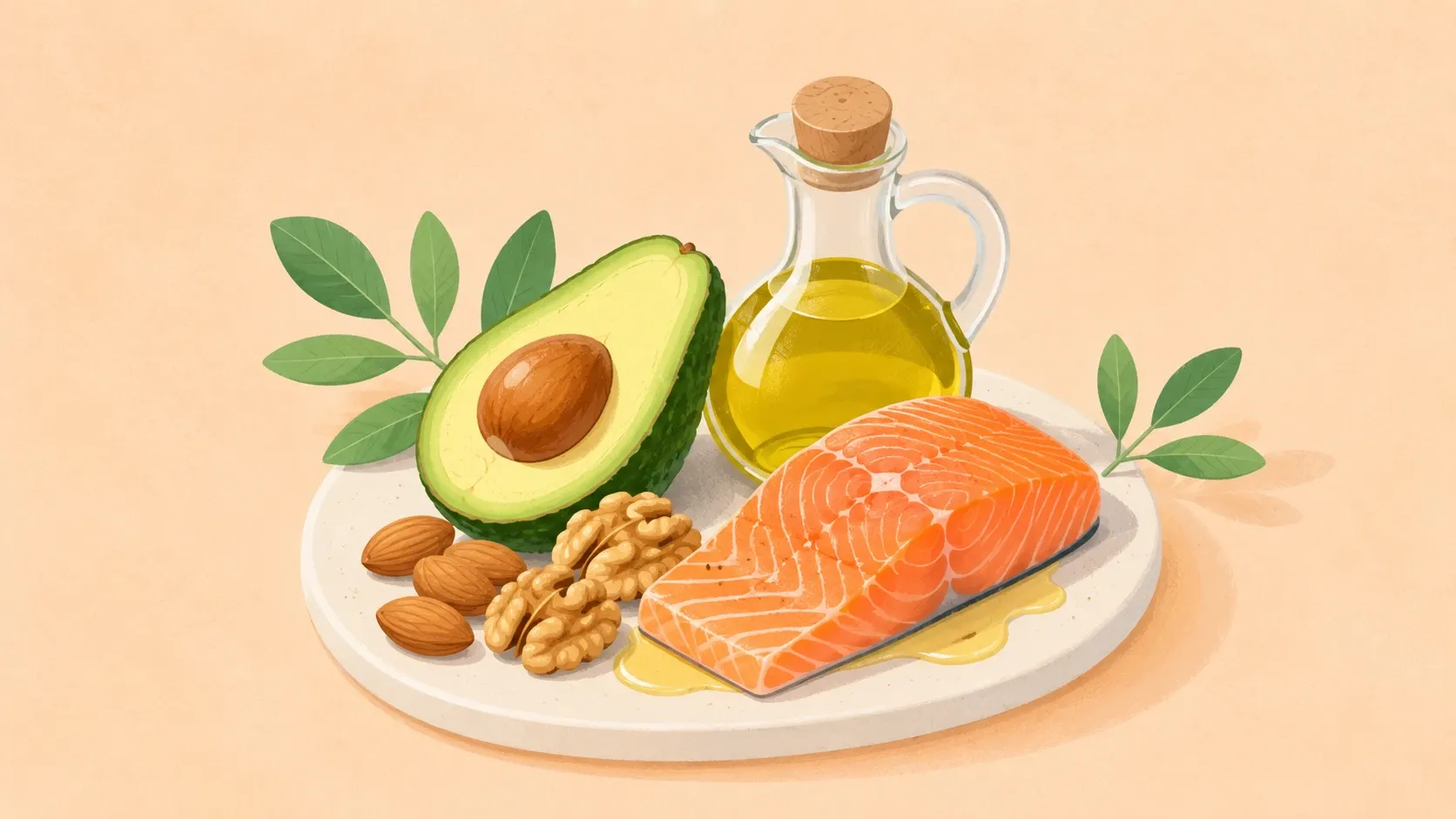
Unsaturated fats are the ones to favor. These are the monounsaturated and polyunsaturated fats found in olive and other non-tropical vegetable oils, avocados, nuts, seeds, and fatty fish like salmon and sardines. Most of your fat intake can comfortably come from this group.
Saturated fat is the one to cap. It shows up mainly in fatty cuts of meat, butter, full-fat dairy, and tropical oils like coconut and palm. The 2025–2030 Dietary Guidelines for Americans keep the long-standing cap: saturated fat should generally stay under 10 percent of your daily calories (Dietary Guidelines for Americans, 2025–2030; USDA Dietary Data Brief). On a 2,000-calorie diet that is about 22 grams. Where the new edition breaks with earlier ones is the swap: it lists butter and beef tallow as cooking options and recommends full-fat dairy. The American Heart Association takes a different line. It still advises replacing foods high in saturated fat with ones rich in unsaturated fat, citing trials in which switching to polyunsaturated vegetable oil cut cardiovascular disease by about 30 percent, and after the new guidelines came out it urged people to keep choosing low-fat dairy and to limit butter and tallow (Sacks et al., 2017; AHA, 2026).
If you are focused on heart health, aim lower. The American Heart Association suggests a dietary pattern with less than 6 percent of total calories from saturated fat for people who would benefit from further lowering their LDL (“bad”) cholesterol, which works out to roughly 13 grams on a 2,000-calorie day (American Heart Association). That is a stricter goal than the general 10 percent ceiling, and it is most relevant if you are managing cholesterol.
A practical way to picture it: keep your total fat in the 20 to 35 percent band, and within that total, lean on unsaturated sources so saturated fat naturally stays under the cap. You do not need to weigh out saturated grams daily; shifting the mix toward fish, nuts, seeds, and olive oil does most of the work.
For the bigger picture on how fat fits alongside protein and carbs, see What Are Macros? and the hub on Macros and Protein.
Fat on a weight-loss diet
A common myth is that losing weight means eating very little fat. It does not. What drives fat loss is an overall calorie deficit, and you can run that deficit while keeping fat in the same 20 to 35 percent range, just calculated from your lower calorie target.
Here is how that looks. Say you drop from a 2,200-calorie maintenance level to an 1,800-calorie cut. Your fat target moves with the calories: instead of about 49 to 86 grams, you would aim for roughly 40 to 70 grams a day. The percentage stays put; the grams come down because total calories came down.
There are good reasons not to slash fat further than that. Fat is the most satiating per bite for many people and carries a lot of flavor, so meals that are too lean often feel unsatisfying, which makes a deficit harder to stick to. Cutting fat to the floor also makes it tougher to absorb fat-soluble vitamins. If you want to trim calories, it is usually smarter to pull a bit from each macro, or to focus on portions and food choices, rather than driving fat down to near-zero.
If weight loss is your goal, the macro-specific playbook lives in Macros for Weight Loss, and you may want to read the protein side of the equation in How Much Protein Do You Need a Day?, since adequate protein is what protects muscle while you lose fat.
How to set your fat target
You have two routes: do the quick math, or let a tool do it.
The math. Take your daily calorie target, multiply by 0.20 and by 0.35, then divide each result by 9 (the calories in a gram of fat). That gives you the low and high ends of your personal fat range in grams. For example, at 2,000 calories: 2,000 times 0.20 is 400 calories, or about 44 grams, and 2,000 times 0.35 is 700 calories, or about 78 grams. That is your range, and the midpoint of about 56 grams is a sensible number.
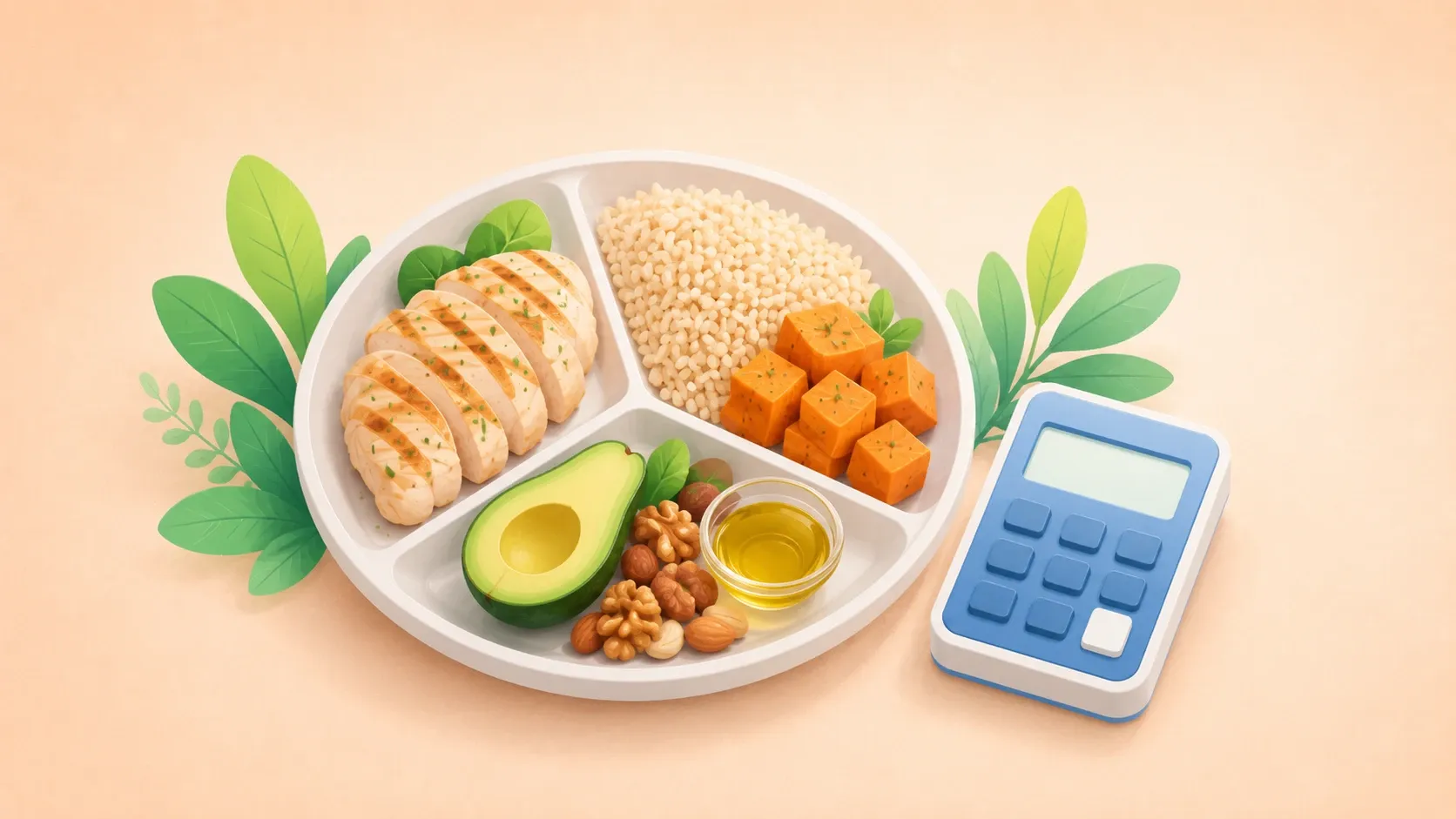
The calculator. If you would rather skip the arithmetic, our free macro calculator does it for you. Enter your details and goal, and it estimates your calories, then splits them into protein, fat, and carbs, putting fat at a balanced 25 percent of calories by default. It is the fastest way to turn “20 to 35 percent” into a concrete gram number for your body and goal. To go further and get a full daily plan built around those numbers, you can get a free plan in a couple of minutes.
Once you have a target, the trick is hitting it without obsessing:
- Build meals around whole-food fats. A drizzle of olive oil, half an avocado, a small handful of nuts, or a portion of salmon covers a lot of ground while keeping the fat mostly unsaturated.
- Watch the hidden sources. Much of the saturated fat people overshoot on comes from fatty meat, cheese, butter, and baked goods rather than the fats they add on purpose. Trimming those is usually where the easy wins are.
- Track it for a week or two. You do not have to count forever, but logging long enough to see what your meals actually contain is eye-opening. The free CalcEat app lets you snap a photo of your plate to estimate fat and calories, scan barcodes for exact label values, or log manually, which takes the guesswork out of seeing whether you are in your range.
If macro tracking is new to you, How to Count Macros walks through setting your numbers and following them without it taking over your life. And if you are building meals to hit protein at the same time, High-Protein Foods lists options with the calories and protein per serving so the two targets line up.
The bottom line
Aim for 20 to 35 percent of your calories from fat, which is roughly 44 to 78 grams a day at 2,000 calories, and let unsaturated sources carry most of that so saturated fat stays under 10 percent (or under about 6 percent if you are managing cholesterol). Do not fear fat or cut it to the floor: it is essential, satisfying, and helps you absorb key vitamins. Find your calorie level, run the simple math or let the calculator do it, and pick mostly whole-food fats. That is genuinely all it takes to get this macro right.