Protein is the one macronutrient almost everyone could use a little more of, whether the goal is losing weight, building muscle, or just not feeling hungry an hour after lunch. The catch is figuring out which foods actually deliver, and how many calories come along for the ride. This guide gives you 40-plus high-protein foods with verified calories and protein per serving, organized so you can build a plate that fits your goals.
Why protein matters
Protein does a lot of quiet work in the background, and three benefits stand out if you are trying to manage your weight or eat better.
It keeps you full
Protein is the most filling of the three macronutrients, calorie for calorie. It blunts appetite, helps you feel satisfied sooner, and tends to keep hunger away longer than the same calories of carbs or fat. Reviews of controlled feeding studies consistently find that higher-protein meals raise fullness and often lead people to eat less later in the day (Paddon-Jones et al., 2008). That makes protein a quiet ally for eating less without feeling deprived.
It helps protect muscle while you lose fat
When you eat in a calorie deficit, your body can break down muscle along with fat. Eating enough protein helps push that balance toward keeping the muscle. A major review in the American Journal of Clinical Nutrition found that, compared with lower-protein diets, higher-protein energy-restricted diets led to greater fat loss and better preservation of lean mass (Leidy et al., 2015). Holding on to muscle also helps keep your metabolism steadier as the weight comes off.
It costs more energy to digest
Your body burns calories just digesting and processing food, an effect called the thermic effect of food. Protein has the highest thermic effect of the macronutrients, so a meaningful slice of its calories is used up simply handling it. The effect is modest, not magic, but it is one more small reason protein earns its place on the plate.
How much protein you actually need
The official baseline, the Recommended Dietary Allowance, is 0.8 grams of protein per kilogram of body weight per day. That works out to roughly 55 grams for a 150-pound person, and it represents the minimum to avoid deficiency rather than an optimal target.
Many people benefit from aiming higher. The National Academies put the acceptable range for protein at 10 to 35 percent of daily calories (Institute of Medicine), the 2025–2030 Dietary Guidelines for Americans set an everyday goal of 1.2 to 1.6 grams per kilogram (Dietary Guidelines for Americans, 2025–2030), and a good deal of research points to that same range for supporting fullness and protecting muscle, especially during weight loss (Leidy et al., 2015). A practical approach: include a solid protein source at every meal and spread your intake across the day rather than loading it all at dinner.
One quick note on quality. Animal proteins are “complete,” meaning they contain all nine essential amino acids your body cannot make. Most single plant foods are lower in one or more, so plant-focused eaters simply eat a variety, which covers all the bases over a day (MedlinePlus).
High-protein foods with calories and protein per serving
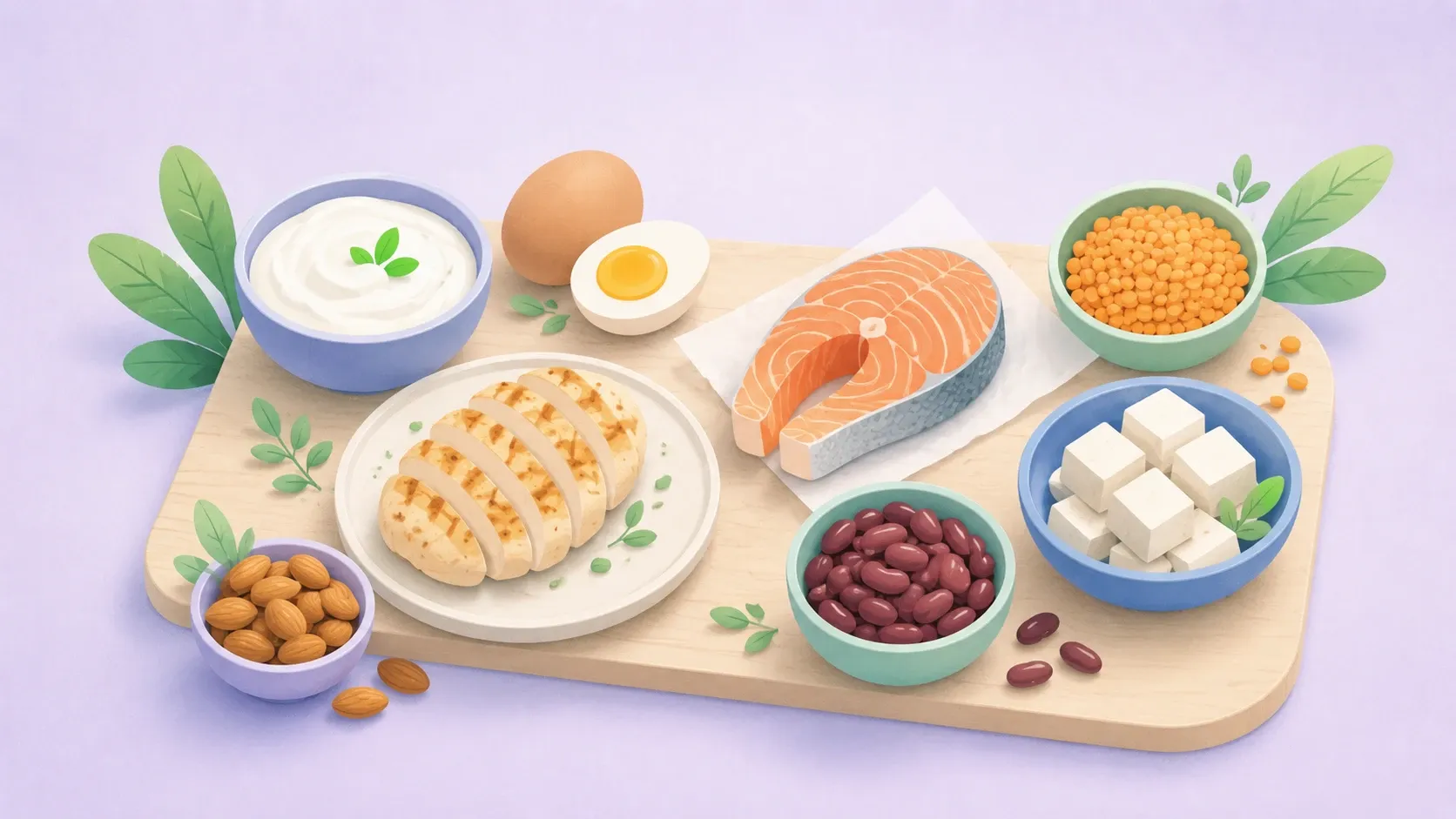
Below is a large reference table of high-protein foods grouped by type. All values are rounded figures from USDA FoodData Central and the USDA protein reference list. Exact numbers vary by cut, brand, and preparation, so treat them as close estimates. Meats and fish are listed cooked unless noted, since cooking concentrates protein into a smaller, lighter portion.
| Food | Typical serving | Approx. calories | Protein (g) |
|---|---|---|---|
| Lean meats and poultry | |||
| Chicken breast, skinless | 3 oz (85 g) cooked | About 140 | About 26 |
| Chicken thigh, skinless | 3 oz (85 g) cooked | About 150 | About 21 |
| Turkey breast, skinless | 3 oz (85 g) cooked | About 125 | About 26 |
| Ground turkey, 93% lean | 3 oz (85 g) cooked | About 170 | About 22 |
| Ground beef, 90% lean | 3 oz (85 g) cooked | About 180 | About 22 |
| Beef sirloin, lean | 3 oz (85 g) cooked | About 160 | About 26 |
| Pork loin, lean | 3 oz (85 g) cooked | About 160 | About 24 |
| Pork tenderloin | 3 oz (85 g) cooked | About 125 | About 22 |
| Fish and seafood | |||
| Salmon, Atlantic | 3 oz (85 g) cooked | About 155 | About 22 |
| Tuna, light, canned in water | 3 oz (85 g) drained | About 100 | About 18 |
| Salmon, pink, canned | 3 oz (85 g) drained | About 90 | About 20 |
| Shrimp | 3 oz (85 g) cooked | About 85 | About 20 |
| Cod | 3 oz (85 g) cooked | About 90 | About 19 |
| Tilapia | 3 oz (85 g) cooked | About 110 | About 23 |
| Sardines, canned in oil | 3 oz (85 g) drained | About 180 | About 21 |
| Eggs and dairy | |||
| Egg, whole | 1 large | About 78 | About 6 |
| Egg whites | 3 large | About 50 | About 11 |
| Greek yogurt, plain nonfat | 1 container (170 g) | About 120 | About 17 |
| Cottage cheese, 1% lowfat | 1 cup (226 g) | About 165 | About 28 |
| Milk, 1% lowfat | 1 cup (240 ml) | About 100 | About 8 |
| Cheddar cheese | 1 oz (28 g) | About 115 | About 7 |
| Mozzarella, part-skim | 1 oz (28 g) | About 85 | About 7 |
| Whey protein powder | 1 scoop (about 30 g) | About 120 | About 25 |
| Legumes and soy | |||
| Lentils | 1 cup (about 198 g) cooked | About 230 | About 18 |
| Black beans | 1 cup (about 172 g) cooked | About 227 | About 15 |
| Chickpeas (garbanzos) | 1 cup (about 164 g) cooked | About 269 | About 15 |
| Kidney beans | 1 cup (about 177 g) cooked | About 225 | About 15 |
| Edamame | 1/2 cup (about 78 g) cooked | About 110 | About 9 |
| Tofu, firm | 3 oz (85 g) | About 125 | About 15 |
| Tempeh | 3 oz (85 g) | About 160 | About 17 |
| Soy milk, unsweetened | 1 cup (240 ml) | About 80 | About 7 |
| Other plant proteins | |||
| Quinoa | 1 cup (185 g) cooked | About 222 | About 8 |
| Peanut butter | 2 tbsp (32 g) | About 190 | About 8 |
| Almonds | 1 oz (28 g) | About 164 | About 6 |
| Pumpkin seeds | 1 oz (28 g) | About 160 | About 9 |
| Peanuts | 1 oz (28 g) | About 165 | About 7 |
| Oats | 1/2 cup dry (40 g) | About 150 | About 5 |
| High-protein snacks | |||
| Hard-boiled egg | 1 large | About 78 | About 6 |
| String cheese | 1 stick (28 g) | About 80 | About 7 |
| Beef or turkey jerky | 1 oz (28 g) | About 115 | About 9 |
| Roasted chickpeas | 1/4 cup (about 40 g) | About 120 | About 6 |
| Tuna pouch | 1 pouch (74 g) | About 70 | About 16 |
| Edamame, in pod | 1/2 cup shelled | About 110 | About 9 |
That is more than 40 options spanning every food group, which means there is a high-protein choice for almost any meal, budget, or dietary preference.
Lean meats and poultry
Poultry and lean cuts of beef and pork are the most protein-dense foods on the list per serving. Skinless chicken breast is the classic, with about 26 grams of protein in a 3-ounce cooked portion for roughly 140 calories. Choosing leaner cuts, trimming visible fat, and skipping the skin keeps the calories down while the protein stays high.
Fish and seafood
Seafood is excellent because it pairs high protein with low calories and, in fatty fish like salmon and sardines, heart-healthy omega-3 fats. Canned tuna and salmon are some of the best values around: shelf-stable, cheap, and ready to eat, with 17 to 20 grams of protein in a small can. Shrimp and white fish like cod and tilapia are especially lean, delivering plenty of protein for under 110 calories per serving.
Eggs and dairy
Eggs are a near-perfect protein, about 6 grams each, and a staple of any high-protein kitchen. Dairy punches above its weight too. Plain nonfat Greek yogurt gives you around 17 grams of protein per container, and a cup of low-fat cottage cheese delivers a remarkable 28 grams. Choosing plain, unsweetened versions keeps added sugar and calories in check. These foods also tend to be both filling and low in calories, which is why so many of them show up in our guide to low-calorie foods that keep you full.
Legumes and soy
Beans, lentils, and chickpeas are the heart of affordable, plant-based protein, bringing fiber along for the ride. A cup of cooked lentils has about 18 grams of protein and a big dose of fiber for around 230 calories. Soy foods are special because they are complete proteins: tofu, tempeh, and edamame all stand on their own without needing to be combined with other proteins.
Other plant proteins
Nuts, seeds, and whole grains add up over the day. They are more calorie-dense, since they carry healthy fats, so portion them as accents rather than mains. Two tablespoons of peanut butter or an ounce of almonds adds 6 to 8 grams of protein, and a cup of cooked quinoa contributes about 8 grams as a protein-boosted grain.
High-protein snacks
Snacks are where many people fall short on protein. Reaching for a hard-boiled egg, a stick of string cheese, a tuna pouch, or a handful of edamame instead of crackers or chips can easily add 7 to 16 grams of protein between meals, which helps steady your appetite until dinner.
Practical tips for hitting your protein target
Knowing the foods is half the battle. Here is how to actually get enough, whatever your situation.
On a budget
You do not need expensive powders, bars, or specialty products to eat plenty of protein. The cheapest sources are some of the best:
- Eggs and canned fish. Eggs, canned tuna, and canned salmon are inexpensive, shelf-stable, and protein-dense.
- Dried and canned legumes. Lentils, beans, chickpeas, and split peas cost very little per gram of protein and store for months.
- Buy in bulk and freeze. Family packs of chicken or lean ground beef drop the per-serving cost; portion and freeze what you will not use right away.
- Milk and plain yogurt. Dairy is one of the most economical ways to add protein to breakfast and snacks.
As a vegetarian or vegan
A plant-based diet can absolutely hit any protein target with a little planning:
- Build meals around legumes and soy. Lentils, beans, chickpeas, tofu, tempeh, edamame, and seitan should anchor your plates.
- Lean on soy for complete protein. Tofu, tempeh, edamame, and soy milk supply all the essential amino acids on their own.
- Mix it up across the day. Combine grains, legumes, nuts, and seeds over your meals so the amino acids round each other out; you do not need to combine them in the same sitting.
- Vegetarians, use eggs and dairy. Greek yogurt, cottage cheese, eggs, and milk are some of the easiest, most protein-dense additions available.
Spread it out and track it
Aim for a protein source at every meal rather than backloading it all at dinner; your body uses protein more effectively when it is spread across the day. If you are not sure where you are landing, it helps to track for a week or two. You can do this by hand, but a tool like CalcEat makes it faster: snap a photo of your plate for an estimate of calories and macros, scan a barcode, or log by hand, so you can see your daily protein add up and adjust on the fly. Pairing a protein target with the right calorie total is the real engine of fat loss, which we break down in how many calories you should eat to lose weight.
The bottom line
Protein keeps you full, helps protect your muscle while you lose fat, and even costs a few extra calories to digest, which is why building meals around it pays off. The good news is that high-protein foods are everywhere and fit any budget, from a can of tuna or a cup of lentils to a container of Greek yogurt.
Pick a few staples from the table above that you genuinely enjoy, and aim to put a protein source on your plate at every meal. That one habit, repeated, does more than any supplement. For more food-by-food breakdowns and practical guides, explore our Food & Calorie Guides hub. You have got this.