
If you have ever searched for the perfect macro ratio to lose weight, you have probably found a dozen different answers. The honest truth is simpler and a lot less stressful: no specific split of protein, carbs, and fat is what makes you lose weight. A calorie deficit does that. Your macros decide how good you feel and how much muscle you keep along the way.
This guide shows you how to set your macros in the right order, with example splits at a few calorie levels and a worked example you can copy. The goal is a plan that fits your life, not a ratio you have to chase.
The key principle: calories drive loss, macros make it livable
Weight loss comes down to energy balance. When you take in fewer calories than your body burns over time, your body draws on stored energy and you lose weight. That gap is a calorie deficit, and it is the engine behind every successful fat-loss plan no matter what it is called. If that idea is new to you, our explainer on what a calorie deficit is walks through the science.
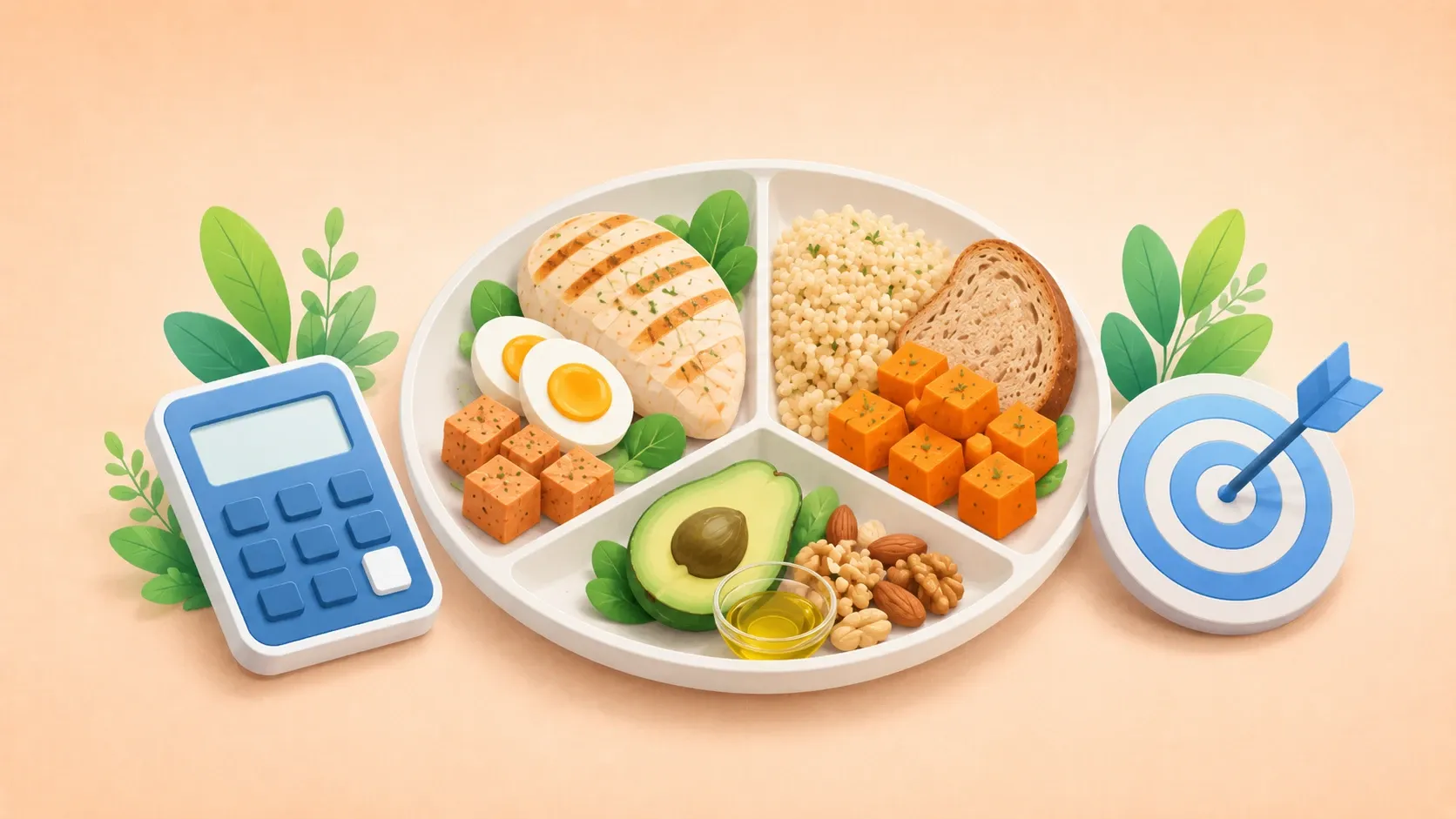
So where do macros come in? Macronutrients (protein, carbohydrate, and fat) are simply the three things in food that carry calories. Your “macros” are how those calories are split up. Changing the split does not change the law of energy balance, but it changes your experience of the diet in three big ways: how hungry you feel, how well you train, and how much of your weight loss comes from fat versus muscle.
The leading sports-nutrition consensus says it plainly. The International Society of Sports Nutrition notes that diets focused on fat loss “are driven by a sustained caloric deficit,” and that a wide range of dietary approaches, from low-fat to low-carbohydrate, can be similarly effective for improving body composition (Aragon et al., 2017). In other words, the deficit is the cause, and the macro split is a tool for comfort and results.
That reframes the whole task. You are not hunting for a magic ratio. You are setting calories first, then arranging your macros so the deficit is something you can actually stick to.
The official ranges (and why they leave room to choose)
National nutrition guidelines do not prescribe one ratio either. They give broad ranges. The Acceptable Macronutrient Distribution Ranges from the National Academies are 45 to 65 percent of calories from carbohydrate, 20 to 35 percent from fat, and 10 to 35 percent from protein (Institute of Medicine).
Notice how wide those windows are. They are designed to support good nutrition across many different eating patterns, not to point at a single perfect number. That is your permission slip to build a split around your preferences and goals rather than someone else’s rulebook.
For fat loss specifically, we will aim toward the higher end of the protein range, set a sensible fat floor, and let carbs fill the rest. Here is the step-by-step.
Step 1: Set your calories in a deficit
Everything starts with your calorie target, because that is the number that actually moves the scale. First estimate your maintenance calories (the amount that keeps your weight steady), then subtract a moderate amount to create your deficit.
A practical deficit for most people is about 300 to 500 calories per day below maintenance, which tends to produce a steady loss of roughly 0.5 to 1 pound (about 0.25 to 0.5 kg) per week. Bigger is not better here: very aggressive cuts are harder to sustain and tend to cost you more muscle. For a full walkthrough of finding your maintenance level and choosing a deficit, see our guide on how many calories you should eat to lose weight.
Lock in that calorie number before you touch the macros. The macros are how you spend that calorie budget wisely.
Step 2: Set protein high to keep muscle and stay full
Protein is the macro that earns its keep during weight loss, so set it before anything else.
Two things make protein special in a deficit. First, it protects muscle. When you eat in a deficit, your body can break down lean tissue along with fat, but a higher protein intake helps shift more of the loss toward fat and preserve the muscle you have. The ISSN reports that higher protein intakes (in the range of 2.3 to 3.1 grams per kilogram of fat-free mass) may be required to maximize muscle retention in lean, resistance-trained people during a calorie deficit (Aragon et al., 2017). Keeping muscle matters for strength, shape, and metabolism.
Second, protein helps with hunger. It is the most filling of the three macronutrients and has the highest “thermic effect,” meaning your body burns a bit more energy digesting it. A critical review concluded there is convincing evidence that higher protein intake increases thermogenesis and satiety compared with lower-protein diets (Halton and Hu, 2004). A diet that keeps you fuller is a diet you can keep.
How much should you aim for? The baseline protein RDA for the general population is just 0.8 grams per kilogram of body weight, but that figure is the minimum to prevent deficiency, not the target for someone losing fat and training (Institute of Medicine RDA). For weight loss with some activity, a widely used evidence-based target is roughly 1.6 to 2.2 grams per kilogram of body weight per day (about 0.7 to 1.0 gram per pound). For most exercising adults, the ISSN considers a daily intake of 1.4 to 2.0 grams per kilogram sufficient to build and maintain muscle, and the higher end is sensible while dieting (Jäger et al., 2017).
One practical note: if you carry a lot of body fat, basing protein on your total weight can produce an unnecessarily large number. Using a goal weight or an estimate of your lean weight keeps the target reasonable. For a deeper look at choosing your number, see how much protein you need a day.
Step 3: Set fat to a sensible minimum
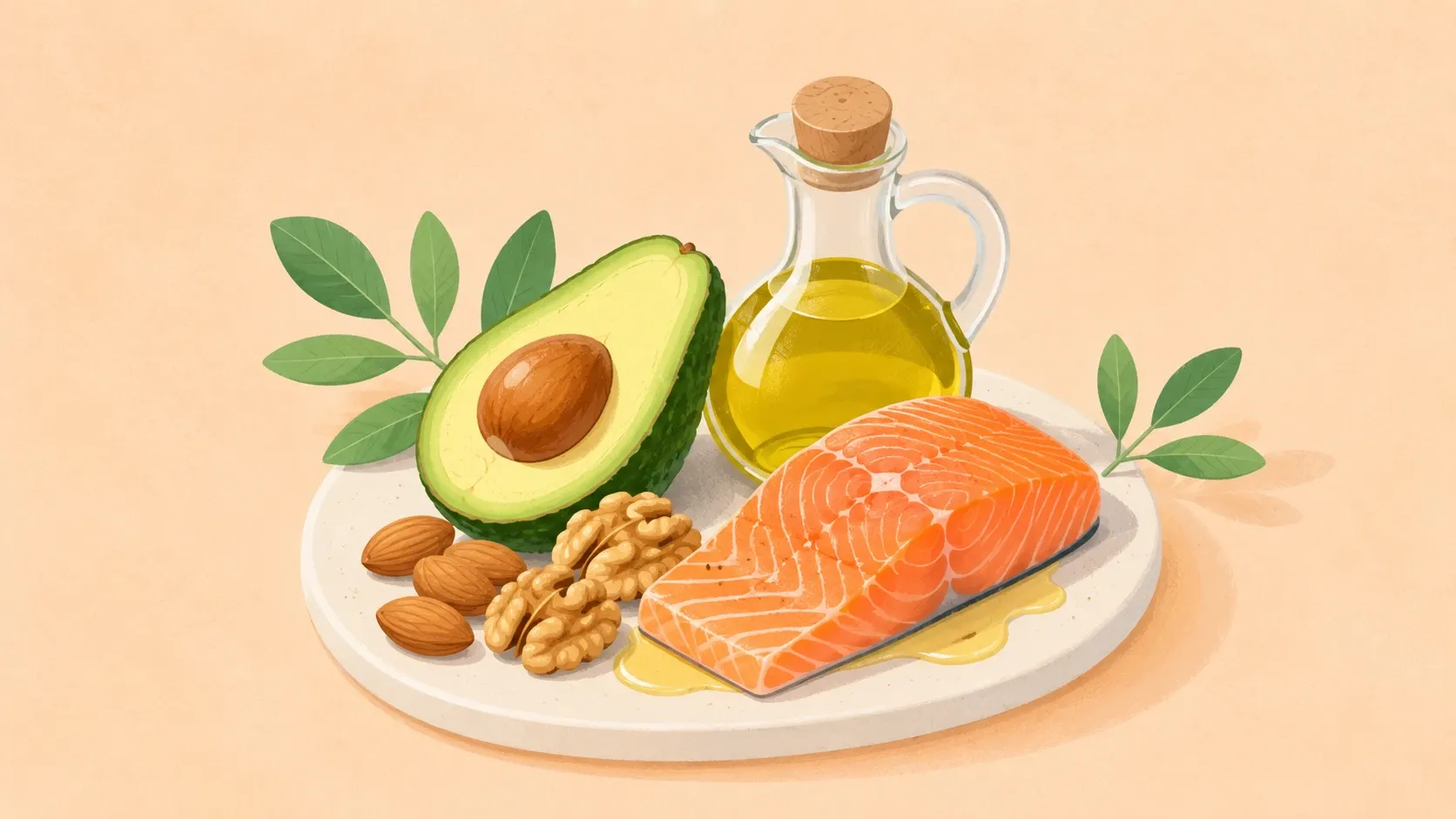
Fat is not the enemy, and you should not drive it too low. Dietary fat supplies the essential fatty acids your body cannot make on its own and helps you absorb certain vitamins (MedlinePlus). Fat also makes food taste good and helps meals feel satisfying, which supports adherence.
A reasonable approach is to set fat at roughly 20 to 35 percent of your calories, in line with the official range, and treat the lower part of that band as a floor you do not dip under for long. In gram terms, many people do well anchoring fat around 0.5 to 0.8 grams per kilogram of body weight per day, then checking that the result still lands inside the percentage band above. Within that window, exactly where you land is mostly preference.
The point is balance: enough fat to stay healthy and satisfied, without letting it crowd out the protein and carbs that fuel your day.
Step 4: Fill the rest with carbs
Carbohydrates get the budget that is left after protein and fat are set. Carbs are your body’s most convenient fuel, especially for harder workouts, and they tend to make a diet easier to stick with because they show up in so many everyday foods.
To find your carb number, subtract your protein and fat calories from your total, then divide what remains by four (since carbohydrate has about 4 calories per gram, the same as protein; fat has about 9). Whatever is left is your carb target. There is no need to fear it. Carbs do not uniquely cause fat gain; only a calorie surplus does that. Inside a deficit, a generous carb allowance can make training and daily energy feel a lot better.
If you train hard or feel drained on lower carbs, lean toward more carbs and slightly less fat. If you feel better on fewer carbs, do the reverse. Protein stays put either way.
Example macro splits at a few calorie levels
Here is how those four steps play out at different calorie targets. These examples use a protein anchor of about 1.8 grams per kilogram for a 70 kg (about 154 lb) person (roughly 130 grams), a moderate fat level, and carbs filling the remainder. Treat them as starting points to adjust, not prescriptions.
| Daily calories | Protein | Fat | Carbs | Rough % split (P / F / C) |
|---|---|---|---|---|
| 1,500 cal | 130 g | 50 g | 135 g | 35% / 30% / 35% |
| 1,800 cal | 135 g | 60 g | 185 g | 30% / 30% / 40% |
| 2,000 cal | 140 g | 65 g | 215 g | 28% / 29% / 43% |
| 2,200 cal | 145 g | 70 g | 250 g | 26% / 29% / 45% |
A few things stand out. Protein stays high and fairly steady across every level, because the muscle and hunger benefits do not change with your calorie budget. Fat sits in a sensible band. Carbs do most of the flexing as calories rise. Protein and fat sit inside the official AMDR windows in every row. Carbs land at or just below the 45 percent floor, which is simply what happens when protein is set high inside a smaller calorie budget, and it shows how much room you have to personalize.
A worked example
Say you are a 70 kg (154 lb) person, moderately active, and your maintenance is about 2,300 calories. You choose a 400-calorie deficit, giving a target of 1,900 calories per day.
- Calories: 1,900 per day.
- Protein: 1.8 g/kg of 70 kg is about 126 grams. Round to 130 grams. At 4 calories per gram, that is 520 calories.
- Fat: Aim for around 0.8 g/kg, about 56 grams. Round to 60 grams. At 9 calories per gram, that is 540 calories.
- Carbs: 1,900 minus 520 minus 540 leaves 840 calories for carbs. Divide by 4 to get 210 grams.
Your targets: roughly 130 g protein, 60 g fat, 210 g carbs. That works out to about 27 percent protein, 28 percent fat, and 44 percent carbs, so protein and fat sit inside the official ranges while carbs land just under the 45 percent floor, with protein high enough to protect muscle and keep you full.
Why “protein first, then preference” beats chasing a ratio
Once your calories are set and your protein is high, the carb-to-fat balance is largely a matter of what you enjoy and what helps you stay consistent. This is the freeing part of macro setting.
Research backs this up. Studies and reviews consistently find that low-fat and low-carb diets produce similar fat loss when calories and protein are matched. So the “best” balance is the one you can follow. Love bread, rice, and fruit? Run higher carbs. Prefer richer, more satisfying meals? Nudge fat up and carbs down. Neither choice is more virtuous, and neither is faster, as long as your calorie deficit and protein hold.
Chasing a perfect ratio tends to add stress without adding results. Anchoring protein and then choosing the rest by preference gives you most of the benefit with far less fuss.
Flexible versus strict approaches
There is more than one way to hit your macros, and you can pick the level of structure that suits you.
A flexible approach (sometimes called “if it fits your macros”) means no foods are off-limits as long as your daily totals land near your targets. It is convenient, sustainable, and works well for social eaters. The trade-off is that you still need a basic sense of portions, and “flexible” does not mean filling up on low-nutrition foods.
A stricter approach leans on a more repeatable set of meals and tighter tracking. It removes decision fatigue and can sharpen results when you are close to a goal, but it asks for more effort and can feel limiting over time.
Most people do best somewhere in the middle: a consistent, protein-forward template for everyday meals, with flexibility built in for the rest. Whichever you choose, the mechanics of tracking are the same, and our guide on how to count macros covers them in detail.
Adjusting as you go
Your first macro targets are a starting point, not a verdict. Bodies and routines change, so plan to adjust.
- Track your trend, not the daily blips. Weight bounces day to day from water and food volume. Judge progress over two to four weeks.
- If loss stalls for a few weeks, the usual fix is a small calorie trim (often from carbs or fat, never protein) or a bit more daily movement. Keep changes modest.
- If you feel wrecked, add carbs back around training, make sure fat is not too low, and confirm you are sleeping enough. Misery is a sign to adjust, not to push harder.
- Keep protein steady through all of it. It is the anchor that protects your muscle and appetite while everything else flexes.
Small, evidence-led tweaks will carry you much further than dramatic overhauls.
The bottom line
Setting macros for weight loss is far simpler than the internet makes it sound. Put your calories in a moderate deficit, set protein high to protect muscle and curb hunger, give fat a sensible floor, and let carbs fuel the rest. There is no magic ratio to find, only a livable plan to build.
From there, consistency does the heavy lifting. Track your trend, adjust gently, and keep protein steady, and the numbers start working for you instead of against you. When you are ready to turn these targets into daily habits, our guide on how to count macros shows you exactly how, and an app like CalcEat can snap a photo of your plate to estimate calories and macros in seconds, so staying on target takes moments rather than spreadsheets. You have got this.