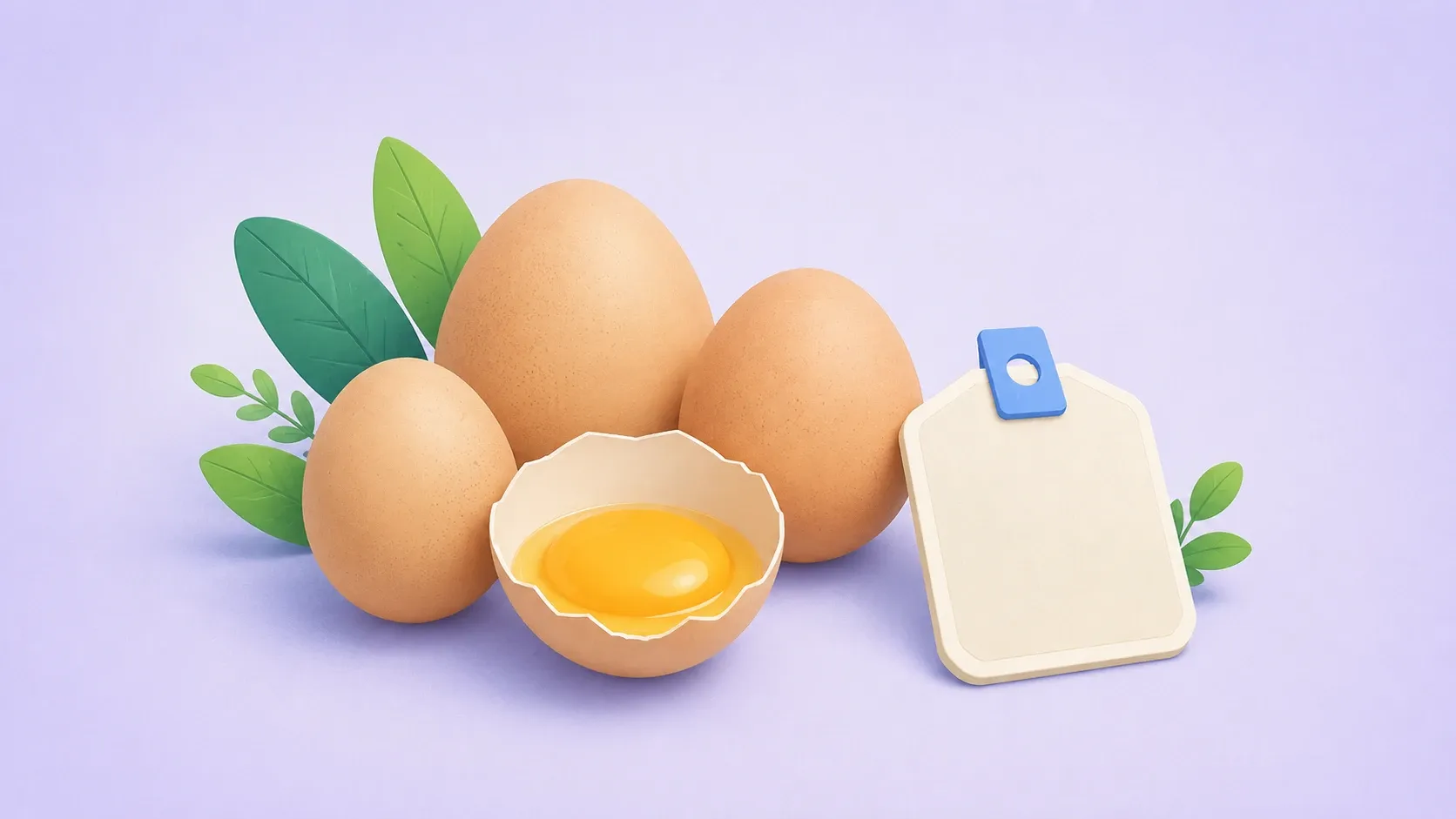

One large egg has about 72 calories, along with roughly 6.3 grams of protein and 4.8 grams of fat, according to USDA FoodData Central. That makes eggs one of the most protein-dense, low-calorie foods you can keep in the fridge. The exact number shifts with egg size and how you cook it, so here is the full picture.
The quick answer: calories in an egg
The calories in an egg come almost entirely from the egg itself, not from cooking, as long as you do not add fat. A standard large egg weighs about 50 grams and delivers around 72 calories. Most of those calories sit in the yolk, which carries all of the fat, while the white is mostly protein and water.
Here is how the macros break down for one large raw egg:
- Calories: about 72 kcal
- Protein: about 6.3 g
- Fat: about 4.8 g
- Carbohydrate: about 0.4 g (essentially none)
Because eggs have almost no carbohydrate, they fit easily into nearly every eating style, from higher-protein plans to lower-carb ones. And at roughly 72 calories for 6 grams of protein, an egg gives you a lot of nutrition for a small calorie cost.
Calories by egg size
Not all eggs are the same size, and the difference adds up if you eat them often. The USDA lists standard weights for each size grade, and since the nutrition scales with weight, you can read the calories straight off the carton.
The table below uses the USDA per-100-gram values for whole raw egg (143 calories, 12.56 g protein, 9.51 g fat) applied to each standard egg weight.
| Egg size | Weight (no shell) | Calories | Protein | Fat |
|---|---|---|---|---|
| Small | about 38 g | about 54 | 4.8 g | 3.6 g |
| Medium | about 44 g | about 63 | 5.5 g | 4.2 g |
| Large | about 50 g | about 72 | 6.3 g | 4.8 g |
| Extra large | about 56 g | about 80 | 7.0 g | 5.3 g |
| Jumbo | about 63 g | about 90 | 7.9 g | 6.0 g |
The takeaway: a jumbo egg has nearly 70 percent more calories than a small one. If you are tracking carefully, it is worth knowing which size you actually buy. A two-egg breakfast can mean anything from about 108 calories (small) to about 180 calories (jumbo) before you add a single drop of oil.
If you want more reference numbers like these for everyday foods, our Food and Calorie Guides hub collects them in one place.
Egg macros: protein and fat, yolk versus white
Eggs are best known as a protein food, and for good reason. A large egg gives you about 6.3 grams of complete protein, meaning it contains all nine essential amino acids your body cannot make on its own. That quality is part of why eggs are a staple on lists of high-protein foods.
People often assume all the protein lives in the white. In reality, it is split fairly evenly: a little over half is in the white and the rest is in the yolk. So if you toss the yolk, you keep most of the protein but not all of it.
The fat tells a cleaner story. Almost all of an egg’s fat, and most of its calories, are in the yolk. Here is the split for a large egg:
- Egg white (about 33 g): roughly 17 calories, about 3.6 g protein, essentially no fat
- Egg yolk (about 17 g): roughly 55 calories, about 2.7 g protein, about 4.5 g fat
That is why egg-white omelets are a popular trick for cutting calories while keeping protein high. Three large egg whites give you around 50 calories and nearly 11 grams of protein. The trade-off is that the yolk is where most of the good stuff lives, including vitamin D, choline, lutein, and B vitamins, so whites-only eating means giving up some nutrition along with the calories.
For most people, the whole egg is the better everyday choice. If you are chasing a high protein target on a tight calorie budget, mixing in some extra whites is a smart, simple lever.
Calories by cooking method
Here is where a lot of confusion creeps in. The egg itself does not gain or lose meaningful calories when you cook it, whether you boil, poach, fry, or scramble. What changes the number is the fat you add to the pan.
Boiling and poaching use only water, so they add essentially zero calories. A hard-boiled large egg comes in around 78 calories per USDA data, just a touch higher than raw because some water cooks off and concentrates the nutrition slightly. Frying and scrambling, on the other hand, soak up whatever butter or oil you use, and that adds up fast.
The table below shows a single large egg cooked different ways. The added-fat amounts are typical examples, not fixed rules, so adjust them to how much you actually use.
| Cooking method | What is added | Approx. calories (1 large egg) |
|---|---|---|
| Hard-boiled or soft-boiled | Nothing (water only) | about 78 |
| Poached | Nothing (water only) | about 72 |
| Scrambled (dry, nonstick) | Nothing | about 78 |
| Fried in 1 tsp oil | about 1 tsp oil (40 kcal) | about 110 to 120 |
| Scrambled in 1 tsp butter | about 1 tsp butter (34 kcal) | about 105 to 115 |
| Two-egg omelet in 1 tbsp oil/butter | about 1 tbsp fat (100 to 120 kcal) | about 240 to 260 (two eggs) |
A few practical points fall out of this:
- Boiled and poached eggs are the lowest-calorie way to cook eggs. If you are counting, they are hard to beat.
- A nonstick pan is your friend. Scrambling or frying with a good nonstick surface and a quick spray of cooking oil keeps added calories minimal.
- The oil is the variable, not the egg. A “healthy” fried egg and a calorie-heavy one differ mainly by how much fat hit the pan. Measuring oil with a spoon instead of free-pouring can save you a surprising number of calories over a week.
This is exactly the kind of detail that is easy to miss when you eyeball portions, and it is one reason a tracking app like CalcEat lets you log the egg and the oil separately so the math stays honest.
Are eggs healthy? The cholesterol question
For years, eggs got a bad reputation because the yolk is high in dietary cholesterol, about 186 milligrams in a large egg. The old advice was simple and blunt: eggs raise your cholesterol, so go easy. The science has moved on, and the picture today is more reassuring.
Research now shows that dietary cholesterol, the kind in food, has only a weak effect on the cholesterol in most people’s blood. The bigger driver of blood cholesterol is saturated fat, and eggs are relatively modest there. As the American Heart Association explains, you cannot really isolate dietary cholesterol from overall fat intake, and for most people the smarter focus is on cutting back on saturated fat rather than counting cholesterol milligrams.
Large studies back this up. Harvard’s Nutrition Source notes that research following roughly 120,000 people found that eating up to one egg a day was not linked to higher heart disease risk in healthy adults. The 2025–2030 Dietary Guidelines for Americans go further, listing eggs among the protein foods to prioritize at every meal.
So where does that leave you? A reasonable, evidence-based summary:
- For most healthy people, an egg a day fits comfortably in a balanced diet. Healthy older adults can often have up to two.
- Saturated fat matters more than the egg’s cholesterol. What you cook the egg in, and what you eat alongside it (bacon, sausage, buttered toast), can affect your heart health more than the yolk itself.
- Some people should be more cautious. If you have type 2 diabetes, high LDL cholesterol, or existing heart disease, it is sensible to be more moderate with yolks and to talk with your doctor about your personal target.
The short version: eggs are a nutritious, affordable, whole food, and the blanket “avoid eggs” advice no longer reflects the current consensus. As always, this is general information, not medical advice for your specific situation.
How eggs fit weight loss and protein goals
Eggs are a favorite for a reason when you are trying to lose weight or hit a protein target. Three things work in their favor.
They are filling for their calories. Protein is the most satiating macronutrient, and eggs are protein-rich for very few calories. Studies on higher-protein breakfasts suggest that starting the day with eggs can help people feel fuller and eat somewhat less later on, which makes a calorie deficit easier to sustain. If you are working out your own targets, our guide on how many calories you should eat to lose weight walks through the numbers.
They make protein goals easy to reach. If you are aiming for, say, 100 grams of protein a day, two or three eggs at breakfast can give you a 12-to-20-gram head start with minimal effort and cost. Pair them with Greek yogurt, oats, or vegetables and you have a balanced, protein-forward meal.
They are flexible and cheap. Hard-boil a batch on Sunday and you have grab-and-go protein all week. Boiled eggs keep added calories near zero, which is ideal when you are watching your intake.
A few simple ways to keep eggs working for your goals:
- Boil or poach when you want the lowest calories. Save the buttery scramble for when it fits your budget.
- Watch the extras, not the egg. The cheese, oil, and sides usually carry more calories than the eggs themselves.
- Use whites to stretch protein. Adding a couple of egg whites to whole eggs bumps protein without much added fat or calories.
- Log the oil too. The cooking fat is the easiest thing to forget and the easiest thing to overdo.
The bottom line
A large egg is about 72 calories and 6 grams of protein, and the egg itself stays roughly that whether you boil, poach, or scramble it. The calories that creep in come from butter and oil, and the size on the carton nudges the number up or down. For most people, eggs are a genuinely healthy, budget-friendly source of high-quality protein that fits weight loss and protein goals beautifully.
Keep it simple: choose the cooking method that matches your day, go easy on the added fat when calories count, and enjoy your eggs without the old guilt. Track the egg and the oil, stay consistent, and the numbers will take care of themselves.