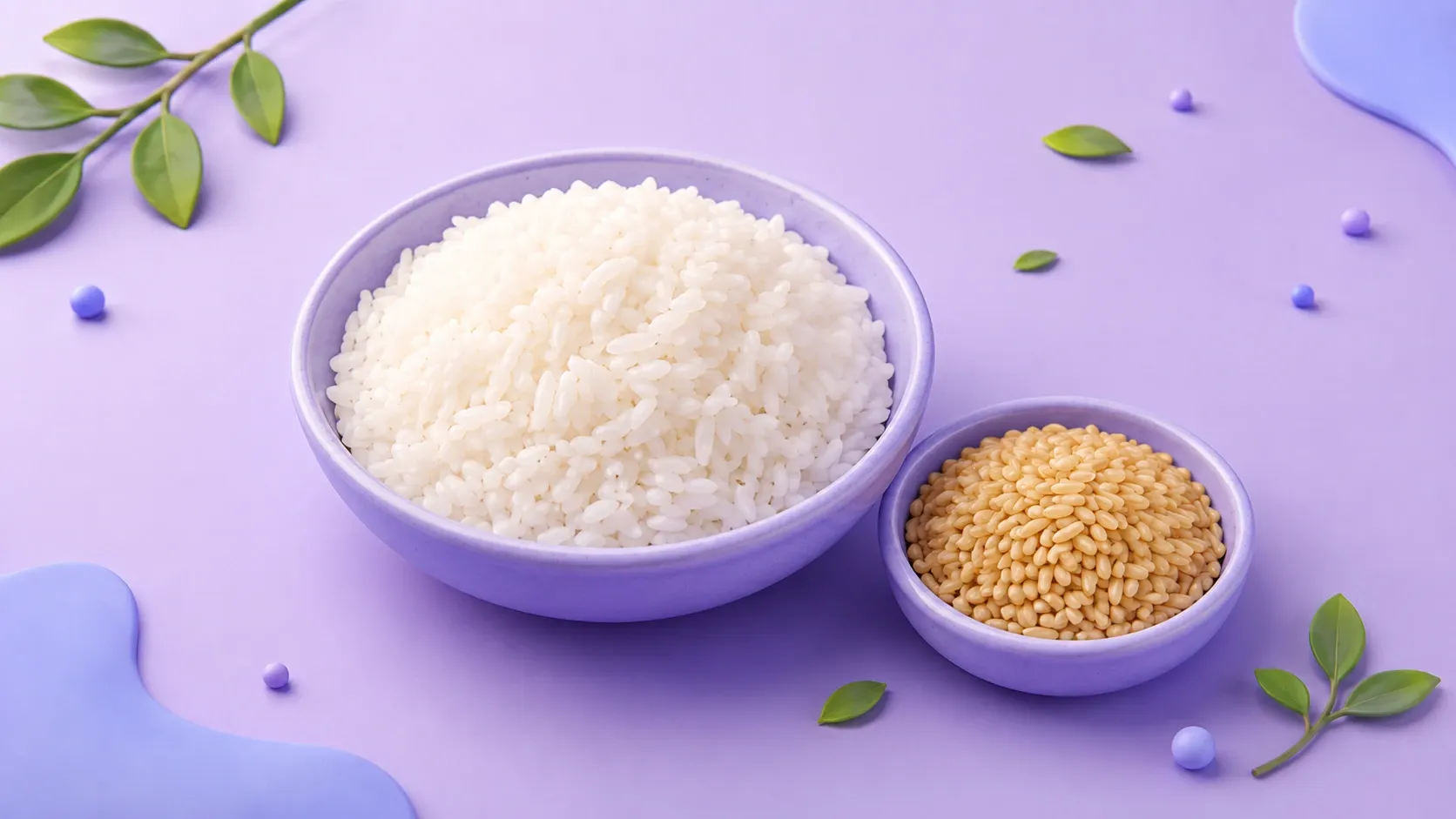

Cooked white rice has about 130 calories per 100 grams, along with roughly 28 grams of carbohydrate, 2.7 grams of protein, and almost no fat, according to USDA FoodData Central. A standard cup of cooked white rice lands at about 205 calories. Rice is one of the most common foods people log, and the number on your plate comes down to two things more than any other: how much it weighs, and whether you are measuring it dry or cooked.
The quick answer: calories in rice
Plain boiled or steamed white rice is about 130 calories per 100 grams once cooked. Because rice is almost entirely carbohydrate with very little fat, the calories track closely with weight, so your portion size is what moves the total.
Here is how the macros break down for 100 grams of cooked white rice:
- Calories: about 130 kcal
- Carbohydrate: about 28 g
- Protein: about 2.7 g
- Fat: about 0.3 g
With almost no fat and a small amount of protein, rice is essentially a carbohydrate source. That makes it an easy, filling base for a meal, but it also means the calories climb quickly when the portion is generous, which is why rice shows up so often in our Food and Calorie Guides hub.
Calories by serving size
“A serving of rice” is not a fixed amount, so the calories swing depending on how much you scoop. The table below applies the USDA per-100-gram value for cooked white rice (130 calories, 28 g carbohydrate, 2.7 g protein) to common serving sizes.
| Serving | Calories | Carbohydrate | Protein |
|---|---|---|---|
| 1/2 cup cooked (about 79 g) | about 103 | 22 g | 2.1 g |
| 1 cup cooked (about 158 g) | about 205 | 45 g | 4.3 g |
| 100 g cooked | about 130 | 28 g | 2.7 g |
| Large / heaping cup (about 200 g) | about 260 | 56 g | 5.4 g |
The takeaway: a heaping cup or a takeout-sized portion can easily carry more than twice the calories of a modest half cup. If you are tracking carefully, weighing the cooked rice beats eyeballing it, because “a bowl of rice” can mean anywhere from about 100 to 300 calories or more.
White rice versus brown rice
The calorie difference between white and brown rice is smaller than most people expect. Cooked brown rice is about 123 calories per 100 grams, only slightly below white rice at about 130. Where they really differ is in fiber and micronutrients.
Brown rice keeps its bran and germ, the parts stripped away to make white rice. That leaves it with about 1.6 grams of fiber per 100 grams, compared with well under 1 gram for white rice. Per 100 grams cooked, here is the rough comparison:
| Type | Calories | Carbohydrate | Fiber | Fat |
|---|---|---|---|---|
| White rice, cooked | about 130 | about 28 g | under 1 g | 0.3 g |
| Brown rice, cooked | about 123 | about 26 g | about 1.6 g | 1.0 g |
So you are not choosing brown rice to save calories; you are choosing it for the extra fiber and the whole-grain benefits. Health authorities consistently recommend making at least half your grains whole, and the fiber in whole grains is linked to better digestion and steadier energy (Harvard, The Nutrition Source). The trade-off is mostly taste and cooking time, not the calorie count.
Cooked versus uncooked: why the number changes
This is where rice trips a lot of people up. Dry, uncooked white rice is about 365 calories per 100 grams, almost three times the cooked figure. Cooking does not add calories; rice simply absorbs water and roughly triples in weight as it cooks. So 100 grams of dry rice becomes about 300 grams of cooked rice, with the same calories spread across three times the weight.
What this means in practice:
- Pick one reference and stick to it. Log dry rice against dry values, or cooked rice against cooked values, but never mix the two.
- Weighing dry is often the most accurate. Dry rice does not vary with how wet your cooking turned out, so weighing the uncooked rice and dividing by your number of servings is a reliable method.
- Watch the cooked-weight trap. A measured cup of dry rice (about 185 g) is roughly 675 calories before cooking, and it expands into about three cups cooked. Logging a cooked cup against the dry number, or the reverse, is one of the most common tracking mistakes, and it can be off by a wide margin.
Portion control and the glycemic angle
Rice is calorie dense relative to vegetables, so portioning is where the real control happens. A few practical habits keep it in check:
- Measure with a cup or scale, at least at first. Most people pour more than they think. Calibrating your eye against a measured cup once or twice pays off for weeks.
- Build the plate around protein and vegetables. Use rice as one component rather than the centerpiece, and let lean protein like chicken breast and a pile of vegetables fill out the rest.
- Mind what goes on top. A tablespoon of oil or butter stirred into rice adds roughly 100 to 120 calories, and rich sauces can quietly double a dish. Often it is the additions, not the rice, that blow the budget.
On the glycemic side, white rice is digested quickly and can raise blood sugar faster than many whole foods, while brown rice and parboiled rice sit a little lower thanks to their fiber and structure. For most people balancing total calories, this is a minor factor next to portion size, but pairing rice with protein, fat, and vegetables naturally slows digestion and makes a meal more satisfying.
How rice fits a calorie budget
Rice is a flexible, affordable carbohydrate that fits almost any eating pattern as long as the portion matches your goals. Two things work in its favor and one is worth watching.
It is filling and easy to portion. A measured cup is a satisfying base for a meal at around 205 calories, leaving room for protein and vegetables. If you are figuring out your own intake, our guide on how many calories you should eat to lose weight lays out the math.
It slots cleanly into your macros. Rice is almost pure carbohydrate, which makes it simple to budget once you know your targets. Our guides on what macros are and how to count macros walk through how to fit a starch like rice around your protein and fat.
Portion creep is the main risk. Because rice is calorie dense by the cupful, an extra scoop here and there adds up fast. Logging it by weight keeps the math honest, and a tracking app like CalcEat lets you record the rice and whatever you add to it separately so nothing slips through.
The bottom line
Cooked white rice is about 130 calories per 100 grams and roughly 205 per cup, and brown rice is close behind at about 123 calories per 100 grams with more fiber. Dry rice is far more calorie dense, near 365 calories per 100 grams, because it has not yet soaked up water, so always match your measurement to whether the rice is cooked or dry. For most people, rice is a perfectly good staple; the calories are driven by portion size and toppings, not by rice being inherently fattening.
Keep it simple: measure your portion, pick brown for extra fiber if you like it, and account for the oil, butter, and sauces you add. Track the rice and its add-ons, stay consistent, and the numbers will take care of themselves.
This article is general information, not medical or dietary advice for your specific situation.