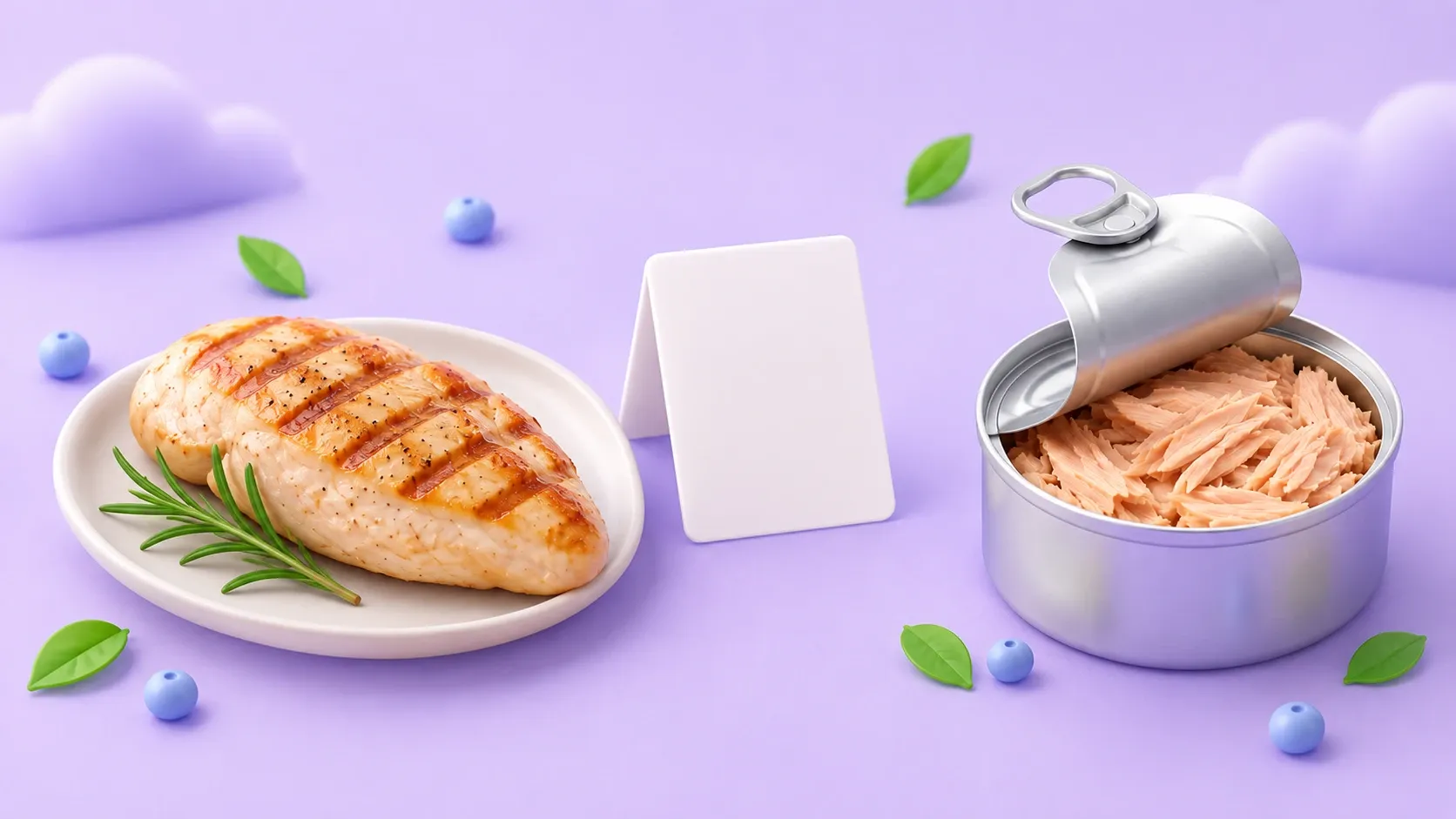

Cooked skinless chicken breast has about 165 calories and 31 grams of protein per 100 grams, while light tuna canned in water and drained has about 86 calories and 19 grams of protein, according to USDA FoodData Central. Both are lean protein with no carbohydrate. Chicken gives you more protein per gram and per portion; water-packed tuna gives you more protein per calorie. And in both cases, the oil, mayonnaise, or skin that comes along moves the total more than the choice between them.
Chicken breast vs tuna per 100 g
The fairest comparison is weight for weight. The table below uses the USDA values for cooked skinless chicken breast and three common kinds of tuna, all per 100 grams (canned tuna is drained).
| Per 100 g | Chicken breast, cooked, skinless | Light tuna in water, drained | Light tuna in oil, drained | Yellowfin, fresh, cooked |
|---|---|---|---|---|
| Calories | about 165 | about 86 | about 198 | about 131 |
| Protein | about 31 g | about 19 g | about 29 g | about 29 g |
| Fat | about 3.6 g | about 1 g | about 8 g | about 0.6 g |
| Carbohydrate | 0 g | 0 g | 0 g | 0 g |
Three things stand out. Water-packed tuna has just over half the calories of chicken breast. Chicken has the most protein per gram of the four. And oil-packed tuna is the only option here with more calories than skinless chicken.
Protein per calorie: which is leaner?
If your goal is the most protein for the fewest calories, water-packed tuna comes out ahead. It has a bit less than two-thirds of chicken’s protein per 100 grams, but only about half the calories. Fresh yellowfin lands in a similar spot, with more protein per gram than water-packed tuna and more calories to match.
Chicken breast is still one of the most protein-dense foods you can eat, and it wins on protein per bite. For a big, filling plate of protein, chicken gets you there in fewer grams of food.
Oil-packed tuna is the weakest of the four on this measure. Draining removes the free oil, but the meat keeps what it absorbed, so it carries the most calories with no more protein than yellowfin. Chicken with the skin on has the same problem: roasted breast with skin is about 197 calories per 100 grams, roughly 30 more than skinless, and most of the extra is saturated fat.
Fat: small numbers, big swings
On their own, both foods are low in fat. Skinless chicken breast has about 3.6 grams per 100 grams, most of it unsaturated. Water-packed tuna has about 1 gram, and cooked yellowfin under 1 gram. That makes yellowfin a lean steak, not a fatty fish like salmon.
The fat that matters comes from what surrounds the meat:
- Oil-packed tuna carries roughly 7 more grams of fat per 100 grams than water-packed, which accounts for most of its extra 112 calories.
- Chicken skin adds about 30 calories per 100 grams, mostly as saturated fat, with no extra protein.
- Cooking oil adds about 120 calories per tablespoon to a pan-fried breast.
- Mayonnaise adds about 90 calories per tablespoon of regular mayo to a tuna salad.
A breast vs a can: calories per portion
Nobody eats exactly 100 grams, and the usual portions are not the same size. A chicken breast is typically bigger than a can of tuna, so it carries more of everything.
| Portion | Calories | Protein | Fat |
|---|---|---|---|
| Chicken breast, 3 oz (85 g), cooked | about 140 | 26 g | 3.1 g |
| Light tuna in water, 3 oz (85 g), drained | about 73 | 17 g | 0.8 g |
| Chicken breast, small, 4 oz (113 g) | about 187 | 35 g | 4.1 g |
| Chicken breast, medium, 6 oz (170 g) | about 280 | 53 g | 6.1 g |
| Chicken breast, large, 8 oz (227 g) | about 375 | 70 g | 8.2 g |
| Tuna pouch in water, 2.6 oz (74 g) | about 64 | 14 g | 0.7 g |
| Tuna can in water, 5 oz (142 g), drained | about 122 | 28 g | 1.4 g |
A medium cooked breast has close to twice the protein of a drained 5 oz can, and more than twice the calories. A larger 6 oz (170 g) can of water-packed tuna is about 145 calories and 32 grams of protein. Switch that 5 oz can to oil-packed and it climbs to about 280 calories drained, the same as a medium chicken breast.
Two tracking notes. Chicken loses roughly a quarter of its weight as water when cooked, so raw skinless breast is about 120 calories per 100 grams; log it against the value that matches how you weighed it. For tuna, go by the drained net weight on the label, since cans and pouches vary. Our full guides to calories in chicken breast and calories in tuna cover every serving size and preparation.
Convenience, cost, and practical trade-offs
Beyond the numbers, the two foods fit different days.
Tuna is the no-cook option. A can or pouch is shelf-stable, ready to eat, and labeled with exactly what you are getting. That makes it easy to keep at work or in a bag for a fast protein fix.
Chicken breast rewards a little prep. It needs cooking, but it batch-cooks well, and a week of grilled or baked breasts is lean protein ready for any meal. Dry cooking methods like grilling, baking, and poaching keep it at the 165 baseline.
Cost depends on where you shop. Prices vary too much by store, region, and brand to compare honestly here. To compare at your own store, divide the price by the grams of protein on each label.
Tuna has two caveats chicken does not. Canned tuna can be high in sodium, so low-sodium versions help if that matters to you. Tuna also carries more mercury than many fish. The FDA places canned light tuna among its best choices, suggests eating albacore and yellowfin less often, and recommends a couple of servings of fish per week overall, with extra care during pregnancy.
The verdict: which to pick for your goal
Neither food is “better”; they solve slightly different problems.
- Cutting calories hard: water-packed tuna. It gives you the most protein for the fewest calories of anything in this comparison.
- Hitting a high protein target: chicken breast. A single medium breast covers about 53 grams, and protein is the most filling macronutrient per calorie (Leidy et al., 2015).
- Fast lunch with no kitchen: a can or pouch of tuna in water.
- Weekly meal prep: skinless chicken breast, cooked in a batch.
- Eating one of them daily: rotate. Mixing chicken and tuna makes it easier to stay within the FDA’s fish guidance and keeps meals from getting boring.
- Either way: choose water-packed over oil, remove the skin, and measure the oil and mayonnaise, since those are where the calories hide.
To see how much protein you need to aim for, use the protein calculator, and to fit chicken or tuna into your full day of protein, carbs, and fat, try the macro calculator. For more options, our list of high-protein foods puts both in context.
The bottom line
Cooked skinless chicken breast is about 165 calories and 31 grams of protein per 100 grams; light tuna canned in water is about 86 calories and 19 grams. Tuna in water is the leaner choice per calorie, chicken is the bigger protein hit per portion, and oil-packed tuna is the one version that out-calories skinless chicken. Pick by your goal, keep the add-ons honest, and both will serve you well.
This article is general information, not medical or dietary advice for your specific situation.