Short answer: yes, accurate enough to be genuinely useful, with one important distinction. AI calorie apps are very good at the first job, recognizing what is on your plate, where peer-reviewed research puts accuracy above 90%. They are less precise at the second job, converting that into an exact calorie number, because that also requires judging portion size. The good news is that this is true of every method, including counting by hand, and that the small remaining error does not stop you from losing weight if you log consistently. This guide explains what the research actually shows and how to get the most reliable results from any app.
What “accurate” means for calorie tracking
Before judging any app, it helps to separate two things people lump together when they ask if calorie counting is accurate.
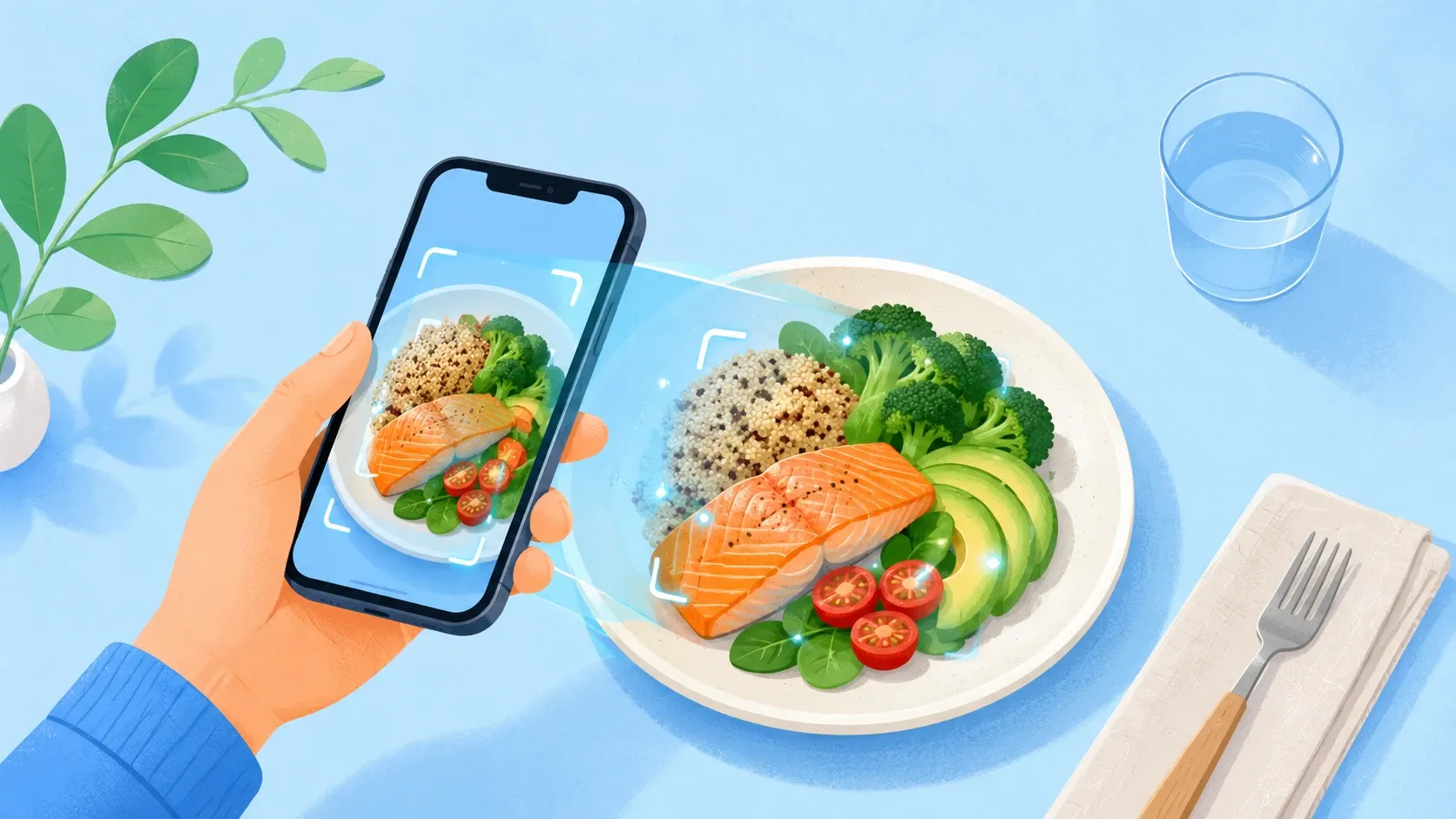
The first is identification: can the app correctly tell that you are eating grilled salmon with rice and broccoli, and not chicken with pasta? The second is estimation: given that it knows the food, how close is its calorie number to the true amount you ate?
These are different problems, and apps are much better at the first than the second. Identifying a food from a photo is something modern AI does extremely well. Pinning down the exact calories is harder, because the same plate of salmon and rice can swing by a hundred calories or more depending on the portion size, how much oil was used, and how it was cooked. No photo carries that information perfectly.
Here is the part worth internalizing early: no calorie count is ever exact, no matter who or what produces it. A registered dietitian eyeballing your plate, a food label printed by the manufacturer, and an AI app are all making an estimate. The right question is not “is it perfect” (nothing is) but “is it consistent and close enough to guide my decisions.” For changing your weight, the answer is yes, and the rest of this article shows why.
How good is the AI, really?
Genuinely good, and improving fast. In peer-reviewed research, deep-learning food-recognition models identify foods with over 90% accuracy, with the best reaching around 93% (Queipo-Alvarez 2025; Huang and Wang 2022). A 2025 review covering 56 computer-vision studies reports that convolutional neural networks and multi-task frameworks achieve “over 90% accuracy in food segmentation and recognition,” and a separate 2022 system reported a recognition rate “above 93%.”
CalcEat is built on this same class of technology, trained against a database of 3M+ verified foods, so it names what is on your plate on the first try in the large majority of cases. And for anything packaged, a barcode scan skips estimation entirely and pulls the exact Nutrition Facts values off the label.
The headline number to remember is that the recognition step, the part that used to be the hard one, is largely solved. What remains genuinely difficult is the next step.
Identification vs. calorie estimation
This is the distinction that explains nearly every “the app got it wrong” story, so it is worth being precise.
Identification is the part AI does best. Naming the food on a plate is a pattern-recognition task, exactly what deep learning excels at, which is why the numbers above clear 90%.
Calorie estimation is harder, because it adds a second judgment: how much. To turn “this is rice” into “this is 240 calories of rice,” the app has to estimate the portion, and a photo is a flat, two-dimensional view of a three-dimensional pile of food. Depth, density, and hidden ingredients (the butter stirred into the rice, the oil the chicken was fried in) are not fully visible. So while the food is identified correctly, the calorie figure carries more uncertainty.
How much uncertainty? In the research, computer-vision calorie systems land in a useful range. One system reported calorie estimation error of “less than 10%,” and the 2025 review of the broader literature found “less than 15% relative error in calorie estimation” across the methods it surveyed (Huang and Wang 2022; Queipo-Alvarez 2025). So a meal the app estimates at 600 calories is realistically somewhere in the neighborhood of 510 to 690. That is an estimate, not a measurement, and it is plenty close enough to be useful, which the next two sections unpack.
Why no calorie count is exact
It is tempting to think the “real” calorie count is a fixed fact and the app simply fails to reach it. In truth, even the most authoritative sources are working with ranges. Three reasons no count, human or AI, is exact:
1. Portion size is the biggest variable, and it is invisible in a photo. Two servings of pasta that look similar can differ by 50% in weight. This is the single largest source of error in any photo-based estimate, which is why verifying the portion (next section) matters more than which app you use.
2. Even printed labels carry a legal margin. People assume the number on a package is exact. It is not. Under US FDA regulations (21 CFR 101.9), a Nutrition Facts label is allowed a tolerance: for naturally occurring nutrients, the food only has to contain “at least 80 percent of the value declared on the label,” while added nutrients must be “at least 100 percent” of the declared value (FDA, 21 CFR 101.9). Labels are still the most exact number you can get for packaged food, but even they are not to-the-calorie precise.
3. People are unreliable narrators of their own intake, which is the real benchmark to beat. This is the finding that reframes the whole debate. In a classic New England Journal of Medicine study, people who believed they could not lose weight on a low-calorie diet were, on average, underreporting their actual food intake by 47% and overreporting their physical activity by 51% (Lichtman 1992). The gap between what they thought they ate and what they actually ate was more than 1,000 calories a day. Against that backdrop, an AI estimate that is within roughly 10 to 15% is not the weak link. It is dramatically more honest than the typical human guess.
Even the researchers building these systems say so plainly. As the 2022 paper’s authors put it, “estimating food calories is a difficult problem. Not even a perfect image processing system can predict perfectly” (Huang and Wang 2022). The goal was never perfection. It is a reliable, repeatable estimate.
How to get the most accurate results
You can meaningfully tighten any app’s accuracy with three habits. None of them require weighing every meal, and they apply whether you use CalcEat or any other tracker.
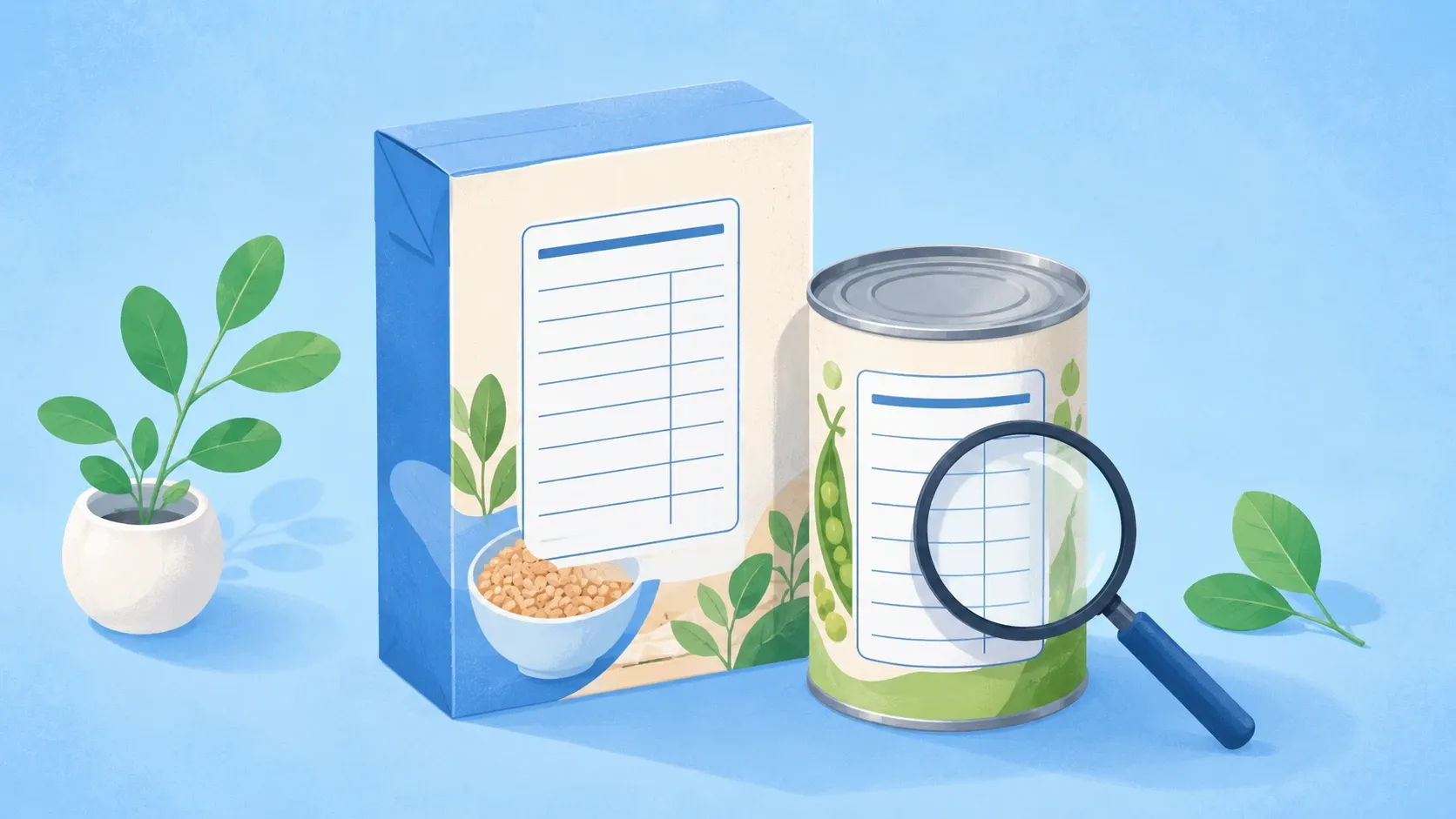
- Scan barcodes for anything packaged. This is the biggest single upgrade. A barcode pulls the manufacturer’s Nutrition Facts values directly, skipping the estimation step entirely, so a labeled food is as exact as food gets. If a meal is half packaged and half fresh, scan the packaged part and estimate the rest.
- Verify the portion, do not just accept the default. Since portion is the largest error source, a quick sanity check pays off more than anything else. You rarely need a food scale: a few reference points (a deck of cards is about a palm-sized serving of meat, a cupped handful is roughly a cup) get you most of the way there. Our guide to counting calories without weighing your food walks through these visual estimates in detail.
- Log promptly, before you forget. The most accurate log is the one that actually captures what you ate. Snapping a photo at the table beats reconstructing the day from memory at 10pm, which is exactly the kind of recall that produced the 47% underreporting above.
Do these three things and your numbers will be as good as a non-laboratory method can realistically be.
Is it accurate enough to lose weight?
Yes, and this is the most important section, because it is where people get the math backwards.
Weight change responds to your average intake over weeks, not to any single meal. That changes what “accurate” needs to mean. If your app is off by a roughly similar percentage each day, it still tracks your trend correctly, because you are watching the direction and the average, not chasing an exact daily figure. A consistent estimate that runs slightly high or slightly low every day will still tell you, accurately, whether you are in a calorie deficit and whether the deficit is working.
This is exactly where photo-and-AI logging beats counting by hand for most people. Manual logging is slow, and slow habits get abandoned. Tracking you have quit is not 10% inaccurate or 15% inaccurate, it is 0% accurate, because it does not exist. A photo and a barcode scan take seconds, and that speed is the difference between logging every day and quietly giving up by midweek. The science of the Lichtman study is really a warning about that gap: the failure mode is not a slightly-off estimate, it is not logging honestly at all.
So the winning strategy is simple. Use the app to get a fast, consistent estimate. Lean on barcodes for exact values where you can. Then let the scale be the final judge: weigh yourself regularly, look at the two-to-four-week trend, and adjust your target if the numbers are not moving the way you want. If you want a starting point to aim at, our calorie calculator estimates your daily target from your stats and goal, and how many calories you should eat a day explains how to read that number. From there, how to count macros covers splitting that target into protein, carbs, and fat if you want more structure.
The bottom line: AI calorie apps are accurate where it counts, at recognizing your food and giving you a consistent number you will actually keep up with. No tool delivers a perfect calorie count, but you do not need one. You need a habit you can sustain and a scale to keep you honest. If you want to put that into practice, you can build a free plan and start logging your next meal in seconds.